Effect of dynamic arterial elastance and assisted fluid management software guided resuscitation in septic shock: Pilot study
Eadyn & AFM software–guided resuscitation in septic shock: Pilot study
DOI:
https://doi.org/10.54205/ccc.v33.274783Keywords:
Dynamic arterial elastance, Stroke volume change predictionAbstract
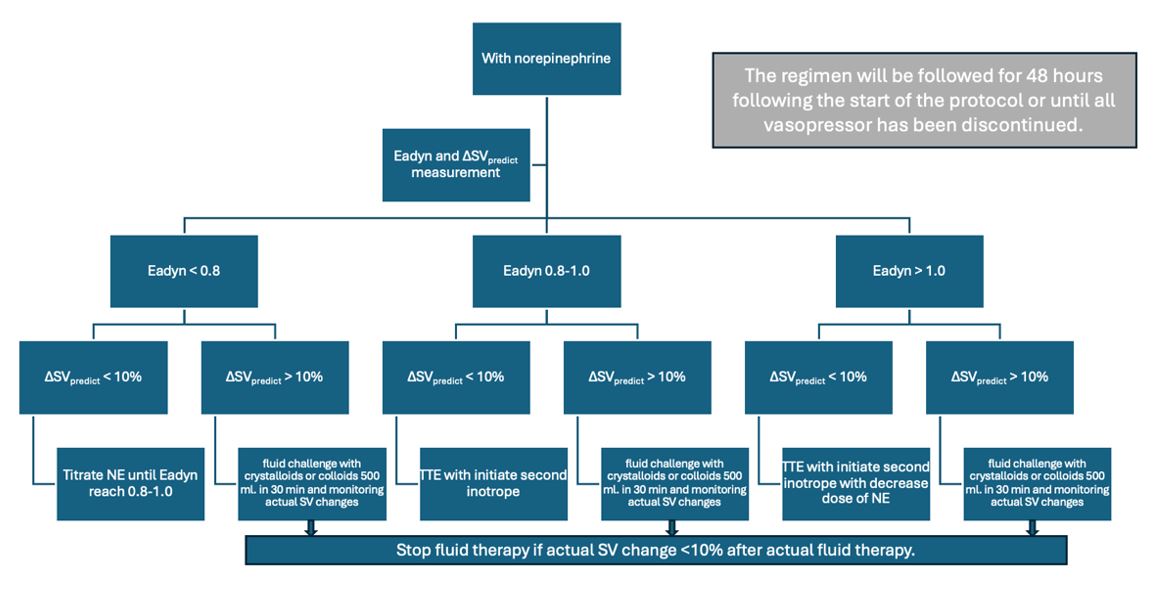
Background: Hypotension in septic shock patients increases mortality and organ dysfunction risks, which is characterized by vasodilation and fluid loss. Therefore, precise fluid and vasopressor therapy is needed. A new monitoring device (Hemosphere®) using parameters of dynamic arterial elastance (Eadyn) and stroke volume change prediction (∆SVpredict) may safely guide treatment, improving outcomes compared to standard care.
Objections: to investigate the benefit of using the assist fluid management and dynamic arterial elastance (AFM-Eadyn) guide resuscitation and vasopressor therapy in septic shock resuscitation for mechanically ventilated patients compared with standard of care.
Methods: This randomized, controlled, experimental clinical medical device pilot trial included patients older than 18 years with a diagnosis of sepsis or septic shock in medical ICU with onset of shock in less than 24 hours assigned in a 1:1 ratio to receive the assist fluid management and dynamic arterial elastance (AFM-Eadyn) guide resuscitation and the standard of care.
Hypothesis: We hypothesize that AFM-Eadyn guide resuscitation in patients with sepsis-induced hypotension would result in less time to shock reversal compared to the standard of care.
Ethics and dissemination: The study protocol was approved by the Siriraj Institutional Review Board with the certificate of approval number Si 895/2567
Trial registration: NCT06937918 (ClinicalTrial.gov ID)
Downloads
References
Angus DC, van der Poll T. Severe sepsis and septic shock. N Engl J Med. 2013;369:840-51.
Permpikul C, Tongyoo S, Viarasilpa T, Trainarongsakul T, Chakorn T, Udompanturak S. Early Use of Norepinephrine in Septic Shock Resuscitation (CENSER). A randomized trial. Am J Respir Crit Care Med. 2019;199:1097-105.
Messmer AS, Zingg C, Muller M, Gerber JL, Schefold JC, Pfortmueller CA. Fluid overload and mortality in adult critical care patients-a systematic review and meta-analysis of observational studies. Crit Care Med. 2020;48:1862-70.
Hatib F, Jian Z, Buddi S, Lee C, Settels J, Sibert K, et al. Machine-learning algorithm to predict hypotension based on high-fidelity arterial pressure waveform analysis. Anesthesiology. 2018;129:663-74.
Monge Garcia MI, Gil Cano A, Gracia Romero M. Dynamic arterial elastance to predict arterial pressure response to volume loading in preload-dependent patients. Crit Care. 2011;15:R15.
Kouz K, Monge Garcia MI, Cerutti E, Lisanti I, Draisci G, Frassanito L, et al. Intraoperative hypotension when using hypotension prediction index software during major noncardiac surgery: a European multicentre prospective observational registry (EU HYPROTECT). BJA Open. 2023;6:100140.
Zhou X, Pan W, Chen B, Xu Z, Pan J. Predictive performance of dynamic arterial elastance for arterial pressure response to fluid expansion in mechanically ventilated hypotensive adults: a systematic review and meta-analysis of observational studies. Ann Intensive Care. 2021;11:119.
Monge Garcia MI, Jian Z, Settels JJ, Hunley C, Cecconi M, Hatib F, et al. Performance comparison of ventricular and arterial dP/dt(max) for assessing left ventricular systolic function during different experimental loading and contractile conditions. Crit Care. 2018;22:325.
Guinot PG, Bernard E, Levrard M, Dupont H, Lorne E. Dynamic arterial elastance predicts mean arterial pressure decrease associated with decreasing norepinephrine dosage in septic shock. Crit Care. 2015;19:14.
Dong S, Wang Q, Wang S, Zhou C, Wang H. Hypotension prediction index for the prevention of hypotension during surgery and critical care: A narrative review. Comput Biol Med. 2024;170:107995.
Lai CJ, Cheng YJ, Han YY, Hsiao PN, Lin PL, Chiu CT, et al. Hypotension prediction index for prevention of intraoperative hypotension in patients undergoing general anesthesia: a randomized controlled trial. Perioper Med (Lond). 2024;13:57.
Kelly RP TC, Yang TM, Liu CP, Maughan WL, Chang MS, Kass DA. Effective arterial elastance as index of arterial vascular load in humans. Circulation. 1992 Aug;86:513-21.
Maheshwari K, Malhotra G, Bao X, Lahsaei P, Hand WR, Fleming NW, et al. Assisted fluid management software guidance for intraoperative fluid administration. Anesthesiology. 2021;135:273-83.
Evans L, Rhodes A, Alhazzani W, Antonelli M, Coopersmith CM, French C, et al. Surviving sepsis campaign: international guidelines for management of sepsis and septic shock 2021. Crit Care Med. 2021;49:e1063-e143.
Freitas FG, Salomao R, Tereran N, Mazza BF, Assuncao M, Jackiu M, et al. The impact of duration of organ dysfunction on the outcome of patients with severe sepsis and septic shock. Clinics (Sao Paulo). 2008;63:483-8.
Brown SM, Lanspa MJ, Jones JP, Kuttler KG, Li Y, Carlson R, et al. Survival after shock requiring high-dose vasopressor therapy. Chest. 2013;143:664-71.
Court O, Kumar A, Parrillo JE, Kumar A. Clinical review: Myocardial depression in sepsis and septic shock. Crit Care. 2002;6:500-8.
Asfar P, Meziani F, Hamel JF, Grelon F, Megarbane B, Anguel N, et al. High versus low blood-pressure target in patients with septic shock. N Engl J Med. 2014;370:1583-93.
Chi-Hong Tseng DS. Sample size planning for pilot studies. Mathematics. 2021. http://dx.doi.org/https://doi.org/10.48550/arXiv.2105.05483.
Downloads
Published
How to Cite
Issue
Section
License
Copyright (c) 2025 The Thai Society of Critical Care Medicine

This work is licensed under a Creative Commons Attribution-NonCommercial 4.0 International License.