The treatment and monitoring of aneurysmal subarachnoid hemorrhage in critically ill patients
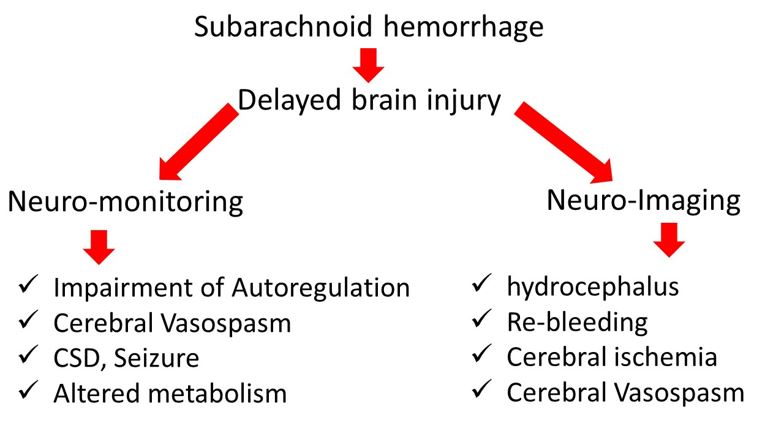
Comprehensive neuromonitoring in the management of aneurysmal subarachnoid hemorrhage
DOI:
https://doi.org/10.54205/ccc.v33.275287Keywords:
Subarachnoid hemorrhage, Neuromonitoring, Cerebral ischemia, Cerebral homeostasis, Secondary brain injuryAbstract
Purpose: To review the treatment and monitoring strategies for aneurysmal subarachnoid hemorrhage (aSAH) in critically ill patients, emphasizing the need for a multidisciplinary approach to stabilize the patient, prevent secondary brain injury, and manage complications.
Methods: The review focuses on targeted management of key cerebral parameters, including intracranial pressure (ICP), pressure reactivity index (PRx), cerebral autoregulation (CA), and the integration of non-invasive modalities such as near-infrared spectroscopy (NIRS). These tools are utilized to prevent rebleeding, control ICP, manage cerebral vasospasm, and support systemic homeostasis.
Important results: Despite advancements in continuous neuromonitoring and multidisciplinary care, current therapeutic strategies must span the entire treatment continuum from diagnosis and preoperative stabilization to intraoperative management and postoperative recovery. Securing the aneurysm via clipping or coiling remains central to reducing complications and improving neurologic outcomes.
Conclusions: Optimal management of aSAH demands individualized and dynamic neuromonitoring strategies. Patients with preserved consciousness may benefit from non-invasive monitoring to detect early deterioration, while those who are comatose or severely impaired require comprehensive invasive monitoring to guide cerebral resuscitation and prevent secondary injuries. Equally important is the strict prevention of systemic complications such as dysglycemia, anemia, hyperthermia, hypoxemia, dysnatremia, and infection, which are critical for maximizing neurologic recovery and survival.
Downloads
References
Hoh BL, Ko NU, Amin-Hanjani S, Chou SH-Y, Cruz-Flores S, Dangayach NS, et al. 2023 Guideline for the management of patients with aneurysmal subarachnoid hemorrhage: A guideline from the american heart Association/American stroke association. Stroke. 2023;54(7):e314-e370.
Osgood ML. Aneurysmal subarachnoid hemorrhage: Review of the pathophysiology and management strategies. Curr Neurol Neurosci Rep. 2021;21(9):50.
Sharma D. Perioperative management of aneurysmal subarachnoid hemorrhage. Anesthesiology. 2020;133(6):1283-1305.
Tawk RG, Hasan TF, D'Souza CE, Peel JB, Freeman WD. Diagnosis and treatment of unruptured intracranial aneurysms and aneurysmal subarachnoid hemorrhage. Mayo Clin Proc. 2021;96(7):1970-2000.
Fujinaka T, Yoshimine T, Mashimo T. [Management of aneurysmal subarachnoid hemorrhage]. Masui. 2012;61(9):962-70.
Jaja BN, Cusimano MD, Etminan N, Hanggi D, Hasan D, Ilodigwe D, et al. Clinical prediction models for aneurysmal subarachnoid hemorrhage: a systematic review. Neurocrit Care. 2013;18(1):143-153.
Hall A, O'Kane R. The management of hypertension in pre-aneurysmal treatment subarachnoid hemorrhage patients. World Neurosurg. 2019;125:469-474.
Vergouwen MDI, Rinkel GJE. Emergency medical management of aneurysmal subarachnoid hemorrhage. Neurocrit Care. 2023;39(1):51-58.
Ran KR, Wang AC, Nair SK, Akça O, Xu R. Acute multidisciplinary management of aneurysmal subarachnoid hemorrhage (aSAH). Balkan Med J. 2023;40(2):74-81.
Grasso G, Alafaci C, Macdonald RL. Management of aneurysmal subarachnoid hemorrhage: State of the art and future perspectives. Surg Neurol Int. 2017;8:11.
Li K, Barras CD, Chandra RV, Kok HK, Maingard JT, Carter NS, et al. A review of the management of cerebral vasospasm after aneurysmal subarachnoid hemorrhage. World Neurosurg. 2019;126:513-527.
Serrone JC, Maekawa H, Tjahjadi M, Hernesniemi J. Aneurysmal subarachnoid hemorrhage: pathobiology, current treatment and future directions. Expert Rev Neurother. 2015;15(4):367-80.
Wan H, AlHarbi BM, Macdonald RL. Mechanisms, treatment and prevention of cellular injury and death from delayed events after aneurysmal subarachnoid hemorrhage. Expert Opin Pharmacother. 2014;15(2):231-43.
Barry C, Turner RJ, Corrigan F, Vink R. New therapeutic approaches to subarachnoid hemorrhage. Expert Opin Investig Drugs. 2012;21(6):845-59.
Neifert SN, Chapman EK, Martini ML, Shuman WH, Schupper AJ, Oermann EK, et al. Aneurysmal subarachnoid hemorrhage: the last decade. Transl Stroke Res. 2021;12(3):428-446.
Robba C, Busl KM, Claassen J, Diringer MN, Helbok R, Park S, et al. Contemporary management of aneurysmal subarachnoid haemorrhage. An update for the intensivist. Intensive Care Med. 2024;50(5):646-664.
Etminan N, Macdonald RL. Management of aneurysmal subarachnoid hemorrhage. Handb Clin Neurol. 2017;140:195-228.
Yang C, Li Y. Review of the prevention and treatment of hydrocephalus after aneurysmal subarachnoid hemorrhage. World Neurosurg. 2022;168:134-138.
Chung DY, Abdalkader M, Nguyen TN. Aneurysmal subarachnoid hemorrhage. Neurol Clin. 2021;39(2):419-442.
D'Souza S. Aneurysmal subarachnoid hemorrhage. J Neurosurg Anesthesiol. 2015;27(3):222-40.
Park S. Emergent management of spontaneous subarachnoid hemorrhage. Continuum (Minneap Minn). 2024;30(3):662-681.
Bailes JE, Spetzler RF, Hadley MN, Baldwin HZ. Management of morbidity and mortality of poor-grade aneurysm patients. J Neurosurg. 1990;72:559-566.
Fountas KN, Kapsalaki EZ, Machinis T, Karampelas I, Smisson HF, Robinson JS. Review of the literature regarding the relationship of rebleeding and external ventricular drainage in patients with subarachnoid hemorrhage of aneurysmal origin. Neurosurg Rev. 2006;29:14-18.
Solou M, Ydreos I, Papadopoulos EK, Demetriades AK, Boviatsis EJ. Management of neurological complications related to aneurysmal subarachnoid hemorrhage: A comparison of the bedside therapeutic algorithms. Surgeon. 2023;21(6):e328-e345.
Sakata H, Endo H. Postoperative management of aneurysmal subarachnoid hemorrhage. No Shinkei Geka. 2024;52(5):906-913.
Abdulazim A, Heilig M, Rinkel G, Etminan N. Diagnosis of delayed cerebral ischemia in patients with aneurysmal subarachnoid hemorrhage and triggers for intervention. Neurocrit Care. 2023;39(2):311-319.
Deem S, Diringer M, Livesay S, Treggiari MM. Hemodynamic management in the prevention and treatment of delayed cerebral ischemia after aneurysmal subarachnoid hemorrhage. Neurocrit Care. 2023;39(1):81-90.
Germanwala AV, Huang J, Tamargo RJ. Hydrocephalus after aneurysmal subarachnoid hemorrhage. Neurosurg Clin N Am. 2010;21:263-270.
Garg R, Bar B. Systemic complications following aneurysmal subarachnoid hemorrhage. Curr Neurol Neurosci Rep. 2017;17(1):7.
Wartenberg KE, Schmidt JM, Claassen J, Temes RE, Frontera JA, Ostapkovich N, et al. Impact of medical complications on outcome after subarachnoid hemorrhage. Crit Care Med. 2006;34(3):617-623.
Le Roux PD. Anemia and transfusion after subarachnoid hemorrhage. Neurocrit Care. 2011;15:342-353.
Svedung Wettervik T, Hånell A, Howells T, Ronne Engström E, Lewén A, Enblad P. ICP, CPP, and PRx in traumatic brain injury and aneurysmal subarachnoid hemorrhage: association of insult intensity and duration with clinical outcome. J Neurosurg. 2022;138(2):446-453.
Imberti R, Picetti E, Rossi S, Capaccio E, Accetta G, Klersy C, et al. Intracranial pressure monitoring in poor-grade patients with aneurysmal subarachnoid hemorrhage treated by coiling. World Neurosurg. 2021;156:e206-e214.
Narotam PK, Garton A, Morrison J, Nathoo N, Narotam N. Brain oxygen-directed management of aneurysmal subarachnoid hemorrhage. Temporal patterns of cerebral ischemia during acute brain attack, early brain injury, and territorial sonographic vasospasm. World Neurosurg. 2022;166:e215-e236.
Diringer MN, Bleck TP, Claude Hemphill J 3rd, Menon D, Shutter L, Vespa P, et al. Critical care management of patients following aneurysmal subarachnoid hemorrhage: recommendations from the Neurocritical Care Society’s Multidisciplinary Consensus Conference. Neurocrit Care. 2011;15:211-240.
Rouanet C, Silva GS. Aneurysmal subarachnoid hemorrhage: current concepts and updates. Arq Neuropsiquiatr. 2019;77(11):806-814.
Picetti E, Barbanera A, Bernucci C, Bertuccio A, Bilotta F, Boccardi EP, et al. Early management of patients with aneurysmal subarachnoid hemorrhage in a hospital with neurosurgical/neuroendovascular facilities: a consensus and clinical recommendations of the Italian Society of Anesthesia and Intensive Care (SIAARTI)-Part 1. J Anesth Analg Crit Care. 2022;2(1):13.
Berhouma M, Eker OF, Dailler F, Rheims S, Balanca B. Cortical spreading depolarizations in aneurysmal subarachnoid hemorrhage: an overview of current knowledge and future perspectives. Adv Tech Stand Neurosurg. 2022;45:229-244.
Lovelock CE, Rinkel GJ, Rothwell PM. Time trends in outcome of subarachnoid hemorrhage: population-based study and systematic review. Neurology. 2010;74:1494-1501.
Budohoski KP, Czosnyka M, Kirkpatrick PJ, Smielewski P, Steiner LA, Pickard JD. Clinical relevance of cerebral autoregulation following subarachnoid haemorrhage. Nat Rev Neurol. 2013;9:152-163.
Dhar R, Scalfani MT, Zazulia AR, Videen TO, Derdeyn CP, Diringer MN. Comparison of induced hypertension, fluid bolus, and blood transfusion to augment cerebral oxygen delivery after subarachnoid hemorrhage. J Neurosurg. 2012;116:648-656.
Sun C, Qin B, Zhang J, Liang Y, Cui M, Yang Q, et al. Increased brain volume in the early phase of aneurysmal subarachnoid hemorrhage leads to delayed cerebral ischemia. Front Surg. 2024;11:1467154.
Ironside N, Buell TJ, Chen CJ, Kumar JS, Paisan GM, Sokolowski JD, et al. High-grade aneurysmal subarachnoid hemorrhage: predictors of functional outcome. World Neurosurg. 2019;125:e723-e728.
Leal-Noval SR, Munoz-Gomez M, Murillo-Cabezas F. Optimal hemoglobin concentration in patients with subarachnoid hemorrhage, acute ischemic stroke and traumatic brain injury. Curr Opin Crit Care. 2008;14:156-162.
Al-Mufti F, Mayer SA, Kaur G, Bassily D, Li B, Holstein ML, et al. Neurocritical care management of poor-grade subarachnoid hemorrhage: Unjustified nihilism to reasonable optimism. Neuroradiol J. 2021;34(6):542-551.
Mack WJ, King RG, Ducruet AF, Kreiter K, Mocco J, Maghoub A, et al. Intracranial pressure following aneurysmal subarachnoid hemorrhage: monitoring practices and outcome data. Neurosurg Focus. 2003;14(4):e3.
Addis A, Baggiani M, Citerio G. Intracranial pressure monitoring and management in aneurysmal subarachnoid hemorrhage. Neurocrit Care. 2023;39(1):59-69.
Snider SB, Migdady I, LaRose SL, Mckeown ME, Regenhardt RW, Lai PMR, et al. Transcranial-doppler-measured vasospasm severity is associated with delayed cerebral infarction after subarachnoid hemorrhage. Neurocrit Care. 2022;36(3):815-821.
Abdulazim A, Küppers C, Hackenberg KAM, Neumaier-Probst E, Alzghloul MM, Krebs J, et al. Multidisciplinary and standardized management of patients with delayed cerebral ischemia after aneurysmal subarachnoid hemorrhage. Acta Neurochir (Wien). 2022;164(11):2917-2926.
Smith WS, Matthay MA. Evidence for a hydrostatic mechanism in human neurogenic pulmonary edema. Chest. 1997;111:1326-1333.
Qureshi AI, Suri MF, Sung GY, Straw RN, Yahia AM, Saad M, et al. Prognostic significance of hypernatremia and hyponatremia among patients with aneurysmal subarachnoid hemorrhage. Neurosurgery. 2002;50:749-755.
Takaku A, Shindo K, Tanaka S, Mori T, Suzuki J. Fluid and electrolyte disturbances in patients with intracranial aneurysms. Surg Neurol. 1979;11:349-356.
Turck N, Vutskits L, Sanchez-Pena P, Robin X, Hainard A, Gex-Fabry M, A multiparameter panel method for outcome prediction following aneurysmal subarachnoid hemorrhage. Intensive Care Med. 2010;36:107-115.
Lagares A, Gómez PA, Alen JF, Lobato RD, Rivas JJ, Alday R, et al. A comparison of different grading scales for predicting outcome after subarachnoid haemorrhage. Acta Neurochir (Wien). 2005;147:5-16.
Claassen J, Vu A, Kreiter KT, Kowalski RG, Du EY, Ostapkovich N, et al. Effect of acute physiologic derangements on outcome after subarachnoid hemorrhage. Crit Care Med. 2004;32:832-838.
Duangthongphon P, Kitkhuandee A, Munkong W, Limwattananon P, Waleekhachonloet O, Rattanachotphanit T, et al. Cost-effectiveness analysis of endovascular coiling and neurosurgical clipping for aneurysmal subarachnoid hemorrhage in Thailand. J Neurointerv Surg. 2022;14(9):942-947.
Downloads
Published
How to Cite
Issue
Section
License
Copyright (c) 2025 The Thai Society of Critical Care Medicine

This work is licensed under a Creative Commons Attribution-NonCommercial 4.0 International License.