Associations between hypochloremia with in-hospital mortality and vasopressor dependence in patients with septic shock requiring vasopressors
Hypochloremia and mortality/vasopressor dependence in septic shock
DOI:
https://doi.org/10.54205/ccc.v34.279540Keywords:
Hypochloremia, Sepsis, Septic shock, VasopressorAbstract
Background: Hypochloremia is common and has been linked to increased mortality among critically ill patients. However, the pathophysiological role of hypochloremia is insufficiently explored. This study aimed to assess the associations between hypochloremia with in-hospital mortality and vasopressor dependence among patients with septic shock.
Method: A retrospective cohort study was conducted at Khon Kaen Hospital. Patients with septic shock requiring vasopressors were included from July to December 2022 and categorized into three groups based on serum chloride levels prior to vasopressor initiation (up to 72 hours before septic shock diagnosis): hypochloremia (<96 mEq/L), normochloremia (96-105 mEq/L), and hyperchloremia (>105 mEq/L). The primary outcome was a comparison of in-hospital mortality between patients with hypochloremia and normochloremia. Secondary outcomes include vasopressor duration and vasopressor dependence or death at 24, 48, and 72 hours.
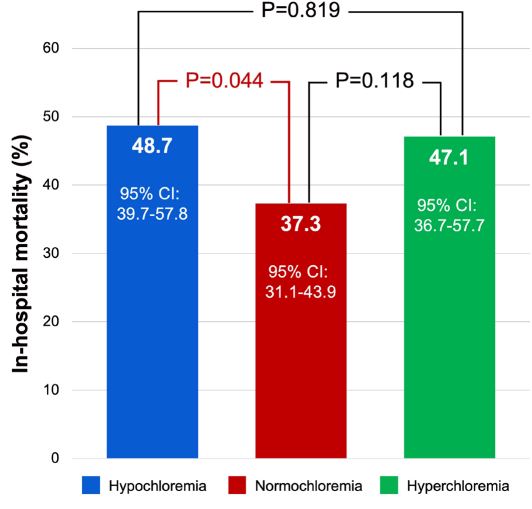
Result: Of the 420 patients included, 35.7% were hypochloremic and 52.4% were normochloremic based on baseline serum chloride status. In-hospital mortality was higher in patients with hypochloremia compared with normochloremia (48.7% vs 37.3%; P=0.044). In multivariable analysis (N=373), after adjustment for age, sex, infection source, bacteremia, fluid balance, and baseline bicarbonate status, hypochloremia remained associated with increased mortality (adjusted RR 1.48, 95% CI 1.13-1.96; P=0.005). No significant differences were found in vasopressor duration or vasopressor dependence or death at 24, 48, and 72 hours among the 3 groups.
Conclusion: Hypochloremia was associated with increased in-hospital mortality after multivariable adjustment in patients with septic shock. However, an association between hypochloremia and vasopressor dependence or duration was not demonstrated. Other adverse outcomes of hypochloremia leading to excess mortality should be further explored.
Downloads
References
Zandijk AJL, van Norel MR, Julius FEC, Sepehrvand N, Pannu N, McAlister FA, et al. Chloride in heart failure: The neglected electrolyte. JACC Heart Fail. 2021;9:904-15.
Yunos NM, Bellomo R, Story D, Kellum J. Bench-to-bedside review: Chloride in critical illness. Crit Care. 2010;14:226.
Pfortmueller CA, Uehlinger D, von Haehling S, Schefold JC. Serum chloride levels in critical illness-the hidden story. Intensive Care Med Exp. 2018;6:10.
Rein JL, Coca SG. "I don't get no respect": the role of chloride in acute kidney injury. Am J Physiol Renal Physiol. 2019;316:F587-F605.
Chowdhury AH, Cox EF, Francis ST, Lobo DN. A randomized, controlled, double-blind crossover study on the effects of 1-L infusions of 6% hydroxyethyl starch suspended in 0.9% saline (voluven) and a balanced solution (Plasma Volume Redibag) on blood volume, renal blood flow velocity, and renal cortical tissue perfusion in healthy volunteers. Ann Surg. 2014;259:881-7.
Young P, Bailey M, Beasley R, Henderson S, Mackle D, McArthur C, et al. Effect of a buffered crystalloid solution vs saline on acute kidney injury among patients in the intensive care unit: The SPLIT randomized clinical trial. JAMA. 2015;314:1701-10.
Yunos NM, Bellomo R, Hegarty C, Story D, Ho L, Bailey M. Association between a chloride-liberal vs chloride-restrictive intravenous fluid administration strategy and kidney injury in critically ill adults. JAMA. 2012;308:1566-72.
Zampieri FG, Machado FR, Biondi RS, Freitas FGR, Veiga VC, Figueiredo RC, et al. Effect of intravenous fluid treatment with a balanced solution vs 0.9% saline solution on mortality in critically ill patients: The BaSICS randomized clinical trial. JAMA. 2021;326:1-12.
Finfer S, Micallef S, Hammond N, Navarra L, Bellomo R, Billot L, et al. Balanced Multielectrolyte Solution versus Saline in Critically Ill Adults. N Engl J Med. 2022;386:815-26.
Semler MW, Self WH, Wanderer JP, Ehrenfeld JM, Wang L, Byrne DW, et al. Balanced crystalloids versus saline in critically ill adults. N Engl J Med. 2018;378:829-39.
Kimura S, Matsumoto S, Muto N, Yamanoi T, Higashi T, Nakamura K, et al. Association of serum chloride concentration with outcomes in postoperative critically ill patients: a retrospective observational study. J Intensive Care. 2014;2:39.
Ter Maaten JM, Damman K, Hanberg JS, Givertz MM, Metra M, O'Connor CM, et al. Hypochloremia, diuretic resistance, and outcome in patients with acute heart failure. Circ Heart Fail. 2016;9.
Grodin JL, Simon J, Hachamovitch R, Wu Y, Jackson G, Halkar M, et al. Prognostic role of serum chloride levels in acute decompensated heart failure. J Am Coll Cardiol. 2015;66:659-66.
Sumarsono A, Wang J, Xie L, Chiang GC, Tielleman T, Messiah SE, et al. Prognostic value of hypochloremia in critically ill patients with decompensated cirrhosis. Crit Care Med. 2020;48:e1054-e61.
Ji Y, Li L. Lower serum chloride concentrations are associated with increased risk of mortality in critically ill cirrhotic patients: an analysis of the MIMIC-III database. BMC Gastroenterol. 2021;21:200.
Oh HJ, Kim SJ, Kim YC, Kim EJ, Jung IY, Oh DH, et al. An increased chloride level in hypochloremia is associated with decreased mortality in patients with severe sepsis or septic shock. Sci Rep. 2017;7:15883.
Berend K, van Hulsteijn LH, Gans RO. Chloride: the queen of electrolytes? Eur J Intern Med. 2012;23:203-11.
Goto K, Kitazono T. Chloride Ions, Vascular Function and Hypertension. Biomedicines. 2022;10.
Beck V, Chateau D, Bryson GL, Pisipati A, Zanotti S, Parrillo JE, et al. Timing of vasopressor initiation and mortality in septic shock: a cohort study. Crit Care. 2014;18:R97.
World Medical A. World medical association declaration of Helsinki: ethical principles for medical research involving human subjects. JAMA. 2013;310:2191-4.
Petnak T, Thongprayoon C, Cheungpasitporn W, Bathini T, Vallabhajosyula S, Chewcharat A, et al. Serum chloride levels at hospital discharge and one-year mortality among hospitalized patients. Med Sci (Basel). 2020;8.
Li Z, Xing C, Li T, Du L, Wang N. Hypochloremia is associated with increased risk of all-cause mortality in patients in the coronary care unit: A cohort study. J Int Med Res. 2020;48:300060520911500.
Zhang K, Han Y, Gu F, Gu Z, Zhao J, Chen J, et al. U-Shaped association between serum chloride levels and in-hospital mortality in patients with congestive heart failure in intensive care units. Int Heart J. 2024;65:237-45.
Song K, Yang T, Gao W. Association of hyperchloremia with all-cause mortality in patients admitted to the surgical intensive care unit: a retrospective cohort study. BMC Anesthesiol. 2022;22:14.
Ramanan M, Hammond N, Billot L, Delaney A, Devaux A, Finfer S, et al. Serum chloride concentration and outcomes in adults receiving intravenous fluid therapy with a balanced crystalloid solution or 0.9% sodium chloride. Intensive Care Med. 2025;51:249-58.
Canepa-Escaro F, Neyra JA. Is dyschloremia a marker of critical illness or euchloremia an interventional target to improve outcomes? Ann Transl Med. 2019;7:S264.
McCallum L, Lip S, Padmanabhan S. The hidden hand of chloride in hypertension. Pflugers Arch. 2015;467:595-603.
Abboud HE, Luke RG, Galla JH, Kotchen TA. Stimulation of renin by acute selective chloride depletion in the rat. Circ Res. 1979;44:815-21.
Piala AT, Moon TM, Akella R, He H, Cobb MH, Goldsmith EJ. Chloride sensing by WNK1 involves inhibition of autophosphorylation. Sci Signal. 2014;7:ra41.
Luke RG, Galla JH. It is chloride depletion alkalosis, not contraction alkalosis. J Am Soc Nephrol. 2012;23:204-7.
Valga F, Monzon T, Vega-Diaz N, Ruiz-Santana S, Aladro S, Diallo-Saavedra R, et al. Hypochloremia associated with a greater incidence of pneumonia in chronic hemodialysis patients with COVID-19: a center's experience. Nefrologia (Engl Ed). 2024;44:290-2.
Ruan X, Gao Y, Lai X, Wang B, Wu J, Yu X. Trimatch comparison of the prognosis of hypochloremia, normolchloremia and hyperchloremia in patients with septic shock. J Formos Med Assoc. 2024;124:426-31.
Downloads
Published
How to Cite
Issue
Section
License
Copyright (c) 2026 The Thai Society of Critical Care Medicine

This work is licensed under a Creative Commons Attribution-NonCommercial 4.0 International License.