Effects of nurse-led rehabilitation promotion program on functional capacity and complications in patients with abdominal aortic aneurysm surgery: A quasi-experimental study
Nurse-led rehabilitation in AAA surgery
DOI:
https://doi.org/10.54205/ccc.v34.280069Keywords:
Abdominal aortic aneurysm, Functional capacity, Nurse-led care, Postoperative complications, Rehabilitation nursingAbstract
Background: Recovery after abdominal aortic aneurysm surgery often involves prolonged functional decline and various postoperative complications. Structured nursing interventions during the perioperative period may help patients regain independence more quickly, though research specifically examining this surgical population remains sparse. This study aimed to determine the effects of a nurse-led rehabilitation promotion program on functional capacity and postoperative complications in patients undergoing abdominal aortic aneurysm surgery.
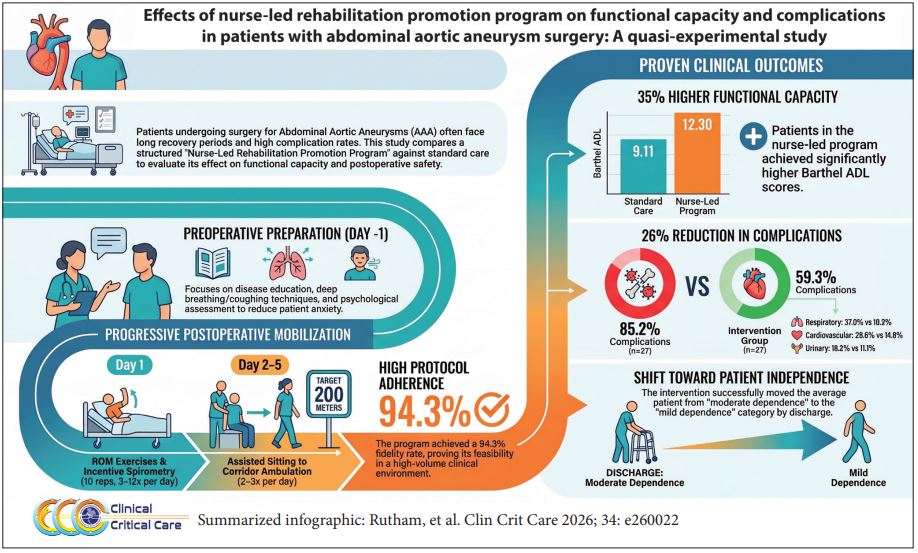
Methods: We conducted a posttest-only quasi-experimental study at Nakornping Hospital from September to December 2025. Fifty-four patients undergoing abdominal aortic aneurysm repair were enrolled and allocated through matched-pairs methodology into either a nurse-led rehabilitation promotion program (n = 27) or standard care (n = 27). The primary outcomes were functional capacity assessed by the Barthel Activities of Daily Living Index on the day of hospital discharge or postoperative day 5, whichever came first, and the occurrence of postoperative complications recorded daily until discharge. We analyzed the data using independent t-tests and chi-square tests.
Results: Patients in the intervention group achieved higher functional capacity scores (mean = 12.30, SD = 2.95) than those in the control group (mean = 9.11, SD = 5.56); the mean difference was 3.19 points (95% CI: 0.74 to 5.64; t = −2.63, df = 39.52, p = .012). Fewer patients in the intervention group experienced postoperative complications (59.3%) compared to the control group (85.2%); the absolute risk reduction was 25.9% (95% CI: 3.2% to 48.6%; χ² = 4.52, p = .033; number needed to treat = 3.86).
Conclusions: A structured nurse-led rehabilitation program was associated with improved functional recovery and lower complication rates in patients after abdominal aortic aneurysm surgery. These findings support the integration of such programs into routine perioperative vascular nursing care.
Trial registration: TCTR20260702010
Downloads
References
Shaw PM, Loree JM, Gibbons RC, Balogun AA. Abdominal Aortic Aneurysm. In: StatPearls [Internet]. Treasure Island (FL): StatPearls Publishing; 2025.
Song P, He Y, Adeloye D, Zhu Y, Ye X, Yi Q, et al. The global and regional prevalence of abdominal aortic aneurysms: A systematic review and modeling analysis. Ann Surg. 2023;277:912-9.
Li X, Zhao G, Zhang J, Duan Z, Xin S. Prevalence and trends of the abdominal aortic aneurysms epidemic in general population--a meta-analysis. PLoS One. 2013;8:e81260.
Wang Y, Zeng L, Wang W, Guo X, Huang X, Lin C, et al. Global, regional, and national burden of aortic aneurysm and its attributable risk factors from 1990 to 2021: An analysis based on the Global Burden of Disease Study 2021. Front Cardiovasc Med. 2025;11:1381292.
Chaikof EL, Dalman RL, Eskandari MK, Jackson BM, Lee WA, Mansour MA, et al. The Society for Vascular Surgery practice guidelines on the care of patients with an abdominal aortic aneurysm. J Vasc Surg. 2018;67:2-77.
Isselbacher EM, Preventza O, Hamilton Black J 3rd, Augoustides JG, Beck AW, Bolen MA, et al. 2022 ACC/AHA Guideline for the diagnosis and management of aortic disease. Circulation. 2022;146:e334-e482.
Jones WS, Patel MR, Holleran SA, Harrison JK, Rajagopal K, Swaminathan M, et al. Changes in functional health status following open abdominal aortic aneurysm repair and the role of exercise-based rehabilitation: A systematic review. J Vasc Soc GB Irel. 2022;1:78-85.
Furutani A, Ihara T, Komori K, Yamamoto H. Usefulness of an enhanced recovery after surgery protocol for perioperative management following open repair of an abdominal aortic aneurysm. J Vasc Surg. 2021;74:90-6.
Farivar B, Corbett M, Sperling L. Transforming outcomes in open AAA through improved recovery. UVA Health Physician Resource [Internet]. 2025 [cited 2025 Dec 20]. Available from: https://www.uvaphysicianresource.com/transforming-outcomes-open-aaa-surgery-new-recovery-program/.
Ramesh SH, Jull D, Fournier H, Rajabiyazdi F. Exploring barriers to patients' progression in the cardiac rehabilitation journey from health care providers' perspectives: Qualitative study. Interact J Med Res. 2025;14:e66164.
Wang L, Yao D, Xu S, Li H, Chen H, Wu Q, et al. Risk factors for preoperative anxiety and depression in patients scheduled for abdominal aortic aneurysm repair. Chin Med J. 2018;131:1669-75.
Yang H, Li S, Ong S, Grigorian A, Schubl SD, Lekawa M, et al. Depression predicts non-home discharge after abdominal aortic aneurysm repair. J Vasc Surg. 2021;73:2063-70.
Tyagi N. Nurse-led Enhanced Recovery after Surgery Programs: Potential solution to shorten postoperative recovery. Indian J Crit Care Med. 2025;29:3-5.
Premkumar S, Ramamoorthy L, Pillai AA. Impact of nurse-led cardiac rehabilitation on patient's behavioral and physiological parameters after a coronary intervention: A pilot randomized controlled trial. J Family Community Med. 2022;29:17-23.
Sakashita C, Endo E, Ota E, Matsuoka S, Kugo M, Andrew B. Effectiveness of nurse-led transitional care interventions for adult patients discharged from acute care hospitals: A systematic review and meta-analysis. BMC Nurs. 2025;24:379.
Cohen J. Statistical power analysis for the behavioral sciences. 2nd ed. Lawrence Erlbaum Associates; 1988.
Faul F, Erdfelder E, Lang AG, Buchner A. G*Power 3: A flexible statistical power analysis program for the social, behavioral, and biomedical sciences. Behav Res Methods. 2007;39:175-91.
Lappan SN, Brown AW, Hendricks PS. Dropout rates of in-person psychosocial substance use disorder treatments: a systematic review and meta-analysis. Addiction 2020;115:201-17.
Clarke J, Davis K, Douglas J, Peters MDJ. Defining nurse-led models of care: contemporary approaches to nursing. Int Nurs Rev. 2025;72:e13076.
Mahoney FI, Barthel DW. Functional evaluation: The Barthel Index. Md State Med J. 1965;14:61-5.
Yamvong C. Effects of application of Orem's nursing system on patients' and relatives' satisfaction with care and functional outcomes in hospitalized elderly patients [master's thesis]. Bangkok: Mahidol University; 1995.
Yilmaz DU, Bebis H, Ortabag T. The effects of Nurse Led Transitional Care Model on elderly patients undergoing open heart surgery: A randomized controlled trial. Eur J Integr Med. 2021;43:101287.
Wainwright TW, Poulter S, Mauger AR. The Quality Improvement Challenge-How nurses and allied health professionals can solve the knowing-doing gap in Enhanced Recovery after Surgery (ERAS). J Pers Med. 2020;10:267.
Downloads
Published
How to Cite
Issue
Section
License
Copyright (c) 2026 The Thai Society of Critical Care Medicine

This work is licensed under a Creative Commons Attribution-NonCommercial 4.0 International License.