Monitoring the depth of neuromuscular blockade in the intensive care unit
Neuromuscular blockade monitoring in the ICU
DOI:
https://doi.org/10.54205/ccc.v34.280649Keywords:
Neuromuscular blocking agents, Neuromuscular monitoring, Train-of-Four stimulation, Critical care, Intensive care unitsAbstract
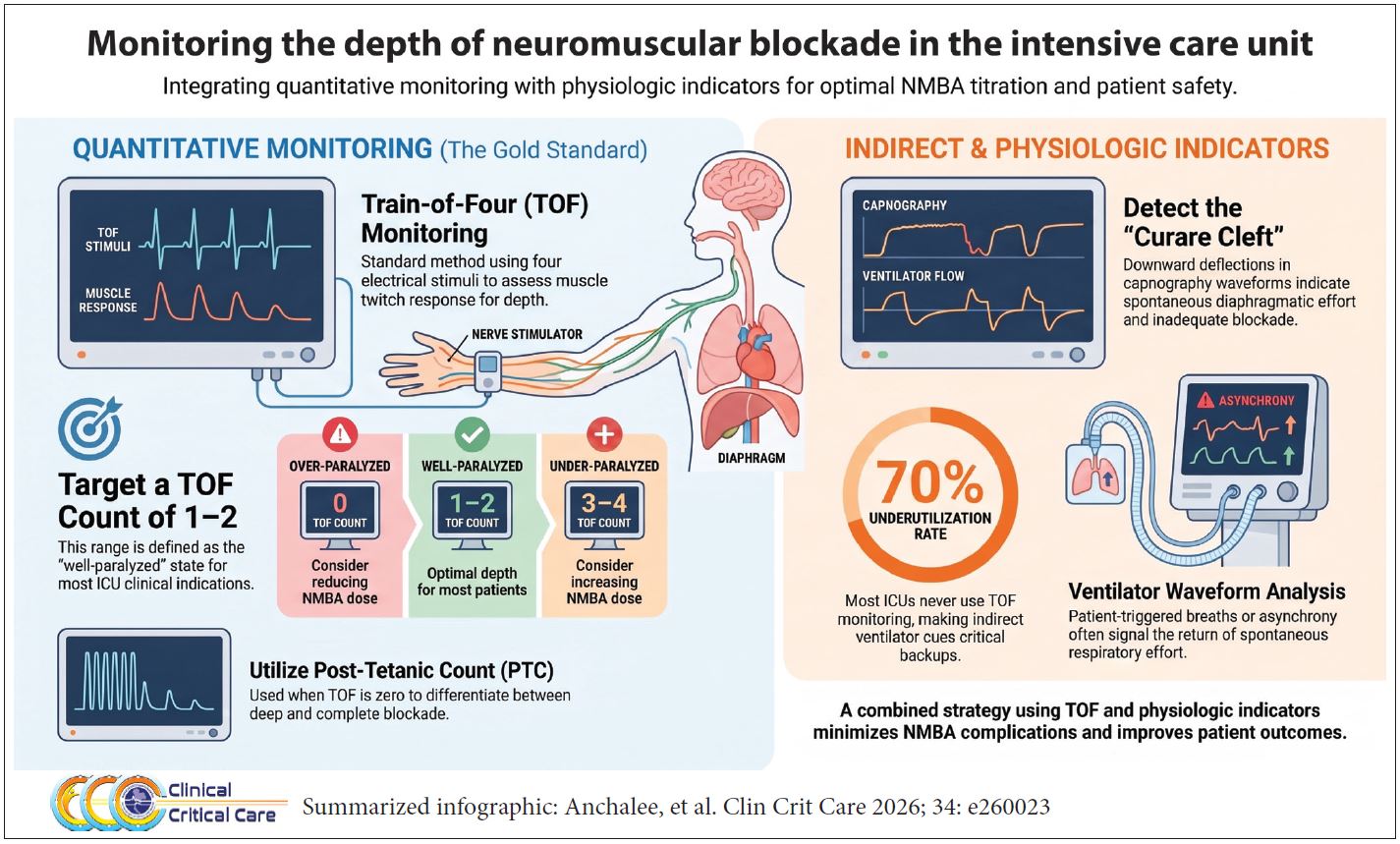
Neuromuscular blocking agents (NMBAs) are widely used in the intensive care unit (ICU) to facilitate mechanical ventilation; however, excessive or prolonged blockade increases the risk of complications such as ICU-acquired weakness. Quantitative train-of-four (TOF) monitoring remains the standard for assessing depth of neuromuscular blockade, although it is often underutilized in ICU practice. Indirect methods including capnography, ventilator waveform analysis, and respiratory effort indices provide complementary but nonspecific information. Integration of quantitative and physiologic monitoring supports safer and more individualized NMBAs management in critically ill patients. This review summarizes current neuromuscular monitoring strategies in the ICU and discusses the clinical utility, limitations, and practical integration of quantitative and indirect monitoring modalities during NMBAs administration.
Downloads
References
Iavarone IG, Al-Husinat L, Vélez-Páez JL, Robba C, Silva PL, Rocco PRM, et al. Management of neuromuscular blocking agents in critically ill patients with lung diseases. JCM. 2024;13(4):1182. doi:10.3390/jcm13041182
Tezcan B, Turan S, Özgök A. Current use of neuromuscular blocking agents in intensive care units. Turk J Anaesthesiol Reanim. 2019;47(4):273-281. doi: 10.5152/TJAR.2019.33269
Rodríguez-Blanco J, Rodríguez-Yanez T, Rodríguez-Blanco JD, Almanza-Hurtado AJ, Martínez-Ávila MC, Borré-Naranjo D, et al. Neuromuscular blocking agents in the intensive care unit. J Int Med Res. 2022;50(9):03000605221128148. doi:10.1177/03000605221128148
Gainnier M, Roch A, Forel JM, Thirion X, Arnal JM, Donati S, et al. Effect of neuromuscular blocking agents on gas exchange in patients presenting with acute respiratory distress syndrome. Critical Care Medicine. 2004;32(1):113–9. doi:10.1097/01.CCM.0000104114.72614.BC
Papazian L, Forel JM, Gacouin A, Penot-Ragon C, Perrin G, Loundou A, et al. Neuromuscular Blockers in Early Acute Respiratory Distress Syndrome. N Engl J Med. 2010;363(12):1107–16. doi:10.1056/NEJMoa1005372
Guervilly C, Bisbal M, Forel JM, Mechati M, Lehingue S, Bourenne J, et al. Effects of neuromuscular blockers on transpulmonary pressures in moderate to severe acute respiratory distress syndrome. Intensive Care Med. 2017;43(3):408–18. doi:10.1007/s00134-016-4653-4
The National Heart, Lung, and Blood Institute PETAL Clinical Trials Network. Early neuromuscular blockade in the acute respiratory distress syndrome. N Engl J Med. 2019;380(21):1997–2008. doi:10.1056/NEJMoa1901686
Lin C, Chao WC, Pai KC, Yang TY, Wu CL, Chan MC. Prolonged use of neuromuscular blocking agents is associated with increased long-term mortality in mechanically ventilated medical ICU patients: a retrospective cohort study. J Intensive Care. 2023;11(1):55. doi:10.1186/s40560-023-00696-x
Bellaver P, Schaeffer AF, Leitao CB, Rech TH, Nedel WL. Association between neuromuscular blocking agents and the development of intensive care unit-acquired weakness (ICU-AW): A systematic review with meta-analysis and trial sequential analysis. Anaesthesia Critical Care & Pain Medicine. 2023;42(3):101202. doi:10.1016/j.accpm.2023.101202
Workum JD, Janssen SHV, Touw HRW. Considerations in neuromuscular blockade in the ICU: A case report and review of the literature. Case Reports in Critical Care. 2020;2020:1–4. doi:10.1155/2020/8780979
Schweickert WD, Hall J. ICU-acquired weakness. Chest. 2007;131(5):1541–9. doi:10.1378/chest.06-2065
Morales Castro D, Dresser L, Granton J, Fan E. Pharmacokinetic alterations associated with critical illness. Clin Pharmacokinet. 2023;62(2):209–20. doi:10.1007/s40262-023-01213-x
Zhou J, Poloyac SM. The effect of therapeutic hypothermia on drug metabolism and response: cellular mechanisms to organ function. Expert Opinion on Drug Metabolism & Toxicology. 2011;7(7):803–16. doi:10.1517/17425255.2011.574127
Ross J, Ramsay DP, Sutton‐Smith LJ, Willink RD, Moore JE. Residual neuromuscular blockade in the ICU : a prospective observational study and national survey. Anaesthesia. 2022;77(9):991–8. doi:10.1111/anae.15789
Groetzinger LM, Hutchins AT, Rivosecchi RM. An evaluation of continuous infusion rocuronium for sustained neuromuscular blockade in critically ill adults. Ann Pharmacother. 2021;55(6):732–7. doi:10.1177/1060028020966731
Alhazzani W, Belley-Cote E, Møller MH, Angus DC, Papazian L, Arabi YM, et al. Neuromuscular blockade in patients with ARDS: a rapid practice guideline. Intensive Care Med. 2020;46(11):1977–86. doi:10.1007/s00134-020-06227-8
Naguib M, Brull SJ, Kopman AF, Hunter JM, Fülesdi B, Arkes HR, et al. Consensus statement on perioperative use of neuromuscular monitoring. Anesthesia & Analgesia. 2018;127(1):71–80. doi:10.1213/ANE.0000000000002670
Jones SK. An Algorithm for Train-of-Four Monitoring in Patients Receiving Continuous Neuromuscular Blocking Agents: Dimensions of Critical Care Nursing. 2003;22(2):50–7. doi:10.1097/00003465-200303000-00001
Murray MJ, DeBlock H, Erstad B, Gray A, Jacobi J, Jordan C, et al. Clinical practice guidelines for sustained neuromuscular blockade in the adult critically ill patient. Critical Care Medicine. 2016;44(11):2079–103. doi:10.1097/CCM.0000000000002027
Rowlee SC. Monitoring neuromuscular blockade in the intensive care unit: The peripheral nerve stimulator. Heart & Lung. 1999;28(5):352–64. doi:10.1053/hl.1999.v28.a99734
Warnaar RSP, Cornet AD, Beishuizen A, Moore CM, Donker DW, Oppersma E. Advanced waveform analysis of diaphragm surface EMG allows for continuous non-invasive assessment of respiratory effort in critically ill patients at different PEEP levels. Crit Care. 2024;28(1):195. doi:10.1186/s13054-024-04978-0
Radkowski P, Ruść J, Kęska M. Evaluation of Neuromuscular Blockade: A Comparative Study of TOF-Cuff® on the Lower Leg and TOF-Scan® on the Ulnar Nerve During Mivacurium Anesthesia. Med Sci Monit. 2024;30. doi:10.12659/MSM.945227
Bouju P, Tadié JM, Barbarot N, Letheulle J, Uhel F, Fillatre P, et al. Clinical assessment and train-of-four measurements in critically ill patients treated with recommended doses of cisatracurium or atracurium for neuromuscular blockade: a prospective descriptive study. Ann Intensive Care. 2017;7(1):10. doi:10.1186/s13613-017-0234-0
Donati F, Antzaka C, Bevan DR. Potency of pancuronium at the diaphragm and the adductor pollicis muscle in humans. Anesthesiology. 1986;65(1):1–5. doi:10.1097/00000542-198607000-00001
Cantineau JP, Porte F, d’Honneur G, Duvaldestin P. Neuromuscular effects of rocuronium on the diaphragm and adductor pollicis muscles in anesthetized patients. Anesthesiology. 1994;81(3):585–90. doi:10.1097/00000542-199409000-00010
Donati F, Meistelman C, Plaud B. Vecuronium neuromuscular blockade at the diaphragm, the orbicularis oculi, and adductor pollicis muscles. Anesthesiology. 1990;73(5):870–5. doi:10.1097/00000542-199011000-00013
Devlin JW, Skrobik Y, Gélinas C, Needham DM, Slooter AJC, Pandharipande PP, et al. Clinical practice guidelines for the prevention and management of pain, agitation/sedation, delirium, immobility, and sleep disruption in adult patients in the ICU. Critical Care Medicine. 2018;46(9):e825–73. doi:10.1097/CCM.0000000000003299
Rezaiguia-Delclaux S, Laverdure F, Genty T, Imbert A, Pilorge C, Amaru P, et al. Neuromuscular blockade monitoring in acute respiratory distress syndrome: randomized controlled trial of clinical assessment alone or with peripheral nerve stimulation. Anesthesia & Analgesia. 2021;132(4):1051–9. doi:10.1213/ANE.0000000000005174
Hraiech S, Forel JM, Guervilly C, Rambaud R, Lehingue S, Adda M, et al. How to reduce cisatracurium consumption in ARDS patients: the TOF-ARDS study. Ann Intensive Care. 2017;7(1):79. doi:10.1186/s13613-017-0305-2
Rudis MI, Sikora CA, Angus E, Peterson E, Popovich J, Hyzy R, et al. A prospective, randomized, controlled evaluation of peripheral nerve stimulation versus standard clinical dosing of neuromuscular blocking agents in critically ill patients. Critical Care Medicine. 1997;25(4):575–83. doi:10.1097/00003246-199704000-00005
Heier T, Caldwell JE, Eriksson LI, Sessler DI, Miller RD. The effect of hypothermia on adductor pollicis twitch tension during continuous infusion of vecuronium in isoflurane-anesthetized humans. Anesthesia & Analgesia. 1994;78(2):312–7. doi:10.1213/00000539-199402000-00019
Renew JR, Ratzlaff R, Hernandez-Torres V, Brull SJ, Prielipp RC. Neuromuscular blockade management in the critically Ill patient. J Intensive Care. 2020;8(1):37. doi:10.1186/s40560-020-00455-2
Ward KR, Yealy DM. End‐tidal carbon dioxide monitoring in emergency medicine, Part 1: Basic Principles*. Academic Emergency Medicine. 1998;5(6):628–36. doi:10.1111/j.1553-2712.1998.tb02473.x
Emrath E. The Basics of ventilator waveforms. Curr Pediatr Rep. 2021;9(1):11–9. doi:10.1007/s40124-020-00235-4
Mojoli F, Pozzi M, Orlando A, Bianchi IM, Arisi E, Iotti GA, et al. Timing of inspiratory muscle activity detected from airway pressure and flow during pressure support ventilation: the waveform method. Crit Care. 2022;26(1):32. doi:10.1186/s13054-022-03895-4
De Oliveira B, Aljaberi N, Taha A, Abduljawad B, Hamed F, Rahman N, et al. Patient–ventilator dyssynchrony in critically ill patients. JCM. 2021;10(19):4550. doi:10.3390/jcm10194550
Holanda MA, Vasconcelos RDS, Ferreira JC, Pinheiro BV. Patient-ventilator asynchrony. J bras pneumol. 2018;44(4):321–33. doi:10.1590/s1806-37562017000000185
Flynn BC, Miranda HG, Mittel AM, Moitra VK. Stepwise ventilator waveform assessment to diagnose pulmonary pathophysiology. Anesthesiology. 2022;137(1):85–92. doi:10.1097/ALN.0000000000004220
Jonkman AH, De Vries HJ, Heunks LMA. Physiology of the respiratory drive in ICU patients: Implications for diagnosis and treatment. Crit Care. 2020;24(1):104. doi:10.1186/s13054-020-2776-z
Van Oosten JP, Akoumianaki E, Jonkman AH. Monitoring respiratory muscles effort during mechanical ventilation. Current Opinion in Critical Care. 2024. doi:10.1097/MCC.0000000000001229
Vu PH, Tran VD, Duong MC, Cong QT, Nguyen T. Predictive value of the negative inspiratory force index as a predictor of weaning success: a crosssectional study. Acute Crit Care. 2020;35(4):279–85. doi:10.4266/acc.2020.00598
Kondili E, Alexopoulou C, Xirouchaki N, Vaporidi K, Georgopoulos D. Estimation of inspiratory muscle pressure in critically ill patients. Intensive Care Med. 2010;36(4):648–55. doi:10.1007/s00134-010-1753-4
Akoumianaki E, Maggiore SM, Valenza F, Bellani G, Jubran A, Loring SH, et al. The application of esophageal pressure measurement in patients with respiratory failure. Am J Respir Crit Care Med. 2014;189(5):520–31. doi:10.1164/rccm.201312-2193CI
Clement KC. Ventilator triggering. J Pediatr intensive care. 2015 Jul 28;02(01):011–7. doi:10.3233/PIC-13043
Jonkman AH, Telias I, Spinelli E, Akoumianaki E, Piquilloud L. The oesophageal balloon for respiratory monitoring in ventilated patients: updated clinical review and practical aspects. Eur Respir Rev. 2023;32(168):220186. doi:10.1183/16000617.0186-2022
Pham T, Telias I, Beitler JR. Esophageal manometry. respiratory care. 2020;65(6):772–92. doi:10.4187/respcare.07425
Yoshida T, Brochard L. Esophageal pressure monitoring: why, when and how? Current Opinion in Critical Care. 2018;24(3):216–22. doi:10.1097/MCC.0000000000000494
Fuchs‐Buder T, Claudius C, Skovgaard LT, Eriksson LI, Mirakhur RK, Viby‐Mogensen J. Good clinical research practice in pharmacodynamic studies of neuromuscular blocking agents II: the Stockholm revision. Acta Anaesthesiol Scand. 2007;51(7):789–808. doi:10.1111/j.1399-6576.2007.01352.x
Telias I, Junhasavasdikul D, Rittayamai N, Piquilloud L, Chen L, Ferguson ND, et al. Airway occlusion pressure as an estimate of respiratory drive and inspiratory effort during assisted ventilation. american journal of respiratory and critical care medicine. 2020;201(9):1086–98. doi:10.1164/rccm.201907-1425OC
Werawatganon T, Desudchit T, Pirompanich K, Tailanan K, Hamta-nont P. Agreement of Train-of-Four count by Thai peripheral nerve stimulator compare with TOF-Watch® SX. Thai J Anesthesiol. 2023;49(3):243-250.
Chanthawong S, Apithambundit T, Chaimala N, Saras S, Yotepanya T, Nonphiaraj S. Incidence of postoperative residual neuromuscular blockade at the postanesthesia care unit following general anesthesia. Siriraj Med J. 2025;77(7):496–504. doi:10.33192/smj.v77i7.272875
Hadique S, Badami V, Forte M, Kovacic N, Umer A, Shigle A, et al. The Implementation of protocol-based utilization of neuromuscular blocking agent using clinical variables in acute respiratory distress syndrome patients. Critical Care Explorations. 2021;3(3):e0371. doi:10.1097/CCE.0000000000000371
Downloads
Published
How to Cite
Issue
Section
License
Copyright (c) 2026 The Thai Society of Critical Care Medicine

This work is licensed under a Creative Commons Attribution-NonCommercial 4.0 International License.