FANCAS nursing framework for ARDS: A systematic review and synthesis
FANCAS framework for ARDS
DOI:
https://doi.org/10.54205/ccc.v34.281634Keywords:
ARDS, Critical care nursing, FAST-HUG-BID-C, FANCAS, Nursing framework, Systematic reviewAbstract
Background: Acute respiratory distress syndrome (ARDS) carries high mortality ranging from 35% to 46%. Contemporary clinical guidelines predominantly emphasize medical management, leaving nursing care without a comprehensive evidence-based framework.
Method: This study aimed to develop an evidence-based operationalization of the FANCAS nursing framework specifically for ARDS patients through systematic review and narrative synthesis. We conducted a systematic review following PRISMA 2020 guidelines. The detailed search strategy is reported in a companion manuscript. We searched PubMed, Cochrane Library, CINAHL, ThaiJO, and Google Scholar from January 2016 to March 2026. We included studies reporting nursing-sensitive outcomes in ARDS patients. Two reviewers independently coded the data and assessed quality using ROB-2 and ROBINS-I. Inter-rater agreement was substantial for initial coding of nursing interventions into the six FANCAS domains (κ = 0.82).
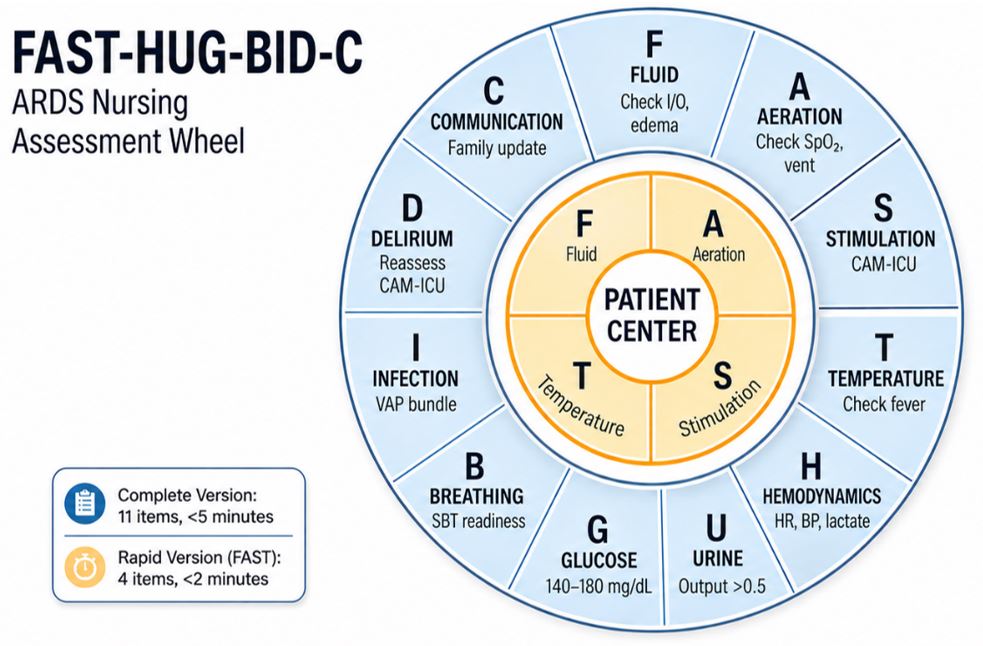
Result: Our search identified 45 studies that met inclusion criteria: 12 randomized controlled trials, 18 cohort studies, 10 quality improvement projects, and five qualitative studies. The evidence-based FANCAS framework emerged with six domains: Fluid, Aeration, Nutrition, Communication, Activity, and Stimulation. We derived a bedside checklist called FAST-HUG-BID-C, with a rapid version (FAST) for unstable patients. We also identified twelve frugal innovations applicable to resource-limited settings, with nine having feasibility ratings of four or five (ready for immediate implementation).
Conclusion: This study provides the first systematic review-based operationalization of the FANCAS framework for ARDS nursing care. The frugal innovations are ready for implementation in resource-limited settings. The checklist requires prospective validation before widespread clinical implementation.
Registration: This study is part of a project registered with PROSPERO (CRD420261360074) as 'Development of Clinical Nursing Practice Guidelines for Patients with Acute Respiratory Distress Syndrome (ARDS): A Synthesis of Empirical Evidence for Clinical Practice in the Thai Context'.
Downloads
References
Bellani G, Laffey JG, Pham T, Fan E, Brochard L, Esteban A, et al. Epidemiology, patterns of care, and mortality for patients with acute respiratory distress syndrome in intensive care units in 50 countries. JAMA. 2016;315(8):788-800.
ARDS Definition Task Force. Acute respiratory distress syndrome: the Berlin Definition. JAMA. 2012;307(23):2526-33.
Diniz-Silva F, Morais CCA, Aliberti MJR, Da Silva PSR, De Souza MD, De Oliveira A, et al. The 2024 global definition of acute respiratory distress syndrome: a systematic review and meta-analysis. Crit Care. 2025;29(1):45.
Thawitsri T, Chittawatanarat K, Morakul S, Kiatboonsri S, Suwanpimolkul G, Srisawat N, et al. Epidemiology and outcomes of ARDS in Thai intensive care units: a multicenter cohort study. J Med Assoc Thai. 2021;104(5):789-97.
Grasselli G, Calfee CS, Camporota L, Poole D, Amato MBP, Antonelli M, et al. ESICM guidelines on acute respiratory distress syndrome: assessment, management, and rehabilitation. Intensive Care Med. 2023;49(7):727-59.
Qadir N, Sahetya S, Munshi L, Summers C, Abrams D, Beitler J, et al. An update on management of adult patients with acute respiratory distress syndrome: an official American Thoracic Society clinical practice guideline. Am J Respir Crit Care Med. 2024;209(1):24-36.
O'Brien JM, Poteet SJ, Slack DF, Meyer J, Martin S, Needham DM. Nursing recommendations in clinical practice guidelines for ARDS: a scoping review. Heart Lung. 2024;63:45-52.
Holloway NM. Nursing the Critically Ill Adult. 1st ed. Menlo Park, CA: Addison-Wesley Publishing; 1979.
Vincent JL. Give your patient a fast hug at least once a day. Crit Care. 2005;9(3):221-2.
Ely EW, Truman B, Shintani A, Thomason JWW, Wheeler AP, Gordon S, et al. Monitoring sedation status over time in ICU patients: reliability and validity of the Richmond Agitation-Sedation Scale (RASS). JAMA. 2003;289(22):2983-91.
Guérin C, Reignier J, Richard JC, Beuret P, Gacouin A, Boulain T, et al. Prone positioning in severe acute respiratory distress syndrome. N Engl J Med. 2013;368(23):2159-68.
Page MJ, McKenzie JE, Bossuyt PM, Boutron I, Hoffmann TC, Mulrow CD, et al. The PRISMA 2020 statement: an updated guideline for reporting systematic reviews. BMJ. 2021;372:n71.
Papazian L, Forel JM, Gacouin A, Penot-Ragon C, Perrin G, Loundou A, et al. Neuromuscular blockers in early respiratory distress syndrome. N Engl J Med. 2010;363(12):1107-16.
National Heart, Lung, and Blood Institute ARDS Clinical Trials Network. Comparison of two fluid-management strategies in acute lung injury. N Engl J Med. 2006;354(24):2564-75.
Moss M, Huang DT, Brower RG, Ferguson ND, Gajic O, Gundel S, et al. Early neuromuscular blockade in the acute respiratory distress syndrome. N Engl J Med. 2019;380(21):1997-2008.
Rice TW, Wheeler AP, Thompson BT, Steingrub J, Hite RD, Moss M, et al. Initial trophic vs full enteral feeding in patients with acute lung injury: the EDEN randomized trial. JAMA. 2012;307(8):795-803.
Girard TD, Kress JP, Fuchs BD, Thomason JWW, Schweickert WD, Pun BT, et al. Efficacy and safety of a paired sedation and ventilator weaning protocol for mechanically ventilated patients in intensive care. Lancet. 2008;371(9607):126-34.
Schweickert WD, Pohlman MC, Pohlman AS, Nigos C, Pawlik AJ, Esbrook CL, et al. Early physical and occupational therapy in mechanically ventilated, critically ill patients: a randomised controlled trial. Lancet. 2009;373(9678):1874-82.
Devlin JW, Skrobik Y, Gélinas C, Needham DM, Slooter AJC, Pandharipande PP, et al. Clinical practice guidelines for the prevention and management of pain, agitation/sedation, delirium, immobility, and sleep disruption in adult patients in the ICU. Crit Care Med. 2018;46(9):e825-73.
Villar J, Blanco J, del Campo R, Andaluz-Ojeda D, Diaz-Dominguez FJ, Muriel A, et al. Assessment of PaO2/FiO2 for stratification of patients with moderate and severe acute respiratory distress syndrome. BMJ Open. 2015;5(3):e006812.
Ferguson ND, Cook DJ, Guyatt GH, Mehta S, Hand L, Austin P, et al. High-frequency oscillation in early acute respiratory distress syndrome. N Engl J Med. 2013;368(9):795-805.
Young D, Lamb S, Shah S, MacKenzie I, Tunnicliffe W, Lall R, et al. High-frequency oscillation for acute respiratory distress syndrome. N Engl J Med. 2013;368(9):806-13.
Goligher EC, Fan E, Herridge MS, Murray A, Vorona S, Brace D, et al. Evolution of diaphragm thickness during mechanical ventilation: impact of inspiratory effort. Am J Respir Crit Care Med. 2015;192(9):1080-8.
Jaber S, Petrof BJ, Jung B, Chanques G, Berthet JP, Rabuel C, et al. Rapidly progressive diaphragmatic weakness and injury during mechanical ventilation in humans. Am J Respir Crit Care Med. 2011;183(3):364-71.
Sessler CN, Gosnell MS, Grap MJ, Brophy GM, O'Neal PV, Keane KA, et al. The Richmond Agitation-Sedation Scale: validity and reliability in adult intensive care unit patients. Am J Respir Crit Care Med. 2002;166(10):1338-44.
Chanques G, Jaber S, Barbotte E, Violet S, Sebbane M, Perrigault PF, et al. Impact of systematic evaluation of pain and agitation in an intensive care unit. Crit Care Med. 2006;34(6):1691-9.
Puntillo K, Pasero C, Li D, Mularski RA, Grap MJ, Erstad BL, et al. Evaluation of pain in ICU patients. Chest. 2009;135(4):1069-74.
Gelinas C, Fillion L, Puntillo KA, Viens C, Fortier M, Savard M. Validation of the critical-care pain observation tool in adult patients. Am J Crit Care. 2006;15(4):420-7.
Rose L, Haslam L, Dale C, Knechtel L, McGillion M, Watt-Watson J. Behavioral pain assessment tool for critically ill adults unable to self-report pain. Am J Crit Care. 2013;22(3):246-55.
Needham DM, Dinglas VD, Morris PE, Jackson JC, Hough CL, Mendez-Tellez PA, et al. Physical and cognitive performance of patients with acute lung injury 1 year after initial trophic vs full enteral feeding: EDEN trial follow-up. Am J Respir Crit Care Med. 2013;188(5):567-76.
Vincent JL, Sakr Y, Sprung CL, Ranieri VM, Reinhart K, Gerlach H, et al. Sepsis in European intensive care units: results of the SOAP study. Crit Care Med. 2006;34(2):344-53.
Boyd JH, Forbes J, Nakada T, Walley KR, Russell JA. Fluid resuscitation in septic shock: a positive fluid balance and elevated central venous pressure increase mortality. Crit Care Med. 2011;39(2):259-65.
Payen D, de Pont AC, Sakr Y, Spies C, Reinhart K, Vincent JL. A positive fluid balance is associated with a worse outcome in patients with acute renal failure. Crit Care. 2008;12(3):R74.
Micek SC, McEnvoy C, McKenzie M, Hampton N, Doherty JA, Kollef MH. Fluid balance and cardiac function in septic shock as predictors of hospital mortality. Crit Care. 2013;17(5):R246.
Jozwiak M, Silva S, Persichini R, Anguel N, Osman D, Richard C, et al. Extravascular lung water is an independent prognostic factor in patients with acute respiratory distress syndrome. Crit Care Med. 2013;41(2):472-80.
Tagami T, Sawabe M, Kushimoto S, Yokota H, Yamamoto T, Aoki H, et al. Quantitative diagnosis of diffuse alveolar damage using extravascular lung water. Crit Care Med. 2013;41(9):2144-50.
Bouchard J, Soroko SB, Chertow GM, Himmelfarb J, Ikizler TA, Paganini EP, et al. Fluid accumulation, survival and recovery of kidney function in critically ill patients with acute kidney injury. Kidney Int. 2009;76(4):422-7.
Climo MW, Yokoe DS, Warren DK, Perl TM, Bolon M, Herwaldt LA, et al. Effect of daily chlorhexidine bathing on hospital-acquired infection. N Engl J Med. 2013;368(6):533-42.
Derde LP, Cooper BS, Goossens H, Malhotra-Kumar S, Willems RJ, Gniadkowski M, et al. Interventions to reduce colonisation and transmission of antimicrobial-resistant bacteria in intensive care units: an interrupted time series study and cluster randomised trial. Lancet Infect Dis. 2014;14(1):31-9.
Huang SS, Septimus E, Kleinman K, Moody J, Hickok J, Avery TR, et al. Targeted versus universal decolonization to prevent ICU infection. N Engl J Med. 2013;368(24):2255-65.
Harris AD, Pineles L, Belton B, Johnson JK, Shardell M, Loeb M, et al. Universal glove and gown use and acquisition of antibiotic-resistant bacteria in the ICU: a randomized trial. JAMA. 2013;310(15):1571-80.
Timsit JF, Bouadma L, Ruckly S, Schwebel C, Garrouste-Orgeas M, Bronchard R, et al. Dressing disruption is a major risk factor for catheter-related infections. Crit Care Med. 2012;40(6):1707-14.
Wright MO, Tropp J, Schora DM, Dingle K, Peterson LR, Robicsek A. Continuous passive disinfection of catheter hubs prevents contamination and bloodstream infection. Am J Infect Control. 2013;41(1):33-8.
Caserta RA, Marra AR, Durao MS, Silva CV, Pavao dos Santos OF, Neves HS, et al. A program for sustained improvement in preventing ventilator associated pneumonia in an intensive care setting. BMC Infect Dis. 2012;12:234.
Van Nieuwenhoven CA, Vandenbroucke-Grauls C, van Tiel FH, Joore HC, van Schijndel RJ, van der Tweel I, et al. Feasibility and effects of the semirecumbent position to prevent ventilator-associated pneumonia: a randomized study. Crit Care Med. 2006;34(2):396-402.
[Manzano F, Fernandez-Mondejar E, Colmenero M, Poyatos ME, Rivera R, Machado J, et al. Positive-end expiratory pressure reduces incidence of ventilator-associated pneumonia in nonhypoxemic patients. Crit Care Med. 2008;36(8):2225-31.
Oostdijk EA, de Wit GA, Bakker M, de Smet AM, Bonten MJ. Selective decontamination of the digestive tract and selective oropharyngeal decontamination in intensive care unit patients: a cost-effectiveness analysis. BMJ Open. 2013;3(3):e002421.
Rotondi AJ, Chelluri L, Sirio C, Mendelsohn A, Schulz R, Belle S, et al. Patients' recollections of stressful experiences while receiving prolonged mechanical ventilation in an intensive care unit. Crit Care Med. 2002;30(4):746-52.
Schelling G, Richter M, Roozendaal B, Rothenhausler HB, Krauseneck T, Stoll C, et al. Exposure to high stress in the intensive care unit may have negative effects on health-related quality-of-life outcomes after cardiac surgery. Crit Care Med. 2003;31(7):1971-80.
Stein-Parbury J, McKinley S. Patients' experiences of being in an intensive care unit: a select literature review. Am J Crit Care. 2000;9(1):20-7.
Nelson JE, Mercado AF, Camhi SL, Tandon N, Wallenstein S, August GI, et al. Communication about chronic critical illness. Arch Intern Med. 2007;167(22):2509-15.
Azoulay E, Chevret S, Leleu G, Pochard F, Barboteu M, Adrie C, et al. Half the families of intensive care unit patients experience inadequate communication with physicians. Crit Care Med. 2000;28(8):3044-9.
Barnett-Page E, Thomas J. Methods for the synthesis of qualitative research: a critical review. BMC Med Res Methodol. 2009;9:59.
Vincent JL. Give your patient a fast hug at least once a day. Crit Care. 2005;9(3):221-2.
Efe S, Ateş C, Cengizhan MS, Bilgen H, Demir A, Yılmaz F. Alternating pressure air mattresses in the intensive care unit as a cost effective strategy for preventing stage III IV pressure injuries: a retrospective cohort study. Clinics. 2026;81:100577.
Ahtiala M, Kivimaki R, Laitio R, Soppi E. Effect of mattress deployment on pressure ulcer development: a real world observational cohort experience. J Wound Care. 2020;29(2):84 91.
Polhan B, Pengpinij O, Wongviseskarn J. The use of air mattresses for prone position in acute respiratory distress syndrome patients reduces complications in pressure injury. J Royal Thai Army Nurses. 2024;25(3):19.
Downloads
Published
How to Cite
Issue
Section
License
Copyright (c) 2026 The Thai Society of Critical Care Medicine

This work is licensed under a Creative Commons Attribution-NonCommercial 4.0 International License.