Heart–lung interaction in acute respiratory distress syndrome: Pathophysiological insights and stepwise lung- and right ventricular-protective management
Heart-lung interaction in ARDS
DOI:
https://doi.org/10.54205/ccc.v34.282063Keywords:
Acute respiratory distress syndrome, Prone positioning, Right ventricular dysfunction, Heart–lung interaction, Acute cor pulmonale, Right ventricular-protective managementAbstract
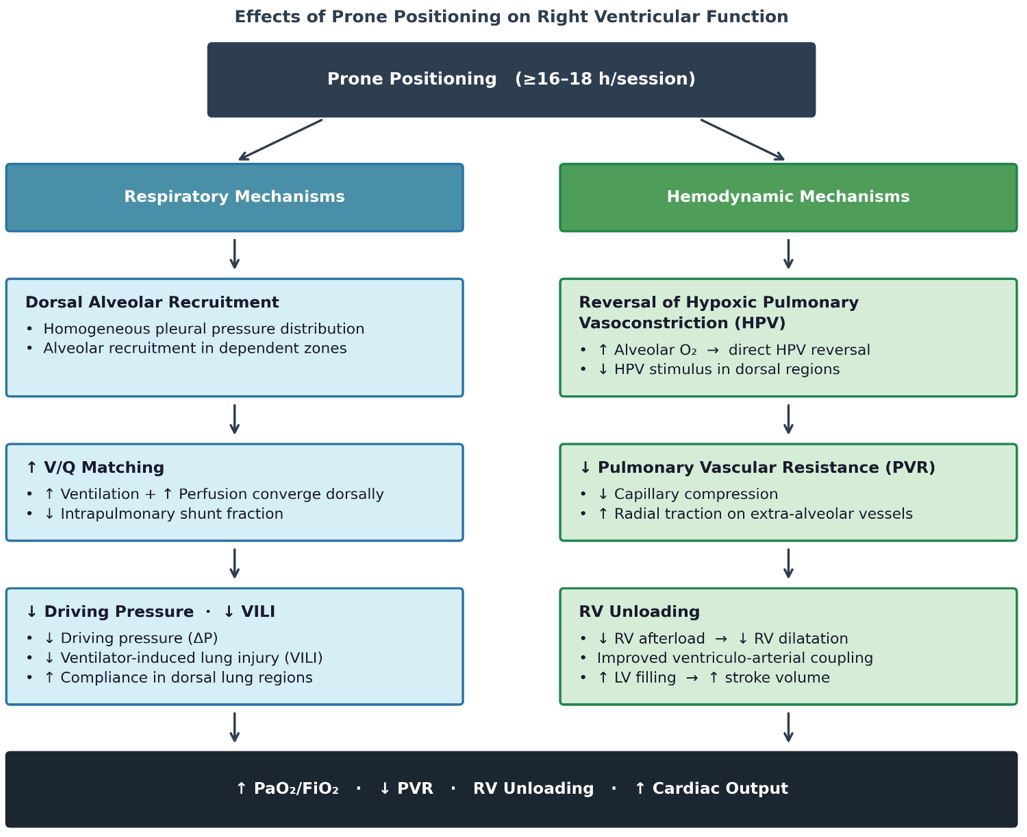
Acute respiratory distress syndrome (ARDS) imposes a substantial burden on right ventricular (RV) function through increased pulmonary vascular resistance driven by pulmonary vascular injury, hypoxemia, hypercapnia, and the mechanical effects of positive-pressure ventilation. In a subset of patients, this may progress to acute cor pulmonale and is associated with worse outcomes. This narrative review summarizes the pathophysiology of heart–lung interaction in ARDS, the respiratory and hemodynamic effects of prone positioning, and current RV-protective management strategies. Current guidelines support prone positioning in selected patients with moderate-to-severe ARDS, particularly those with severe hypoxemia despite optimized ventilatory support. The 2024 American Thoracic Society (ATS) guideline recommends prone positioning for >12 hours/day in severe ARDS, whereas the 2023 European Society of Intensive Care Medicine (ESICM) guideline and contemporary practice commonly support longer sessions of 16–18 hours, consistent with the PROSEVA protocol. Recent meta-analytic evidence suggests that extended prone positioning may improve oxygenation and reduce mortality, although optimal session duration, patient selection, and complication risk require further study. Prone positioning should be considered a central component of an integrated RV-protective approach that also includes lung-protective ventilation, minimization of driving pressure, individualized positive end-expiratory pressure (PEEP) titration, carbon dioxide control, hemodynamic assessment, and rescue therapies such as inhaled pulmonary vasodilators and veno-venous extracorporeal membrane oxygenation when indicated.
Downloads
References
Ranieri VM, Rubenfeld GD, Thompson BT, Ferguson ND, Caldwell E, Fan E, et al. Acute respiratory distress syndrome: the Berlin Definition. JAMA. 2012;307:2526–33.
Fan E, Del Sorbo L, Goligher EC, Hodgson CL, Munshi L, Walkey AJ, et al. An official American Thoracic Society/European Society of Intensive Care Medicine/Society of Critical Care Medicine clinical practice guideline: mechanical ventilation in adult patients with acute respiratory distress syndrome. Am J Respir Crit Care Med. 2017;195:1253–63.
Bellani G, Laffey JG, Pham T, Fan E, Brochard L, Esteban A, et al. Epidemiology, patterns of care, and mortality for patients with acute respiratory distress syndrome in intensive care units in 50 countries. JAMA. 2016;315:788–800.
Voelkel NF, Quaife RA, Leinwand LA, Barst RJ, McGoon MD, Meldrum DR, et al. Right ventricular function and failure: report of a National Heart, Lung, and Blood Institute working group on cellular and molecular mechanisms of right heart failure. Circulation. 2006;114:1883–91.
Matthay MA, Zemans RL, Zimmerman GA, Bhatt DL, Calfee CS, Camara AK, et al. Acute respiratory distress syndrome. Nat Rev Dis Primers. 2019;5:18.
Yogeswaran A, Kremer NC, Janetzko P, Schäfer S, Rako ZA, Vadász I, et al. Right-sided heart failure in acute respiratory distress syndrome. Eur Respir Rev. 2025;34:250060.
Vieillard-Baron A, Schmitt JM, Augarde R, Fellahi JL, Prin S, Page B, et al. Acute cor pulmonale in acute respiratory distress syndrome submitted to protective ventilation: incidence, clinical implications, and prognosis. Crit Care Med. 2001;29:1551–7.
Mekontso Dessap A, Boissier F, Charron C, Béger F, Aghaidari N, Razazi K, et al. Acute cor pulmonale during protective ventilation for acute respiratory distress syndrome: prevalence, predictors, and outcome. Intensive Care Med. 2016;42:862–70.
Guerin C, Reignier J, Richard JC, Beuret P, Gacouin A, Boulain T, et al. Prone positioning in severe acute respiratory distress syndrome. N Engl J Med. 2013;368:2159–68.
Vieillard-Baron A, Boissier F, Pesenti A. Hemodynamic impact of prone position. Let’s protect the lung and its circulation to improve prognosis. Intensive Care Med. 2023;49:692–694.
Corp A, Thomas C, Adlam M. The cardiovascular effects of positive pressure ventilation. BJA Educ. 2021;21(6):202–209.
Pinsky MR. Cardiopulmonary interactions: physiologic basis and clinical applications. Ann Am Thorac Soc. 2018;15(Suppl 1):S45–48.
Jardin F, Vieillard-Baron A. Is there a safe plateau pressure in ARDS? The right heart only knows. Intensive Care Med. 2007;33:444–7.
Swenson ER. Hypoxic pulmonary vasoconstriction. High Alt Med Biol. 2013;14:101–10.
Petit M, Vieillard-Baron A. Ventricular interdependence in critically ill patients: from physiology to bedside. Front Physiol. 2023;14:1232340.
Wasserman E, Wulff L, Bandyopadhyay D, Restrepo-Jaramillo R, Qureshi R, Herazo-Maya J, et al. Reverse Bernheim phenomenon – a true enigma. Respir Med Case Rep. 2025;57:102250.
Vieillard-Baron A, Naeije R, Haddad F, Bogaard HJ, Bull TM, Fletcher N, et al. Diagnostic workup, etiologies and management of acute right ventricle failure: a state-of-the-art paper. Intensive Care Med. 2018;44:774–90.
Santos A, Ioan AM, Monge MI, Suarez-Sipmann F. Open up the lung and keep the lung vessels open. Am J Respir Crit Care Med. 2025;211(2):289–90.
Slobod D, Yusuff H, Zochios V. Right ventricular-protective ventilation in ARDS: thinking beyond lung protection. Intensive Care Med. 2026. doi: 10.1007/s00134-026-08421-6
Slobod D, Zochios V, Yusuff H, Lyhne MD, Denault AY. Right ventricular hemodynamics in acute respiratory distress syndrome: monitoring and implications for clinical management. Am J Respir Crit Care Med. 2026;212(1):45–58.
Amato MB, Meade MO, Slutsky AS, Brochard L, Costa EL, Schoenfeld DA, et al. Driving pressure and survival in the acute respiratory distress syndrome. N Engl J Med. 2015;372:747–55.
Vieillard-Baron A, Charron C, Caille V, Belliard G, Page B, Jardin F. Prone positioning unloads the right ventricle in severe ARDS. Chest. 2007;132:1440–6.
Guerin C, Albert RK, Beitler J, Gattinoni L, Jaber S, Marini JJ, et al. Prone position in ARDS patients: why, when, how and for whom. Intensive Care Med. 2020;46:2385–96.
Cheong I, Álvarez Viariño FM, Gómez RA, Merlo PM, Tamagnone FM. Assessing right ventricular performance during prone ventilation in ARDS patients using speckle tracking echocardiography. J Clin Ultrasound. 2025;53(5):1004–11.
Qadir N, Sahetya S, Munshi L, Summers C, Abrams D, Beitler J, et al. An Update on Management of Adult Patients with Acute Respiratory Distress Syndrome: An Official American Thoracic Society Clinical Practice Guideline. Am J Respir Crit Care Med. 2024;209(1):24–36.
Grasselli G, Calfee CS, Camporota L, Poole D, Amato MB, Antonelli M, et al. ESICM guidelines on acute respiratory distress syndrome: definition, phenotyping and respiratory support strategies. Intensive Care Med. 2023;49:727–57.
Sud S, Friedrich JO, Adhikari NK, Taccone P, Mancebo J, Polli F, et al. Effect of prone positioning during mechanical ventilation on mortality among patients with acute respiratory distress syndrome: a systematic review and meta-analysis. CMAJ. 2014;186(10):E381–90.
Munshi L, Del Sorbo L, Adhikari NKJ, Hodgson CL, Wunsch H, Meade MO, et al. Prone position for acute respiratory distress syndrome. A systematic review and meta-analysis. Ann Am Thorac Soc. 2017;14(Suppl 4):S280–88.
Berger do Rosário M, Warpechowski da Silva D, Wawrzeniak IC, Ziegelmann PK, Rios Vieira SR, Boniatti MM, et al. Extended prone positioning in ARDS: a systematic review and meta-analysis. Respir Care. 2026;71(4):417–25.
Harjola VP, Mebazaa A, Celutkiene J, Balmain S, Bauersachs J, Bhatt DL, et al. Contemporary management of acute right ventricular failure: a statement from the Heart Failure Association and the Working Group on Pulmonary Circulation and Right Ventricular Function of the European Society of Cardiology. Eur J Heart Fail. 2016;18(3):226-41.
Ventetuolo CE, Klinger JR. Management of acute right ventricular failure in the intensive care unit. Ann Am Thorac Soc. 2014;11(5):811-22.
Combes A, Hajage D, Capellier G, Demoule A, Lavoue S, Guervilly C, et al. Extracorporeal membrane oxygenation for severe acute respiratory distress syndrome. N Engl J Med. 2018;378:1965–75.
Bunge JJH, Caliskan K, Gommers D, Reis Miranda D. Right ventricular dysfunction during acute respiratory distress syndrome and veno-venous extracorporeal membrane oxygenation. J Thorac Dis. 2018;10(Suppl 5):S674–S682.
Schmidt M, Hajage D, Lebreton G, Dres M, Guervilly C, Richard JC, et al. Prone positioning during extracorporeal membrane oxygenation in patients with severe ARDS: the PRONECMO randomized clinical trial. JAMA. 2023;330(24):2343–53.
Bagate F, Masi P, Boukantar M, Mekontso Dessap A. Refractory cor pulmonale under extracorporeal membrane oxygenation for acute respiratory distress syndrome: the role of conversion to veno-pulmonary arterial assist: a case series. Front Med. 2024;11:1348077.
Downloads
Published
How to Cite
Issue
Section
License
Copyright (c) 2026 The Thai Society of Critical Care Medicine

This work is licensed under a Creative Commons Attribution-NonCommercial 4.0 International License.