ผลของการเมื่อยล้าจากการออกกำลังกายในที่ร้อนเปรียบเทียบกับการออกกำลังกายในอุณหภูมิปกติต่อความมั่นคงในการทรงตัวภายหลังจากการกระโดดขาเดียว
Article Sidebar
Main Article Content
บทคัดย่อ
การเมื่อยล้าจากการออกกำลังกายเป็นปัจจัยสำคัญที่ทำให้ความมั่นคงในการทรงตัวแบบไดนามิกลดลง ยิ่งไปกว่านั้น ผลของการเมื่อยล้าจะเพิ่มมากขึ้น เมื่ออยู่ในภาวะที่อุณหภูมิร่างกายสูงกว่าปกติหรือการออกกำลังกายในที่ร้อน อย่างไรก็ตามยังไม่มีงานวิจัยที่ศึกษาเปรียบเทียบความแตกต่างระหว่างผลของความเมื่อยล้าในที่ร้อนกับในอุณหภูมิปกติต่อความมั่นคงในการทรงตัวแบบไดนามิก
วัตถุประสงค์ เพื่อศึกษาผลของการเมื่อยล้าจากการออกกำลังกายในที่ร้อนเปรียบกับในอุณหภูมิปกติต่อความมั่นคงในการทรงตัวแบบไดนามิกและศึกษาลักษณะของการเมื่อยล้าระหว่างในที่ร้อนเปรียบเทียบกับในอุณหภูมิปกติ
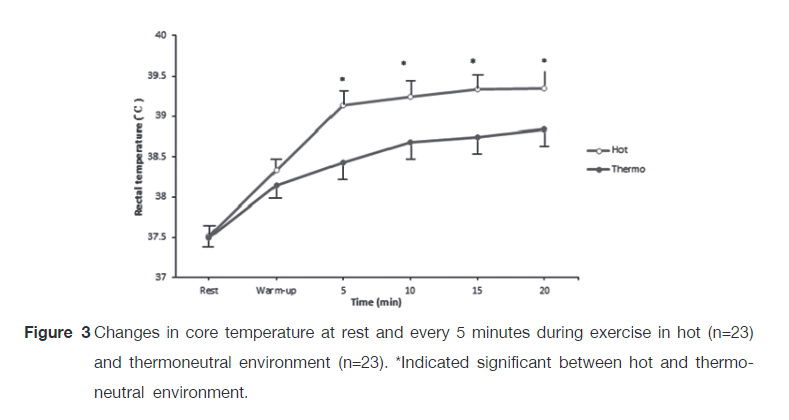
วิธีดำเนินการวิจัย ในงานวิจัยนี้ทำการศึกษาในชายสุขภาพดีทั้งหมด 23 คน โดยผู้เข้าร่วมงานวิจัยทำการออกกำลังกายโดยการปั่นจักรยานเป็นระยะเวลา 20 นาทีทั้งในที่ร้อน(อุณหภูมิ 31-33 องศา ความชื้นสัมพันท์ 60 %) และในที่อุณหภูมิปกติ (อุณหภูมิ 23-25 องศาความชื้นสัมพันท์ 50 %) โดยใช้ตัวชี้วัด คือ ความมั่นคงในการทรงตัวภายหลังการกระโดดขาเดียว Dynamic postural stability (DPSI) ส่วนในการแยกลักษณะของการเมื่อยล้าจากการออกกำลังกายในที่ร้อนเปรียบเทียบกับในอุณหภูมิปกติจะใช้ตัวชี้วัด Integrated electromyography/ Compound muscle action potential (iEMG/CMAP) ในกล้ามเนื้อน่องส่วน lateral (lateral gastrocnemius) ก่อนและหลังการออกกำลังกาย
ผลการวิจัย ข้อมูลจากการวิจัย พบว่า DPSI ภายหลังจากการออกกำลังกายในที่ร้อน (0.99 ± 0.15) มีค่าสูงกว่าอย่างมีนัยสำคัญทางสถิติ (P ≤ 0.05) เมื่อเปรียบเทียบกับการออกกำลังกายในอุณหภูมิปกติ (0.48 ± 0.10) และพบว่า iEMG ในที่ร้อนลดลงอย่างมีนัยสำคัญทางสถิติเมื่อเปรียบเทียบกับที่อุณหภูมิปกติ แต่ไม่พบความแตกต่างของ CMAP
สรุปผลการวิจัย ผลของการเมื่อยล้าจากการออกกำลังกายในที่ร้อนส่งผลเสียต่อความมั่นคงในการทรงตัวแบบไดนามิกมากกว่าในอุณหภูมิปกติ ในทิศทาง anterior-posterior และลักษณะของการเมื่อยล้าเป็นการเมื่อยล้าจากส่วนกลาง
Article Details
เอกสารอ้างอิง
Sell, TC. (2012). An examination, correlation, and comparison of static and dynamic measures of postural stability in healthy, physically active adults. Physical therapy in sport: official journal of the Association of Chartered Physiotherapists in Sports Medicine, 13(2), 80-6.
Conforto, S., Schmid, M., Camomilla, V., D'Alessio, T., Cappozzo, A. (2001). Hemodynamics as a possible internal mechanical disturbance to balance. Gait & posture, 14(1), 28-35.
Bigland-Ritchie, B., and Woods, JJ. (1984). Changes in muscle contractile properties and neural control during human muscular fatigue. Muscle & nerve, 7(9), 691-9.
Riemann, BL., Caggiano, NA., Lephart SM. (1999). Examination of a Clinical method of Assessing Postural Control during a Functional Performance Task. Journal of Sport Rehabilitation, 8(3), 171-83.
Golding, L.A., Myers, C.R., Sinning, W.E. (1989). The complete guide to fitness and instruction 3rdEd. Champaign, IL: Human Kinetics.
Paillard, T. (2012). Effects of general and local fatigue on postural control: a review. Neuroscience and biobehavioral reviews, 36(1), 162-76.
Lundin,T.M., Feuerbach, J.W., Grabiner, M.D. (1993). Effect of plantarflexor and dorsiflexor fatigue on unilateral postural control. J.ApplBiomech, 9,191-201.
Nybo, L., and Nielsen, B. (2001). Hyperthermia and central fatigue during prolonged exercise in humans. Journal of applied physiology, 91(3), 1055-60.
Nybo, L. (2008). Hyperthermia and fatigue. Journal of applied physiology, 104(3), 871-8.
Harkins, K.M., Mattacola, C.G., Uhl, T.L, Malone, T.R., McCrory, J.L. (2005). Effects of 2 ankle fatigue models on the duration of postural stability dysfunction. Journal of Athletic Training, 40,191-196.
Wikstrom, E.A., Tillman, M.D., Smith, A.N., Borsa, P.A. (2005). A new force-plate technology measure of dynamic postural stability: the dynamic postural stability index. Journal of Athletic Training, 40,305-309.
Maxwell, NS., Castle, PC., Spencer, M. (2008). Effect of recovery intensity on peak power output and the development of heat strain during intermittent sprint exercise while under heat stress. Journal of science and medicine in sport, 11(5), 491-9.
Salavati, M., Moghadam, M., Ebrahimi, I., Arab, AM. (2007). Changes in postural stability with fatigue of lower extremity frontal and sagittal plane movers. Gait & posture, 26(2), 214-8.
Kent-Braun, JA. (1999). Central and peripheral contributions to muscle fatigue in humans during sustained maximal effort. European Journal of Applied Physiology and Occupational Physiology, 80(1), 57-63.
Bigland-Ritchie, B., Johansson, R., Lippold, OC., Woods, JJ. (1983). Contractile speed and EMG changes during fatigue of sustained maximal voluntary contractions. Journal of neurophysiology, 50, 313-324.
Caron, O., Gelat, T., Rougier, P., Blanchi, JP. (2000). A comparative analysis of the center of gravity and center of pressure trajectory path lengths in standing posture: an estimation of active stiffness. Journal of applied biomechanics, 16(3), 234-47.
Enoka, RM., and Stuart, DG. (1992). Neurobiology of muscle fatigue. Journal of applied physiology, 72(5), 1631-48.
Enoka, RM. (2002). Neuromechanices of human movement 3rd edition. Journal of Applied Physiology, 386-9.
Fuglevand, AJ., Winter, DA., Patla, AE. (1993). Models of recruitment and rate coding organization in motor-unit pools. Journal of neurophysiology, 70(6), 2470-88.
Glossary of terms for thermal physiology. (1987). Second edition. Revised by The Commission for Thermal Physiology of the International Union of Physiological Sciences (IUPS Thermal Commission). Pflugers Archiv, European journal of physiology, 410(4-5), 567-87.
Miller, RG., Giannini, D., Milner-Brown, HS., Layzer, RB., Koretsky, AP., Hooper, D., Weiner, MW. (1987). Effects of fatiguing exercise on high-energy phosphates, force, and EMG: evidence for three phases of recovery. Muscle & nerve, 10(9), 810-21.
Montain, SJ., Sawka, MN., Cadarette, BS., Quigley, MD., McKay, JM. (1994). Physiological tolerance to uncompensable heat stress: effects of exercise intensity, protective clothing, and climate. Journal of applied physiology, 77(1), 216-22.
Nybo, L., Secher, NH. (2004). Cerebral perturbations provoked by prolonged exercise. Progress in neurobiology, 72(4), 223-61.
Scott, E., Ross, M., Kevin, M. Guskiewicz. (2003). Time to Stabilization: A Method for Analyzing Dynamic Postural Stability. Athletic Therapy Today, 8(3), 37-9.
