
ผลของท่าทางในขณะใช้งานแท็บเล็ตต่ออาการปวดและการทำงานของกล้ามเนื้อในคนทำงานสำนักงาน
Article Sidebar
Main Article Content
บทคัดย่อ
วัตถุประสงค์ เพื่อศึกษาอาการปวดและคลื่นไฟฟ้ากล้ามเนื้อคอ บ่า หลังส่วนบนและแขนส่วนล่าง เมื่อใช้ Tablet 20 นาทีในท่าวางบนตัก วางราบบนโต๊ะ และวางบนแท่นรองรับบนโต๊ะ
วิธีดำเนินการวิจัย ผู้เข้าร่วมการศึกษาเป็นเพศหญิงอายุ 30-50 ปี จำนวน 25 คน สุ่มลำดับการใช้งาน 3 ท่าทาง ก่อนทำการเก็บข้อมูลผู้เข้าร่วมการวิจัยจะถูกซักถามเกี่ยวกับระดับอาการปวด ให้ระบุระดับความรุนแรงและตำแหน่งของอาการปวดทันทีบนเครื่องมือ Visual analog scale (VAS) และ Body pain chart ตามลำดับ ภายหลังการใช้งานแท็บเล็ต 20 นาที วัดคลื่นไฟฟ้ากล้ามเนื้อ (Electromyography-EMG) ที่กล้ามเนื้อ Cervical erector spinae-CES, Upper trapezius-UT, Middle trapezius-MT และ Wrist extensor-WT ทำการคำนวณค่า Normalization ของค่า EMG ภายหลังจากขบวนการ Rectify และ Smooth ของ EMG กล้ามเนื้อ การเปรียบเทียบระดับอาการปวดก่อนและหลังการใช้งานจะใช้สถิติ Paired-t-test และ การเปรียบเทียบระดับอาการปวดและ EMG ระหว่าง 3 ท่าทางจะใช้สถิติ One way ANOVA repeated measure
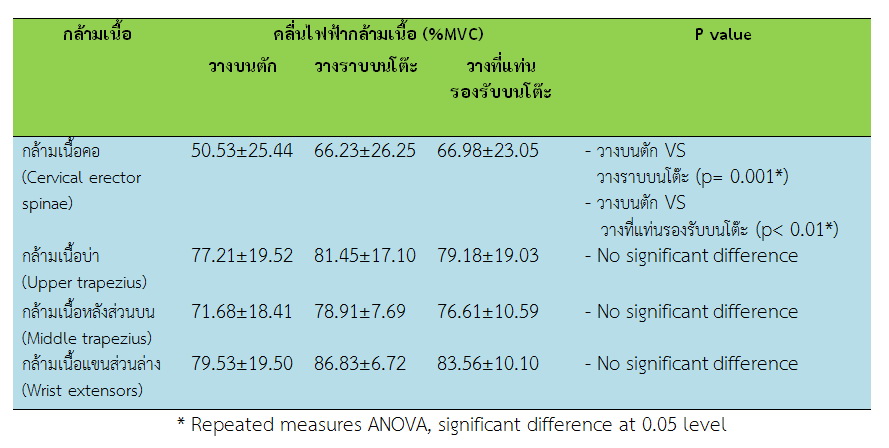
ผลการวิจัย การใช้ Tablet 20 นาที ทำให้ปวดคอและบ่าเพิ่มขึ้นกว่าก่อนใช้งานอย่างมีนัยสำคัญทางสถิติ (p<0.05) ใช้งาน75 ครั้งทำให้เกิดปวดคอ (32 ครั้ง) และบ่า (21 ครั้ง) ตามลำดับ ท่าวางบนตักทำให้ปวดคอมากกว่าท่าทางวางที่แท่นรองรับบนโต๊ะอย่างมีนัยสำคัญทางสถิติ (p<0.05) (วางบนตัก=2.97±0.63, วางบนแท่นรองรับบนโต๊ะ=1.30±0.45 – เต็ม 10 คะแนน) ประมาณ 60-72% ของผู้ใช้งานมีอาการปวดเกิดขึ้นตำแหน่งหนึ่งของร่างกายหลังการใช้ Tablet 20 นาที EMG ของกล้ามเนื้อคอ-CES ในท่าวางบนตัก (50.53±25.44%MVC) แตกต่างจากท่าวางราบบนโต๊ะ (66.23±26.25%MVC) และวางบนแท่นรองรับบนโต๊ะ (66.98±23.05%MVC)
สรุปผลการวิจัย คนทำงานสำนักงานเมื่อใช้ Tablet 20 นาทีทำให้เกิดอาการปวดเกิดขึ้นที่บริเวณคอและบ่ามากที่สุด และท่าวาง Tablet บนตักทำให้เกิดอาการปวดคอระดับสูงที่สุด
Article Details
เอกสารอ้างอิง
Ayanniyi, O., Ukpai, B.O., and Adeniyi, A.F. (2010). Differences in prevalence of self-reported musculoskeletal symptoms among computer and non-computer users in a Nigerian population: a cross-sectional study. BMC Musculoskelet Disord, 6(11), 177-86.
Ekstrom, R.A., Soderberg, G.L., and Donatelli, R.A. (2005). Normalization procedures using maximum voluntary isometric contractions for the serratus anterior and trapezius muscles during surface EMG analysis. Journal of Electromyography and Kinesiology, 15(4), 418-428.
Fricton, J.R. (1994). Myofascial pain. Baillieres Clin Rheumatol, 8(4), 857-80.
Gold, J.E., Driban, J.B., Yingling, V.R., et al (2012). Characterization of posture and comfort in laptop users in non-desk settings. Applied Ergonomics, 43(2), 392-401.
Greig, A.M., Straker, L.M., and Briggs, A. (2005). Cervical erector spinae and upper trapezius muscle activity in children using different information technologies. Physiotherapy, 19 (2), 119-26.
Hakala, P.T., Saarni, L.A., Punamaki, R.L., Wallenius, M.A., Nygard, C.H., and Rimpela, A.H. (2012). Musculoskeletal symptoms and computer use among Finnish adolescents--pain intensity and inconvenience to everyday life: a cross-sectional study. BMC Musculoskelet Disord, 13(41), 41-8.
Hansraj, K. (2014). A neurosurgeon Assessment of stresses in the cervical spine caused by posture and position of the head. Surgical Technology International, 25, 277-9.
Intolo, P., Wongwech, G., Wisiasut, P., et al. (2012). An analysis of neck and shoulder posture, muscle activity relative to pain during computer uses at Japanese style table, sofa and bed. Proceeding of Human factor and Ergonomics Society Europe Chapter. 2012 Oct 10-12, Toulouse, France.
Intolo, P., Kaewroongreaung, D., Rushaneepun, O., et al (2013). An analysis of pain, muscle activity and fatigue of neck, shoulder and forearm muscles during using Tablet on the lap, on the table and in a case set. Proceeding of Human Factors and Ergonomic Society of Australia; 2013 Dec 2-4, Perth, Australia.
Intolo, P., Sirininlakul, N., Saksanit, N., Kongdontree, P., and Thuwatorn, P. (2016). Pain and muscle activity of neck, shoulder, upper back and arm during Smartphone use with holding on the lap level, on the chest level and on the table in university students. Journal of Health Systems Research, 3, 351-60.
Kimura, M., Sato, H., Ochi, M., et al. (2007). Electromyogram and perceived fatigue changes in the trapezius muscle during typewriting and recovery. Eur J Appl Physiol, 100(1), 89-96.
Maslen, B. and Straker, L. (2009). A comparison of posture and muscle acitivity means and variation amongst young children, older children and young adults whilst working with computers. Work, 32(3), 311-320.
Marcus, M., Gerr, F., Monteilh, C., Ortiz, D.J., Gentry, E., Cohen, S., Edwards, A., Ensor, C., and Kleinbaum, D. (2002). A prospective study of computer users: II. Postural risk factors for musculoskeletal symptoms and disorders. Am J Ind Med, 41(4), 236–249.
Ning, X., Huang, Y., Hu, B., and Nimbarte,A. (2015). Neck kinematics and muscle activity during mobile device operations. International Journal of Industrial Ergonomics. 48, 10-5.
Robbins, M., Johnson, I.P., and Cunliffe, C. (2009). Encouraging good posture in school children using computers. Clinical Chiropractic, 12(1), 35-44.
Sharan, D., Mohandos,s M., Ranganathan, R., et al. (2014). Distal upper extremity disorders due to extensive usage of hand held mobile device. Human Factors in organizational design and management –XI Nordic ergonomics society annual conference. 46, 1041-1045.
Straker, L., Pollock, C., and Burgess-Limerick, R. (2006). Excerpts from CybErg 2005 discussion on preliminary guidelines for wise use of computers by children. International Journal of Industrial Ergonomics, 36(12), 1089-1095.
Straker, L., Pollock, C., Burgess-Limerick, R., Skoss, R., and Coleman, J., (2008b). The impact of computer display height and desk design on muscle activity during information technology work by young adults. J Electromyogr Kinesiol, 18(4), 606-617.
Straker, L., Pollock, C., and Burgess-Limerick, R. (2006). Excerpts from CybErg 2005 discussion on preliminary guidelines for wise use of computers by children. International Journal of Industrial Ergonomics, 36(12), 1089-1095.
Straker, L., Pollock, C., Burgess-Limerick, R., et al (2008). The impact of computer display height and desk design on muscle activity during information technology work by young adults. J Electromyogr Kinesiol, 18(4), 606-16.
Toh, S.H, Coenen, P., Howie, E.K., Straker, L.M. (2017) The associations of mobile touch screen device use with musculoskeletal symptoms and exposures: A systematic Review. PLOS. August 7. 1-22.
White, T. (2013). Tablet trump Smartphone in global website traffic. Retrieved March 11, 2013 from Website: https://blogs.adobe.com/digitalmarketing/digital-marketing/tablets-trump-smartphones-in-global-website-traffic/.
Waderich, K., Peper, E., Harvey, R., Sutter S. (2013). The psychophysiology of contemporary information technologies-Tablets and smart phones can be a pain in the neck. The 44th Annual Meeting of the Association for Applied Psychophysiology and Biofeedback. Portland, OR. USA
Yassierli, Y, Juraida, A (2016) Effects of Netbook and Tablet Usage Postures on the Development of Fatique, Discomfort and Pain. J. Eng. Technol. Sci, 40(3), 245-53.
Young, J.G., Trudeau, M., Odell, D., et al. (2012). Touch-screen tablet user configurations and case-supported tilt affect head and neck flexion angles. Work, 41(1), 81-91.
Young, J.G., Trudeau, M.B., Odell, D., Marinnelli, K., Dennerlein, J.T. (2013) Wrist and shoulder posture and muscle activity during touch-screen tablet use: Effects of usage configuration,tablet type, and interacting hand. Work 45(1), 59-71.
