ผลการฝึกมวยไทยต่อการระบายอากาศสูงสุดของผู้ที่มีภาวะอ้วน
Article Sidebar
Main Article Content
บทคัดย่อ
วัตถุประสงค์ เพื่อศึกษาผลการฝึกมวยไทยต่อการระบายอากาศสูงสุดในผู้ที่มีภาวะอ้วนระดับที่หนึ่ง
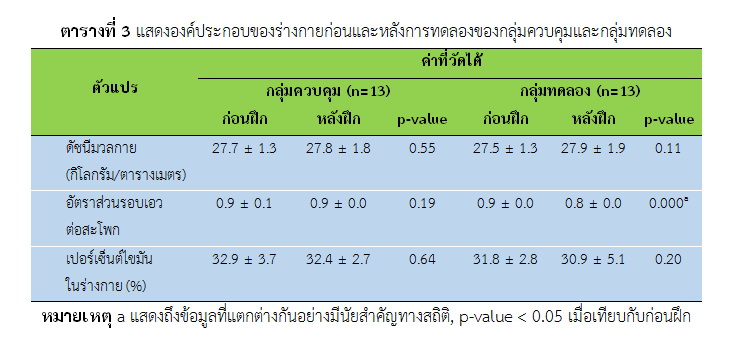
วิธีดำเนินการวิจัย กลุ่มตัวอย่างเป็นอาสาสมัครภาวะอ้วนระดับที่หนึ่ง จำนวน 26 คน (เพศชาย จำนวน 6 คน และเพศหญิง จำนวน 20 คน) ได้รับการสุ่มตัวอย่างแบบง่ายด้วยระบบคอมพิวเตอร์ออกเป็น 2 กลุ่ม คือกลุ่มควบคุม จำนวน 13 คน อายุเฉลี่ย 20.7±1.4 ปี ค่าดัชนีมวลกายเฉลี่ย 27.6±1.2 กิโลกรัมต่อตารางเมตร และกลุ่มทดลอง (มวยไทย) จำนวน 13 คน อายุเฉลี่ย 20.2±1.1 ปี ค่าดัชนีมวลกาย 27.5±1.3 กิโลกรัมต่อตารางเมตร ได้รับการวัดค่าการระบายอากาศสูงสุดจากการทดสอบด้วยจักรยานวัดงานแบบเพิ่มความหนักก่อนเข้าโปรแกรมและหลังสัปดาห์ที่ 8 โดยกลุ่มควบคุม ดำเนินชีวิตประจำวันตามปกติในช่วงระยะเวลา 8 สัปดาห์ และกลุ่มทดลอง (มวยไทย) ได้รับการฝึกตามโปรแกรมมวยไทย ที่ระดับความหนักร้อยละ 89±4 ของอัตราการเต้นหัวใจสูงสุด ช่วงชกเป็นเวลา 3 นาที สลับกับพักเป็นเวลา 4 นาทีต่อยก จำนวน 2-5 ยกต่อครั้ง ระยะเวลา 54-75 นาทีต่อวัน 3 วันต่อสัปดาห์ เป็นระยะเวลาทั้งหมด 8 สัปดาห์ วิเคราะห์ข้อมูลทางสถิติด้วย mixed model ANOVA ระดับนัยสำคัญทางสถิติที่ p-value<0.05 ทั้งนี้โครงการวิจัยได้ผ่านการพิจารณาและรับรองจากคณะกรรมการจริยธรรมเกี่ยวกับการวิจัยในมนุษย์ มหาวิทยาลัยนเรศวร (เลขที่ 242/2017 วันที่ 11 ตุลาคม 2560) เป็นที่เรียบร้อย
ผลการวิจัย ก่อนการฝึก อาสาสมัครทั้งสองกลุ่มมีค่าการระบายอากาศสูงสุดไม่แตกต่างกัน หลังการทดลองครบ 8 สัปดาห์ พบว่ากลุ่มทดลอง (ฝึกมวยไทย) มีค่าการระบายอากาศสูงสุดมากกว่ากลุ่มควบคุมอย่างมีนัยสำคัญทางสถิติที่ระดับ 0.05 (กลุ่มทดลอง = 81.9±23.1 ลิตรต่อนาที และกลุ่มควบคุม = 60.1±19.2 ลิตรต่อนาที) รวมทั้งกลุ่มทดลอง (ฝึกมวยไทย) ยังมีค่าการระบายอากาศสูงสุดระหว่างก่อนการฝึกและหลังการฝึก 8 สัปดาห์ แตกต่างกันอย่างมีนัยสำคัญทางสถิติที่ระดับ 0.05 (ค่าก่อนฝึก 59.3±14.5 ลิตรต่อนาที และค่าหลังฝึก 81.9±23.1 ลิตรต่อนาที ตามลำดับ) อย่างไรก็ดี พบว่า กลุ่มควบคุมมีค่าการระบายอากาศสูงสุดระหว่างก่อนการฝึกและหลังการฝึก 8 สัปดาห์ ไม่แตกต่างกันอย่างมีนัยสำคัญทางสถิติที่ระดับ 0.05
สรุปผลการวิจัย การฝึกมวยไทยในระยะเวลา 8 สัปดาห์ สามารถเพิ่มค่าการระบายอากาศสูงสุดในอาสาสมัครที่มีภาวะอ้วนระดับที่หนึ่งได้
Article Details
เอกสารอ้างอิง
American College of Sports Medicine. (1998). American College of Sports Medicine Position Stand. The recommended quantity and quality of exercise for developing and maintaining cardiorespiratory and muscular fitness, and flexibility in healthy adults. Med Sci Sports Exerc, 30(6), 975-991.
American College of Sports Medicine. (2010). ACSM’s guidelines for exercise testing and prescription (8 ed.). Philadelphia: Lippincott Williams & Wilkins.
Arseneau, E., Mekary, S., & Leger, L. A. (2011). VO(2) requirements of boxing exercises. J Strength Cond Res, 25(2), 348-359.
Boutcher, S. H. (2011). High-intensity intermittent exercise and fat loss. J Obes, 2011, 1-10.
Chaiut., W., Paungmali., A., & Sitilertpisan., P. (2014). Effects of aerobic exercise with core muscle training on cardiopulmonary system in healthy individuals. Journal of Sports Science and Technology, 14(2), 91-103.
Chaiwanichsiri, D. (2010). Rehabilitation medicine. Bangkok: Department of Rehabilitation Medicine Faculty of Medicine Chulalongkorn University.
Cheema, B. S., Davies, T. B., Stewart, M., Papalia, S., & Atlantis, E. (2015). The feasibility and effectiveness of high-intensity boxing training versus moderate-intensity brisk walking in adults with abdominal obesity: a pilot study. BMC Sports Sci Med Rehabil, 7(3), 1-8.
Crisafulli, A., Vitelli, S., Cappai, I., Milia, R., Tocco, F., Melis, F., & Concu, A. (2009). Physiological responses and energy cost during a simulation of a Muay Thai boxing match. Appl Physiol Nutr Metab, 34(2), 143-150.
Ghouse, M. S., Surekha.B.Barwal, & Amruta.S.Wattamwar. (2016). A Review on Obesity. Health Science Journal, 10(4.13), 1-5.
Hebisz, P., Hebisz, R., Zaton, M., Ochmann, B., & Mielnik, N. (2016). Concomitant application of sprint and high-intensity interval training on maximal oxygen uptake and work output in well-trained cyclists. Eur J Appl Physiol, 116(8), 1495-1502.
Kumar, P., & Bin-Jaliah, I. (2007). Adequate stimuli of the carotid body: more than an oxygen sensor? Respir Physiol Neurobiol, 157(1), 12-21.
Lorenzo, S., & Babb, T. G. (2013). Ventilatory responses at peak exercise in endurance-trained obese adults. Chest, 144(4), 1330-1339.
Luo, B. B., Yang, Y., Nieman, D. C., Zhang, Y. J., Wang, J., Wang, R., & Chen, P. J. (2013). A 6-week diet and exercise intervention alters metabolic syndrome risk factors in obese Chinese children aged 11-13 years. Journal of Sport and Health Science, 2(4), 236-241.
Maciejczyk, M., Szymura, J., Gradek, J., Cempla, J., & Wiecek, M. (2014). Physiological response is similar in overweight and normoweight boys during cycling: a longitudinal study. Acta Physiol Hung, 101(2), 236-249.
Nourry, C., Deruelle, F., Guinhouya, C., Baquet, G., Fabre, C., Bart, F., Mucci, P. (2005). High-intensity intermittent running training improves pulmonary function and alters exercise breathing pattern in children. Eur J Appl Physiol, 94(4), 415-423.
Pansayad, W. (2012). Obesity in working age. Academic Journal Institute of Physical Education, 4(1), 165 - 174.
Plowman., S. A., & Smith., D. L. (2008). Exercise physiology for health, fitness, and performance. Philadelphia, Pa. : Wolters Kluwer/Lippincott Williams & Wilkins.
Powers., S. K., & Howley., E. T. (2015). Exercise physiology : theory and application to fitness and performance. New York: McGraw-Hill.
Salome, C. M., King, G. G., & Berend, N. (2010). Physiology of obesity and effects on lung function. J Appl Physiol (1985), 108(1), 206-211.
Sharp, J. T., Henry, J. P., Sweany, S. K., Meadows, W. R., & Pietras, R. J. (1964). The Total Work of Breathing in Normal and Obese Men. J Clin Invest, 43, 728-739.
Susan A. Goldstein, Charles Weissman, Jeffrey Askanazi, Michael Rothkopf, J. Milic-Emili, & Kinney, J. M. (1987). Metabolic and ventilatory responses during very low level exercise. Clinical Science, 73(4), 417-424.
Tawonrungrojn, S. (2011). Indicators and Their Range of Values to Indicate Obesity. Songkla Med J, 9(2), 89-96.
Wongkritpetch, T. (2012). Physiology of Exercise. Bangkok: Tiranasan.
Yodit, C. (2010). Thai Boxing The Encyclopedia of Thai Youth Volume 35 (pp. 243-250). Bangkok: Dan Sutha Printing.
