การฝึกเกมสนามเล็กในกีฬาฟุตบอล
Article Sidebar
Main Article Content
บทคัดย่อ
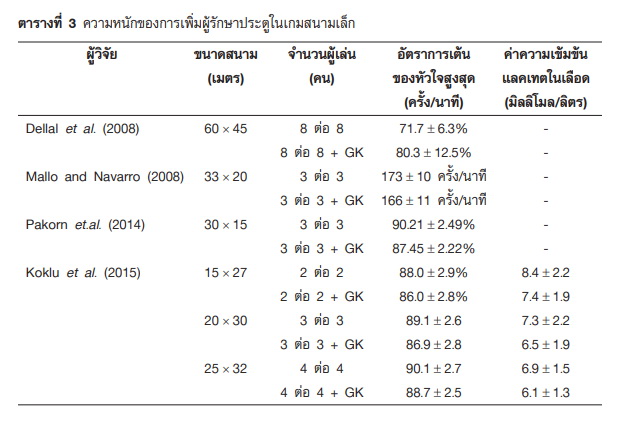
ฟุตบอล (soccer) เป็นกีฬาที่ได้รับความนิยมทั้งเยาวชน และผู้ใหญ่เป็นอย่างมาก ทั้งในประเทศและต่างประเทศ โดยปัจจุบันประเทศไทยได้มีการแข่งขันฟุตบอลอาชีพ และได้ส่งทีมแข่งขันในระดับนานาชาติ โดยรับการรับรองการแข่งขันจากสหพันธ์ฟุตบอลนานาชาติ (Federation International of Football Association : FIFA) กีฬาฟุตบอลเป็นกิจกรรมที่มีความหนักค่อนข้างสูงและไม่ต่อเนื่อง (intermittent exercise) โดยระยะทางในการเคลื่อนที่โดยเฉลี่ยของนักกีฬาฟุตบอลระดับอาชีพ อยู่ที่ประมาณ 10-12 กิโลเมตร ดังนั้นการฝึกซ้อมจึงเป็นสิ่งสำคัญสำหรับนักฟุตบอล โดยรูปแบบการฝึกของกีฬาฟุตบอลมีหลากหลายแบบ เช่น การวิ่งหนักสลับเบา (Interval Training) หรือเกมสนามเล็กที่เป็นการเล่นที่สอดคล้อง สถานการณ์จริงของกีฬาฟุตบอล การฝึกเกมสนามเล็ก (Small-Sided Game) เป็นทางเลือกหนึ่งในการฝึกซ้อมกีฬาฟุตบอล โดยเกมสนามเล็กเป็นการฝึกความอดทนแบบใช้ออกซิเจนที่เฉพาะเจาะจงกับกีฬาฟุตบอล โดยบทความฉบับนี้ เป็นรวบรวมข้อมูลการฝึกเกมสนามเล็กในรูปแบบต่างๆ รวมทั้งผลที่มีต่อสรีรวิทยาการออกกำลังกายของนักฟุตบอล ได้แก่ จำนวนผู้เล่นในเกมสนามเล็ก ขนาดสนามในเกมสนามเล็ก การเพิ่มผู้รักษาประตู ในเกมสนามเล็ก การกำหนดความหนักจากกฎระเบียบในการเล่น และระยะเวลาในการฝึก ที่ส่งผลต่อความหนักในการออกกำลังกายหรือการฝึกในกีฬาฟุตบอล เพื่อให้ผู้ฝึกสอนและผู้ที่สนใจนำไปประยุกต์ใช้เพื่อให้เกิด ประสิทธิภาพสูงสุด
Article Details
เอกสารอ้างอิง
Abrantes CI., Nunes MI., Macas VM., Leite NM., Sampaio JE. (2012). Effects of the number of players and game type constraints on heart rate, rating of perceived exertion, and technical actions of small-sided soccer games. Journal of Strength & Conditioning Research, 26(4), 976-981.
Brandes M, Heitmann A, Müller L. (2012). Physical responses of different small-sided game formats in elite youth soccer players. Journal of Strength & Conditioning Research, 26(5), 1353-1360.
Buchheit M., Laursen PB., Kuhnle J., Ruch D., Renaud C., Ahmaidi S. (2009). Game-based training in young elite handball players. International Journal of Sports Medicine, 30(4), 251-258.
Casamichana D. and Castellano J. (2010). Time-motion, heart rate, perceptual and motor behavior demands in small-sides soccer games: effects of pitch size. Journal of Sports Science, 28(14), 1615-1623.
Christopher J., Beato M., Hulton AT. (2016) Manipulation of exercise to rest ratio within set duration on physical and technical outcomes during small-sided games in elite youth soccer players. Human Movement Science. August 48:1-6.
Da Silva CD., Impellizzeri FM., Natali AJ., De Lima JRP., Bara-Filho MG., Silami-Garcxia E. and Marins, JCB. (2011). Exercise intensity and technical demands of small-sided games in young Brazilian soccer players: effect of number of players, maturation, and reliability. Journal of Strength & Conditioning Research, 25(10), 2746-2751.
Dellal A. Chamari K. Pintus A. Girard O. Cotte T. and Keller D. (2008). Heart rate responses during small-sided and short intermittent running training in elite soccer players: a comparative study. Journal of Strength & Conditioning Research, 22(5), 1449-1457.
Duarte R., Batalha N., Folgado H., Sampaio J. (2009). Effects of exercise duration and number of players in heart rate responses and technical skills during Futsal smallsided games. Open Sports Science Journal, 2, 37-41.
Fradua L., Zubillaga A., Caro O., FernándezGarcía AI., Ruiz-Ruiz C. and Tenga A. (2013). Designing small-sided games for training tactical aspects in soccer: Extrapolating pitch sizes from full-size professional matches. Journal of Sports Sciences, 31(6), 573-581.
Halouani J, Chtourou H, Dellal A et al. (2017). The effects of game types on intensity of small-sided games among pre-adolescent youth football players. Biol Sport. 34(2): 157-162.
Halouani J, Chtourou H, Dellal A, Chaouachi A, Chamari K. (2017). Soccer small-sided games in young players: rule modification to induce higher physiological responses. Biol Sport. 34(2):163-168.
Iaia FM., Rampinini E., Bangsbo J. (2009). High-intensity training in football. International Journal of Sports Physiology and Performance, 4(3), 291-306.
Impellizzeri FM., Marcora SM., Castagna C., Reilly T., Sassi A., Iaia FM., Rampinini E. (2006). Physiological and performance effects of generic versus specific aerobic training in soccer players. International Journal of Sports Medicine, 27, 483-492.
Jake K. Ngo., Man-Chung Tsui., Andrew W. Smith., Christopher Carling., Gar-Sun Chan and Del P.
Wong. (2012). The effects of man-marking on work intensity in small-sided soccer games. Journal of Sports Science and Medicine. 11, 109-114.
Jensen J.M., Randers M.B., Krustrup P., and Bangsbo J. (2007). Effect of additional in-season aerobichigh-intensity drills on physical fitness of elite football players. Journal of Sports Science & Medicine, Suppl 10, 79.
Jones S. and Drust B. (2007). Physiological and technical demands of 4 v 4 and 8 v 8 games in elite youth soccer players. Kinesiology, 39(2), 150-156.
Koklu Y. (2012). A Comparison of Physiological Responses To Various Intermittent And Continuous Small-Sided Games In Young Soccer Players. Journal of Human Kinetics. 31(1):89-96. March 2012
Koklu Y., Albayrak M., H. Keysan, U. Alemdaroglu and A. Dellal. (2013). Improvement of the physical conditioning of young soccer players across small-sided games using different pitch size – special reference on physiological responses. Kinesiology, 45(1), 41-47.
Koklu Y., Asxcxi A., Kocxak FU.,Alemdaroglu U. and Dundar U. (2011). Comparison of the physiological responses to different small-sided games in elite young soccer players. Journal of Strength & Conditioning Research, 25(6), 1522–1528.
Köklü Y, Sert Ö, Alemdaroğlu U, Arslan Y. (2015). Comparison of the physiological responses and time-motion characteristics of young soccer players in small-sided games: the effect of goalkeeper. Journal
of Strength & Conditioning Research, 29(4):964-71.
Mallo J. and Navarro E. (2007). Physical load imposed on soccer players during smallsided training games. The Journal of Sports Medicine and Physical Fitness, 47, 166-171.
Malone Shane., Hughes Brian., Collins Kieran. (2019). The influence of eexercise-to-rest ratios on physical and physiological performance during hurling-specific small-sided games. The Journal of Strength & Conditioning Research. 33(1), 180-187.
Manolopoulos E., Kalapotharakos VI., Ziogas G., Mitrotasios M., Spaneas KS. (2012). Heart rate responses during Small-Sided Soccer Games. Journal of Sports Medicine & Doping Studies, 2, 108.
Pakorn C., Niromlee M., Ratree R. (2014). Physiological responses and technical skills during 3 VS 3 small-sided games with different protocol in futsal players. Journal of Sport Science and Technology, 14(2), 65-73.
Stolen T., Chamari K., Castagna C., Wisloff U. (2005). Physiology of soccer : An Update. Journal of Sports Science & Medicine, 35(6), 501-536.
Owen AL., Wong DP., Paul D. and Dellal A. (2012). Effects of a periodized small-sided game training intervention on physical performance in elite professional soccer. Journal of Strength &Conditioning Research, 26(10), 2748-2754.
Rampinini E., Impellizzeri FM., Castagna C., Abt G., Chamari K., Sassi A. and Marcora SM. (2007). Factors influencing physiological responses to small-sided soccer games. Journal of Sports Science, 25(6), 659-666.
Zois J., Bishop DJ., Ball K., Aughey RJ. (2011). High-intensity warm-ups elicit superior performance to a current soccer warm-up routine. Journal of Science and Medicine in Sport, 14(6), 522-528.
