การเปรียบเทียบผลระหว่างการนอนหงายยกขาสูงและการนอนหงายต่อการฟื้นตัวของกล้ามเนื้อข้อเข่าภายหลังการออกกำลังกายแบบพลัยโอเมตริกในชายสุขภาพดีที่มีกิจกรรมทางกายระดับต่ำ
Article Sidebar
Main Article Content
บทคัดย่อ
วัตถุประสงค์ การวิจัยครั้งนี้ มีวัตถุประสงค์เพื่อเปรียบเทียบผลระหว่างการนอนหงายยกขาสูงและการนอนหงายต่อการฟื้นตัวของกล้ามเนื้อข้อเข่าภายหลังการออกกำลังกายแบบพลัยโอเมตริก
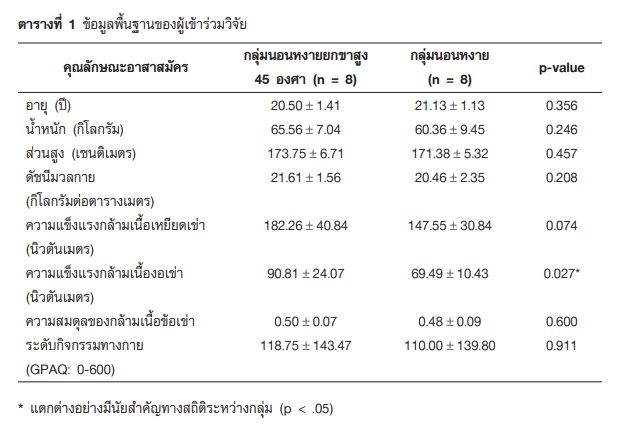
วิธีดำเนินการวิจัย ชายสุขภาพดีที่มีกิจกรรม ทางกายระดับต่ำ จำนวน 16 คน ถูกสุ่มให้อยู่ในท่านอนหงายยกขาสูง 45 องศา หรือท่านอนหงาย 30 นาทีต่อวัน จำนวน 5 วัน หลังการกระโดดดร็อบจัมพ์ จำนวน 100 ครั้ง จากความสูง 0.6 เมตร เพื่อทำให้กล้ามเนื้อระบม โดยดัชนีชี้วัดทางอ้อมของกล้ามเนื้อระบม (ระดับความเจ็บปวด, ความแข็งแรงของกล้ามเนื้อ และความสมดุลของกล้ามเนื้อข้อเข่า) ถูกวัดซ้ำก่อน และหลังออกกำลังกายเป็นเวลา 24, 48, 72 และ 96 ชั่วโมง
ผลการวิจัย ความแข็งแรงของกล้ามเนื้อเหยียดเข่าภายหลัง 96 ชั่วโมงในกลุ่มนอนหงายยกขาสูง มีความแตกต่างอย่างมีนัยสำคัญทางสถิติ เมื่อเปรียบเทียบกับกลุ่มนอนหงาย (p<0.05) อย่างไรก็ตาม ไม่พบความแตกต่างของช่วงเวลาต่อตัวแปรระดับความเจ็บปวดและความสมดุลของกล้ามเนื้อข้อเข่าระหว่างกลุ่ม อย่างมีนัยสำคัญทางสถิติตลอดช่วงระยะของการฟื้นตัว (p > 0.05)
สรุปผลการวิจัย การฟื้นตัวด้วยการนอนหงาย ยกขาสูงมีแนวโน้มบรรเทาอาการกล้ามเนื้อเหยียดเข่าระบมหลังการออกกำลังกายแบบพลัยโอเมตริกได้ดีกว่าการนอนหงาย
Article Details
เอกสารอ้างอิง
Barak, O. F., Ovcin, Z. B., Jakovljevic, D. G., Lozanov-Crvenkovic, Z., Brodie, D. A., and Grujic, N. G. (2011). Heart rate recovery after submaximal exercise in four different recovery protocols in male athletes and non-athletes. Journal of Sports Science and Medicine, 10(2), 369-375.
Bogdanis, G. C. (2012). Effects of physical activity and inactivity on muscle fatigue. Frontiers in Physiology, 3, 142.
Chatzinikolaou, A., Fatouros, I. G., Gourgoulis, V., Avloniti, A., Jamurtas, A. Z., Nikolaidis, M. G., ... Taxildaris, K. (2010). Time course of changes in performance and inflammatory responses after acute plyometric
exercise. Journal of Strength and Conditioning Research, 24(5), 1389-1398.
Cheung, K., Hume, P., and Maxwell, L. (2003). Delayed onset muscle soreness : treatment strategies and performance factors. Sports Medicine, 33(2), 145-164.
Coghill, R. C., McHaffie, J. G., and Yen, Y. F. (2003). Neural correlates of interindividual differences in the subjective experience of pain. Proceedings of the National Academy of Sciences of the United States of America, 100(14), 8538-8542.
Connolly, D. A., Sayers, S. P., and McHugh, M. P. (2003). Treatment and prevention of delayed onset muscle soreness. Journal of Strength and Conditioning Research, 17(1), 197-208.
Ebbeling, C. B., and Clarkson, P. M. (1989). Exercise-induced muscle damage and adaptation. Sports Medicine, 7(4), 207-234.
Highton, J. M., Twist, C., and Eston, R. G. (2009). The Effects of exercise-induced muscle damage on agility and sprint running performance. Journal of Exercise Science and Fitness, 7(1), 24-30.
Jakeman, J. R., Byrne, C., and Eston, R. G. (2010). Lower limb compression garment improves recovery from exercise-induced muscle damage in young, active females. European Journal of Applied Physiology, 109(6), 1137-1144.
Kary, J. M. (2010). Diagnosis and management of quadriceps strains and contusions. Current Reviews in Musculoskeletal Medicine, 3(1-4), 26-31.
Larson, L. M., Smelter, R. M., Petrella, J. K., and Jung, A. P. (2013). The effect of active vs. supine recovery on heart rate, power output, and recovery time. International Journal of Exercise Science, 6(3), 180-187.
Liaw, M. Y., and Wong, M. K. (1989). [The effects of leg elevation to reduce leg edema resulting from prolonged standing]. Taiwan Yi Xue Hui Za Zhi. Journal of the Formosan Medical Association, 88(6), 630-634, 628.
Makaruk, H., and Sacewicz, T. (2011). The effect of drop height and body mass on drop jump intensity. Biology of Sport, 28(1), 63-67.
Marginson, V., Rowlands, A. V., Gleeson, N. P., and Eston, R. G. (2005). Comparison of the symptoms of exercise-induced muscle damage after an initial and repeated bout of plyometric exercise in men and boys. Journal of Applied Physiology (Bethesda, Md. : 1985), 99(3), 1174-1181.
Miyama, M., and Nosaka, K. (2004). Muscle damage and soreness following repeated bouts of consecutive drop jumps. Advances in Exercise and Sports Physiology, 10(3), 63-69.
Nuanjai, P., and Werasirirat, P. (2014). Comparison of effects between static stretching and petrissage massage on functional-sign of delayed onset muscle soreness of knee extensor following stimulated plyometric exercise in Thai male. Journal of Medical Technology and Physical Therapy, 26(2), 158-168.
Palanca, A. A., Yang, A., and Bishop, J. A. (2016). The effects of limb elevation on muscle oxygen saturation: a near-infrared spectroscopy study in humans. PM&R, 8(3), 221-224.
Peng, H.-T., Kernozek, T. W., and Song, C.-Y. (2011). Quadriceps and hamstring activation during drop jumps with changes in drop height. Physical Therapy in Sport, 12(3), 127-132.
Perrin, D. H. (1993). Isokinetic exercise and assessment. Champaign, IL: Human Kinetics
Publishers. Portes, E. M., Portes, L. A., Botelho, V. G., and Souza Pinto, S. (2007). Isokinetic torque peak and hamstrings/quadriceps ratios in endurance athletes with anterior cruciate ligament laxity. Clinics (Sao Paulo), 62(2), 127-132.
Rowlands, A. V., Eston, R. G., and Tilzey, C. (2001). Effect of stride length manipulation on symptoms of exercise-induced muscle damage and the repeated bout effect. Journal of Sports Sciences, 19(5), 333-340.
Safran, M. R., Seaber, A. V., and Garrett, W. E., Jr. (1989). Warm-up and muscular injury prevention. An update. Sports Medicine, 8(4), 239-249.
Stauber, W. T. (1989). Eccentric action of muscles: physiology, injury, and adaptation. Exercise and Sport Sciences Reviews, 17, 157-185.
Van den Bekerom, M. P. J., Struijs, P. A. A., Blankevoort, L., Welling, L., van Dijk, C. N., and Kerkhoffs, G. M. M. J. (2012). What is the evidence for rest, ice, compression, and elevation therapy in the treatment of ankle sprains in adults? Journal of Athletic Training, 47(4), 435-443.
