การวางแผนพัฒนาความแข็งแรง
Article Sidebar
Main Article Content
บทคัดย่อ
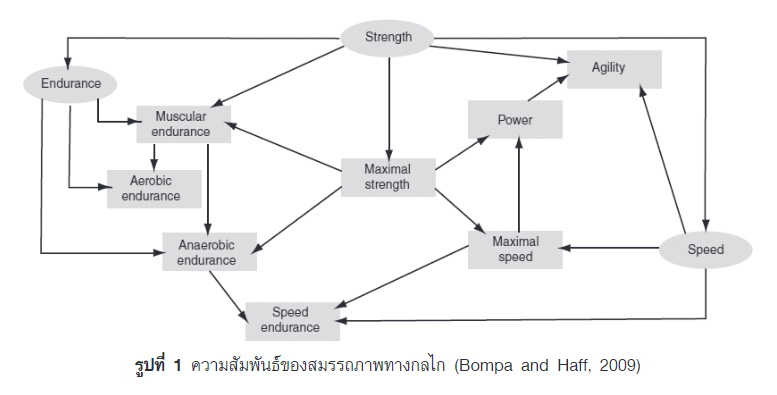
การวางแผนพัฒนาความแข็งแรงควรมีการวางแผนการฝึกซ้อมออกเป็นช่วง ได้แก่ ช่วงแรก คือ การเตรียมความพร้อมแบบทั่วไป และการเตรียมความพร้อมแบบเฉพาะเจาะจง ช่วงที่สอง คือ ช่วงเตรียมความพร้อมก่อนการแข่งขัน และช่วงสุดท้าย คือ ช่วงแข่งขันหลัก ซึ่งมีเป้าหมายเพื่อให้นักกีฬาสามารถ แสดงศักยภาพสูงสุดในขณะแข่งขัน การวางแผนพัฒนาความแข็งแรงเริ่มต้นด้วยการปรับตัวทางกายวิภาค ซึ่งอยู่ในช่วงเตรียมความพร้อมแบบทั่วไป เพื่อให้ร่างกายพร้อมสำหรับการฝึกที่หนักขึ้น การฝึกเพื่อเพิ่มขนาดของเส้นใยกล้ามเนื้ออาจจำเป็นหรือไม่จำเป็นขึ้นอยู่กับความต้องการของแต่ละชนิดกีฬา เป้าหมายหลักที่สำคัญของการวางแผนพัฒนาความแข็งแรงในช่วงเตรียมความพร้อมก่อนการแข่งขัน คือ การพัฒนาความแข็งแรงสูงสุดของนักกีฬา เพื่อเปลี่ยนผ่านเป็นพลังกล้ามเนื้อ ความอดทนของกล้ามเนื้อ หรือพลังอดทนของกล้ามเนื้อ ซึ่งสามารถนำไปใช้ในสถานการณ์การแข่งขันกีฬาจริง ดังนั้น ผู้ฝึกสอนควรมีความเข้าใจและจะต้องเลือกความหนักและท่าฝึกให้สอดคล้องกับการฝึกแต่ละช่วง สมรรถภาพทางกลไกของกีฬา แผนการแข่งขัน เพื่อให้นักกีฬาแสดงศักยภาพสูงสุดช่วงแข่งขัน
Article Details
เอกสารอ้างอิง
Alcaraz, P. E., Sánchez-Lorente, J., Blazevich, A. J. (2008). Physical Performance and Cardiovascular Responses to an Acute Bout of Heavy Resistance Circuit Training versus Traditional Strength Training. The Journal of Strength and Conditioning Research, 22(3), 667-671.
Albert, M. (1995). Eccentric Muscle Training in Sports and Orthopedics. New York: Churchill Livingstone. Bevan, H. R., Bunce, P. J., Owen, N. J., Bennett, M. A., Cook, C. J., Cunningham, D. J., and Kilduff, L. P. (2010). Optimal loading for the development of peak power output in professional rugby players. The Journal of Strength & Conditioning Research, 24(1), 43-47.
Bompa, T.O. (1993). Periodization of strength : the new wave in strength training. Toronto : Veritas Publishing.
Bompa, T. O. (1999). Periodization: theory and methodology of training, 4th ed. Human kinetics. Champaign IL.
Bompa, T.O. and Carrera, M.C. (2005). Periodization training for sports. Auckland New Zealand: Human Kinetics.
Bompa, T.O. and Haff, G.G. (2009). Periodization: Theory and Methodology of Training. 5th ed. Human kinetics. Champaign IL.Deutsch, M.U., Kearney, G.A., and Rechrer,
N.J. (2007) Time-motion analysis of professional rugby union players during match-play. Journal of Sports Sciences, 25: 461-472.
Gamble, P. (2013). Strength and Conditioning for Team Sport : Specific Physical Preparation for High Performance. 2nd ed. New York : Routtedge.
Haff, G. G., Whitley, A., Mccoy, L. B., O’bryant, H. S., Kilgore, J. L., Haff, E. E. and Stone, M. H. (2003). Effects of different set configurations on barbell velocity and displacement during a clean pull. The Journal of Strength and Conditioning Research, 17(1), 95-103.
Haff, G. G., Hobbs, R. T., Haff, E. E., Sands, W. A., Pierce, K. C. and Stone, M. H. (2008). Cluster training: A novel method for introducing training program variation. Strength & Conditioning Journal, 30(1), 67-76.
Hansen, K., Cronin, J. B., Pickering, S. L., and Newton, M. J. (2011). Does cluster loading enhance lower body power development in preseason preparation of elite rugby union players? The Journal of Strength & Conditioning Research, 25(8), 2118-2126.
Hansen, K., Cronin, J. B., & Newton, M. J. (2011). The effect of cluster loading on force, velocity, and power during ballistic jump squat training. International Journal of Sports Physiology and Performance, 6(4), 455-468.
Hewett, T.E., Stroupe, A.L., Nance, T.A., & Noyes, F.R. (1996). Plyometric training in female athletes. Decreased impact forces and increased hamstring torques. The American Journal of Sports Medicine, 24(6), 765-73.
Huw R.B., Nick J.O., Dan J.C., Mike I.C. Kingsley, And Liam P.K. (2009). Complex training in professional rugby players: influence of recovery time on upper-body power output. The Journal of Strength & Conditioning Research, 23(6), 1780-1785.
Lawton, T., Cronin, J. B., Drinkwater, E., Lindsell, R., and Pyne, D. (2004). The effect of continuous repetition training and intra-set rest training on bench press strength and power. The Journal of Sports Medicine and Physical Fitness, 44(4), 361.
McArdle, D., Katch, L., and Katch, L. (1996). Exercise physiology. 4th ed. Baltimore : William & Wilkins.
McClenton, L. S., Brown, L. E., Coburn, J. W., & Kersey, R. D. (2008). The effect of short-term VertiMax vs. depth jump training on vertical jump performance. The Journal of Strength & Conditioning Research, 22(2), 321-325.
Miller, J., Koh, Y., & Park, C.G. (2014). Effect of Power-beased Complex training on Body Composition and Muscular Strength in Collegiate Athletes. American Journal of Sport Science and Medicine, 2(5), 202-207.
Oliver, J. M., Jagim, A. R., Sanchez, A. C., Mardock, M. A., Kelly, K. A., Meredith, H. J., Riechman, S. E. (2013). Greater gains in strength and power with intraset rest intervals in hypertrophic training. The Journal of Strength & Conditioning Research, 27(11), 3116-3131.
Oliver, J. M., Kreutzer, A., Jenke, S. C., Phillips, M. D., Mitchell, J. B., and Jones, M. T. (2016). Velocity drives greater power observed during back squat using cluster sets. The Journal of Strength & Conditioning Research, 30(1), 235-243.
O’Shea, P. (2000). Quantum strength fitness II gaining the winning edge. Oregon : Patrick’s book.
Rosell, D.R., Torrelo, J.T., Márquez, F.F., SuárezJuan, J.G., and Badillo, J.G. (2017). Effects of light-load maximal lifting velocity weight training vs. combined weight training and plyometrics on sprint, vertical jump and strength performance in adult soccer players. Journal of Science and Medicine in Sport, 20(7), 695-699.
Sharkey, B. J., and Gaskill, S. E. (2006). Sport physiology for coaches (Vol. 10) : Human Kinetics.
Swinton, P. A., Stewart, A. D., Lloyd, R., Agouris, I., and Keogh, J. W. (2012). Effect of load positioning on the kinematics and kinetics of weighted vertical jumps. The Journal of Strength & Conditioning Research, 26(4), 906-913.
Thomson, Peter J.L. (1991). Introduction to Coaching Theory. London.: Marshall arts print services.
Turner, A. P., Unholz, C. N., Potts, N., and Coleman, S. G. (2012). Peak power, force, and velocity during jump squats in professional rugby players. The Journal of Strength & Conditioning Research, 26(6), 1594-1600.
Wellman, A.D., Coad, S.C., Goulet, G.C., and McLellan, C.P. (2016) Quantification of competitive game demands of NCAA Division I college football players using global positioning systems. The Journal of Strength & Conditioning Research, 30(1), 11-19.
Wilk, K.E., Voight, M.L., Keirns, M.A., Gambetta, V., Andrews, J.R. and Dillman, C.J. (1993). Stretch-shortening drills for the upper extremities: Theory and clinical applications. Journal of Orthopaedic Sports Physical Therapy. 17:225-239.
