ปริมาณแลคเตทสูงสุดภายหลังการแข่งขันในนักกีฬาว่ายน้ําเยาวชน : ผลของปัจจัยทางเพศ รูปแบบ และระยะทางในการว่าย
Article Sidebar
Main Article Content
บทคัดย่อ
วัตถุประสงค์ เพื่อศึกษาปริมาณแลคเตทสูงสุด ภายหลังการแข่งขันที่แปรผันตาม เพศ รูปแบบการว่าย และระยะทางในการว่ายในนักกีฬาว่ายน้ำเยาวชน
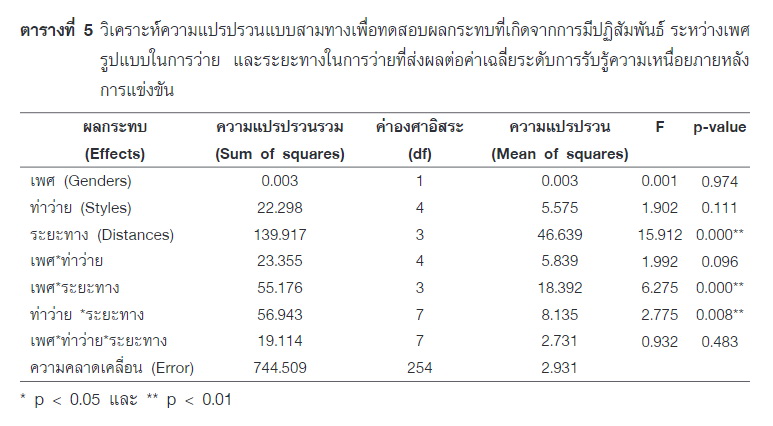
วิธีดำเนินการวิจัย กลุ่มตัวอย่างที่ใช้ในการวิจัยครั้งนี้ เป็นนักกีฬาว่ายน้ำเยาวชน จำนวน 39 คน (ชาย 14, หญิง 25) ปริมาณแลคเตทสูงสุดภายหลังการแข่งขัน 3 นาที หลังจากนักกีฬาขึ้นจากสระเฉพาะในรอบชิงชนะเลิศจำนวนทั้งสิ้น 284 รายการ วิเคราะห์ทางสถิติ เพื่อหาค่าเฉลี่ยและส่วนเบี่ยงเบนมาตรฐาน และเปรียบเทียบความแตกต่างระหว่างความสามารถในการว่ายน้ำระหว่างนักกีฬาเยาวชนชายและหญิง โดยใช้สถิติ T-test วิเคราะห์ความแปรปรวนแบบสามทาง เพื่อทดสอบผลกระทบที่เกิดจากการมีปฏิสัมพันธ์ระหว่างเพศ รูปแบบ และระยะทางในการว่ายที่ส่งผลต่อค่าปริมาณแลคเตทสูงสุด อัตราการเต้นของหัวใจ ระดับการรับรู้ความเหนื่อย ภายหลังการแข่งขันเปรียบเทียบความแตกต่างเป็นรายคู่ของค่าเฉลี่ยด้วยวิธีของ Bonferroni กำหนดความมีนัยสำคัญทางสถิติที่ระดับ 0.05
ผลการวิจัย ปริมาณแลคเตทสูงสุดภายหลังการแข่งขันในนักกีฬาเยาวชนชาย มีค่าเฉลี่ยสูงสุดในการว่ายท่าเดี่ยวผสม 400 เมตร (13.39 ± 3.50 มิลลิโมล/ลิตร) และนักกีฬาหญิงมีค่าเฉลี่ยสูงสุดในการว่ายผีเสื้อ 200 เมตร (8.59 ± 3.16 มิลลิโมล/ลิตร) ปฏิสัมพันธ์ระหว่างเพศรูปแบบในการว่ายและระยะทางในการว่ายส่งผลต่อค่าปริมาณแลคเตทสูงสุดภายหลังการแข่งขันอย่างมีนัยสำคัญทางสถิติ (p < .05) โดยเฉพาะอย่างยิ่งในนักกีฬาว่ายน้ำเยาวชนชาย นอกจากนี้ ยังพบปฏิสัมพันธ์ระหว่างเพศกับระยะทางในการว่าย และระหว่างรูปแบบในการว่ายกับระยะทางในการว่ายที่ส่งผลต่อระดับการรับรู้ความเหนื่อยภายหลังการอย่างมีนัยสำคัญทางสถิติ (p < .05) แต่ไม่พบการมีปฏิสัมพันธ์ระหว่างตัวแปรต้นทั้งสามกับอัตราการเต้นของหัวใจภายหลังการแข่งขัน
สรุปผลการวิจัย ปริมาณแลคเตทมีค่าสูงสุดภายหลังการแข่งขันมีค่าสูงสุดในการว่ายท่าเดี่ยวผสม 400 เมตร และผีเสื้อ 200 เมตรในนักกีฬาว่ายน้ำเยาวชนชายและหญิงปฏิสัมพันธ์ระหว่างรูปแบบในการว่าย และระยะทางในการว่ายต่อปริมาณแลคเตทสูงสุดภายหลังการแข่งขันมีความแตกต่างระหว่างเพศ
Article Details
เอกสารอ้างอิง
Avlonitou, E. (1996). Maximal lactate values following competitive performance varying according to age, sex and swimming style. The Journal of Sports Medicine and Physical Fitness, 36(1), 24-30.
Barbosa, T. M., Fernandes, R., Keskinen, K., Colašo, P., Cardoso, C., Silva, J., and Vilas-Boas, J. (2006). Evaluation of the energy expenditure in competitive swimming strokes. International Journal of Sports Medicine, 27(11), 894-899.
Benelli, P., Ditroilo, M., Forte, R., De Vito, G., and Stocchi, V. (2007). Assessment of post-competition peak blood lactate in male and female master swimmers aged 40-79 years and its relationship with swimming performance. European Journal of Applied Physiology, 99(6), 685-693.
Bonifazi, M., Martelli, G., Marugo, L., Sardella, F., and Carli, G. (1993). Blood lactate accumulation in top level swimmers following competition. Journal of Sports Medicine and Physical Fitness, 33,13-18.
Bonifazi, M., Sardella, F., and Lupo, C. (2000). Preparatory versus main competitions: differences in performances, lactate responses and pre-competition plasma cortisol concentrations in elite male swimmers. European Journal of Applied Physiology, 82(5-6), 368-373.
Chatard, J., Paulin, M., and Lacour, J. (1988). measurements and swimming performance: illustrated by data from a 400 m Olympic record holder. Swimming science V. Human Kinetics, Champaign.
Elliott AC, Woodward WA (2007). Statistical analysis quick reference guidebook with SPSS examples. 1st ed. London: Sage Publications.
Hopkins, W., Marshall, S., Batterham, A., and Hanin, J. (2009). Progressive statistics for studies in sports medicine and exercise science. Medicine and Science in Sports and Exercise, 41(1), 3.
Jacobs, I. (1986). Blood lactate: implications for training and sports performance. Sports Medicine, 3(1), 10-25.
Laffite, L. P., Vilas-Boas, J. P., Demarle, A., Silva, J., Fernandes, R., and Louise Billat, V. (2004). Changes in physiological and stroke parameters during a maximal 400-m free swimming test in elite swimmers. Canadian Journal of Applied Physiology, 29(S1), S17-S31.
Morais, J. E., Garrido, N. D., Marques, M. C., Silva, A. J., Marinho, D. A., and Barbosa, T. M. (2013). The influence of anthropometric, kinematic and energetic variables and gender on swimming performance in youth athletes. Journal of Human Kinetics, 39(1), 203-211.
