ผลของการฝึกเสริมด้วยการฝึกกล้ามเนื้อแกนกลางลำตัวต่อความสามารถทางกีฬาจักรยานของนักกีฬาจักรยานระดับเยาวชนชายประเภทไทม์ไทรอัล
Article Sidebar
Main Article Content
บทคัดย่อ
วัตถุประสงค์ เพื่อศึกษาผลของการฝึกเสริมด้วยการฝึกกล้ามเนื้อแกนกลางลำตัวต่อความสามารถทางกีฬาจักรยานของนักกีฬาจักรยานระดับเยาวชนชายประเภทไทม์ไทรอัล
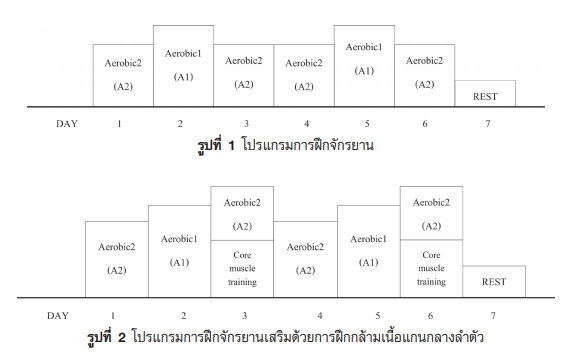
วิธีดำเนินการวิจัย อาสาสมัครเป็นนักกีฬาจักรยานระดับเยาวชนชายประเภทไทม์ไทรอัล อายุเฉลี่ย 16±2 ปี ซึ่งคัดเลือกกลุ่มตัวอย่างแบบเฉพาะเจาะจง จากนั้นเรียงลำดับตามความแข็งแรงของกล้ามเนื้อแกนกลางลำตัว แบ่งกลุ่มตัวอย่างเป็น 2 กลุ่ม ได้แก่ กลุ่มฝึกจักรยานจำนวน 13 คน และกลุ่มฝึกจักรยานเสริมด้วยการฝึกกล้ามเนื้อแกนกลางลำตัว จำนวน 12 คน ทั้ง 2 กลุ่มทำการฝึกโปรแกรมการฝึกจักรยาน คือ ปั่นจักรยานที่ความหนัก 65-80 เปอร์เซ็นต์ของอัตราการเต้นของหัวใจสูงสุด ระยะเวลา 120 นาที จำนวน 2 วันต่อสัปดาห์ และปั่นจักรยานที่ความหนัก 80-90 เปอร์เซ็นต์ของอัตราการเต้นของหัวใจสูงสุด ระยะเวลา 75-90 นาที จำนวน 4 วันต่อสัปดาห์ กลุ่มฝึกจักรยานเสริมด้วยการฝึกกล้ามเนื้อแกนกลางลำตัวทำการฝึกเพิ่มเติมด้วยสวิสบอล และเครื่องกำหนดแรงต้านที่ความหนัก 75 เปอร์เซ็นต์ของความสามารถในการออกแรงสูงสุดหนึ่งครั้ง จำนวน 2 วันต่อสัปดาห์ ทำการทดสอบตัวแปรต่างๆ ก่อนและหลังการฝึก 8 สัปดาห์ ได้แก่ ด้านสรีรวิทยาทั่วไป ด้านความสามารถทางกีฬาจักรยาน ประกอบด้วย การปั่นจักรยานไทม์ไทรอัล 20 กิโลเมตร ความสามารถในการทรงตัว และเวลาที่ทนต่อความเมื่อยล้า และด้านสมรรถภาพของกล้ามเนื้อทำการวิเคราะห์ข้อมูลด้วยการวิเคราะห์ความแปรปรวนสองทางแบบวัดซ้ำ
ผลการวิจัย หลังการฝึก 8 สัปดาห์ ทั้ง 2 กลุ่มมีความสามารถในการใช้ออกซิเจนสูงสุดเพิ่มขึ้น เมื่อเทียบกับก่อนการฝึกอย่างมีนัยสำคัญทางสถิติที่ระดับ .05 กลุ่มฝึกจักรยานเสริมด้วยการฝึกกล้ามเนื้อแกนกลางลำตัว มีการใช้ระยะเวลาในการปั่นจักรยานไทม์ไทรอัล 20 กิโลเมตรลดลง รวมถึงเวลาที่ทนต่อความเมื่อยล้าความสามารถในการทรงตัว และความแข็งแรงของกล้ามเนื้อแกนกลางลำตัวเพิ่มขึ้น เมื่อเทียบกับก่อนการฝึกอย่างมีนัยสำคัญทางสถิติที่ระดับ .05 อีกทั้งกลุ่มฝึกจักรยานเสริมด้วยการฝึกกล้ามเนื้อแกนกลางลำตัวมีค่าแรงสูงสุดของกล้ามเนื้อแกนกลางลำตัวในท่าเหยียดตัวและงอตัวเพิ่มขึ้น และความล้าของกล้ามเนื้อแกนกลางลำตัวในท่าเหยียดตัวลดลง เมื่อเทียบกับกลุ่มฝึกจักรยานอย่างมีนัยสำคัญทางสถิติที่ระดับ .05
สรุปผลการวิจัย กลุ่มฝึกจักรยานเสริมด้วยการฝึกกล้ามเนื้อแกนกลางลำตัว สามารถพัฒนาความสามารถทางกีฬาจักรยานในด้านการเพิ่มความสามารถในการทรงตัว การทนต่อความเมื่อยล้า และลดระยะเวลาในการปั่นจักรยานไทม์ไทรอัล 20 กิโลเมตรได้ ในขณะที่การฝึกด้วยโปรแกรมปั่นจักรยานเพียงอย่างเดียวไม่ส่งผลให้เกิดการพัฒนาดังกล่าว
Article Details
เอกสารอ้างอิง
Alan, M. (2011). Cyclingtips : The pursuit of leanness. (Online). Retrieved April 3, 2019, from Cyclingtips Website https://cyclingtips.com/2011/11/the-pursuit-of-leanness/
Asplund, C., and Ross, M. (2010). Core stability and bicycling. Current Sports Medicine Reports. 9(3), 155-160.
Atkinson, G., Peacock, O., & Passfield, L. (2007). Variable versus constant power strategies during cycling time-trials: Prediction of time savings using an up-to-date mathematical model. Journal of Sports Sciences, 25(9).
Burke E. (2002). Serious Cycling 2nd Edition: Human Kinetics.
Cain S. M., Ashton M., James A., and Perkins N.C. (2016). On the skill of balancing while riding a bicycle. PLoS ONE.
Duc, S., Bertucci, W., Pernin, J., and Grappe, F. (2008). Muscular activity during uphill cycling : Effect of slope, posture, hand grip position and constrained bicycle lateral sways. Journal of Electromyography and Kinesiology, 18(1), 116-127.
Ducheyne, F., Bourdeaudhuij, I., Lenoir, M., & Cardon, G. (2013). Does a cycle training course improve cycling skills in children? Accident Analysis and Prevention, 59, 38-45.
Faria, E. W., Parker, D. L., and Faria, I. E. (2005). The science of cycling physiology and training – part 1. Journal of Sports Medicine, 35(4), 285-312.
Faria, E. W., Parker, D. L., and Faria, I. E. (2005). The Science of cycling factors affecting performance – part 2. Sports Medicine, 35(4), 313-337.
García-Vaquero, P.M., Barbado, D., Juan-Recio, C., López-Valenciano, A. and Vera-Garcia, F. J. (2016). Isokinetic trunk flexion–extension protocol to assess trunk muscle strength and endurance: Reliability, learning effect, and sex differences. Journal of Sport and Health Science. 2016: 1-10.
Hawley, A. J., & Noakes, D. T. (1992). Peak power output predicts maximal oxygen uptake and performance time in trained cyclists. Journal of Applied Physiology, 65, 79-83.
Lucia, A., Hoyos, J., Perez, M., and Chicharro, J. L. (2000). Heart rate and performance parameters in elite cyclists: a longitudinal study. Journal of Medicine and Science in Sports and Exercise, 32(10), 1777-1782.
Laursen, P. B., Shing, C. M., & Jenkins, D. G. (2003). Reproducibility of the cycling time to exhaustion at VO2peak in highly trained cyclists. European Journal of Applied Physiology, 28(4).
Ronald, P. P., Brian , H., David, L., Daniel, B., and Kevin, H. (1993). Correlating indices of aerobic capacity with performance in elite women road cyclists. Journal of Strength and Conditioning Research., 7(4), 201-205.
Samson K. M. (2005). Effects of a five-week core stabilization-training program on dynamic balance in tennis athletes. Athletic Physical Therapy Today. 12(3).41-46
Suksom D. (2018). Exercise for health. Bangkok. Chulalongkorn University Printing House.
Tabata, I., Ogita, F., and Miyachi, M. (1996). Effects of moderate intensity endurance and high intemsity intermittent training on anaerobic capacity and VO2max. Medicine & Science in Sports & Exercise, 28(10), 1327-1330.
Thongho I. (2017). Effect of recovery after exercise methods on lactic acid in the blood, heart rate and anaerobic performance in athletes. Journal of Health, Physical Education and Recreation, 43(1), 290-316.
Union Cycliste Internationale. (2017). Amendments to regulations. (Online). Retrieved October 11, 2017, from Website: https://www.uci.ch/mm/Document/News/Rulesandregulation/Colonnededroite-changementsau01.01.2018-Majdu01.10.2017-E_English.PDF
Weijmans, E., and Berkel, S. v. (2014). Do core stabilization exercises enhance cycling efficiency?. Journal of Science and Cycling. 3(2), 71.
Weston, R. A., Myburgh, H. K., Lindsay, H. F., Dennis, C. S., Noakes, D. T., & Hawley, A. J. (1997). Skeletal muscle buffering capacity and endurance performance after high-intensity interval training by well-trained cyclists. European Journal of Applied Physiology, 75, 7-13.
Wilber, C. A., Holland, C., Madison, R. E., and Loy, F. A. (1994). An pidemiological analysis of overuse injuries among recreational cyclists. Journal of Sports Medicine, 16(3), 201-206.
Willardson, M. J. (2007). Core stability training : Applications to sports conditioning programs. Journal of Strength and Conditioning Research, 21(3), 979-985.
Willardson, M. J., Fontana, E. F., & Bressel, E. (2009). Effect of surface stability on core muscle activity for dynamic resistance exercises. Journal of Sports Physiology and Performance, 4(1), 97-109.
Wiseman, K. (2013). An investigation into the effectiveness of core muscle strengthening on cycling performance in asymptomatic cyclists. Masters’ Degree in Technology, Chiropractic Durban University of Technology.
