การศึกษาเปรียบเทียบความสามารถในการควบคุมการทรงท่าระหว่างนักลีลาศและผู้มีสุขภาพดีที่มีและไม่มีภาวะข้อเท้าไม่มั่นคงเรื้อรัง
Article Sidebar
Main Article Content
บทคัดย่อ
วัตถุประสงค์ การวิจัยครั้งนี้ มีวัตถุประสงค์เพื่อเปรียบเทียบความสามารถในการทรงท่าระหว่างนักลีลาศและผู้มีสุขภาพดีที่มีและไม่มีภาวะข้อเท้าไม่มั่นคงเรื้อรัง
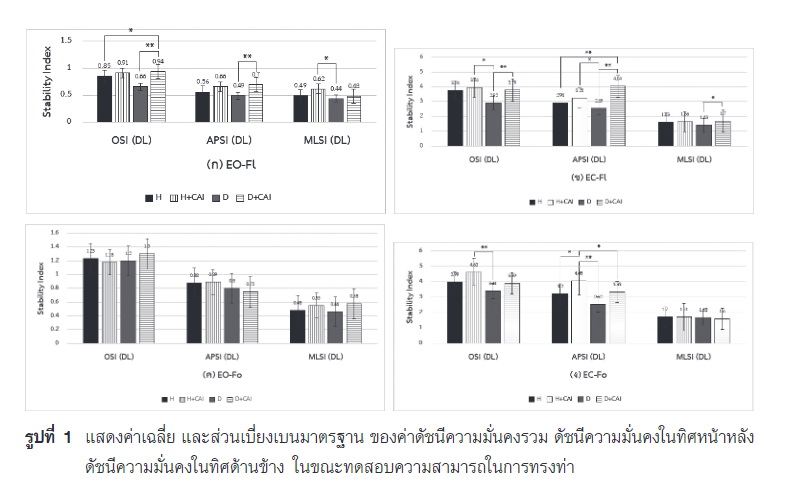
วิธีดำเนินการวิจัย กลุ่มตัวอย่างที่ใช้ในการวิจัย ได้แก่ ผู้มีสุขภาพดี (Healthy sedentary: H) ผู้มีสุขภาพดีที่มีภาวะข้อเท้าไม่มั่นคงเรื้อรัง (Healthy sedentary with chronic ankle instability: H+CAI) นักลีลาศ (Dancer: D) และนักลีลาศที่มีภาวะข้อเท้าไม่มั่นคงเรื้อรัง (D+CAI) กลุ่มละ 10 คน โดยทำการวัดค่าดัชนีความมั่นคงรวม (Overall Stability index: OSI) ดัชนีความมั่นคงในทิศหน้าหลัง (Anteroposterior stability index: APSI) และดัชนีความมั่นคงในทิศด้านข้าง (Mediolateral Stability index: MLSI) ผ่านการทดสอบยืนขาข้างเดียว 4 รูปแบบ คือ ยืนเปิดตา พื้นราบ (Eyes openedFloor: EO-Fl) ยืนปิดตา พื้นราบ (Eyes closed-Floor: EC-Fl) ยืนเปิดตา พื้นโฟม (Eyes opened-Foam: EO-Fo) และยืนปิดตา พื้นโฟม (Eyes closed-Foam: EC-Fo) เปรียบเทียบความแตกต่างโดยใช้สถิติการวัดค่าความแปรปรวนสองทาง (Two-way ANOVA)
ผลการวิจัย พบว่า ขณะยืนทดสอบรูปแบบ EO-Fl ค่า OSI ของกลุ่ม H มีค่าต่ำกว่ากลุ่ม D+CAI อย่างมีนัยสำคัญทางสถิติที่ระดับ 0.04 กลุ่ม D มีค่าดัชนีความมั่นคงรวมต่ำกว่ากลุ่ม H+CAI อย่างมีนัยสำคัญทางสถิติที่ระดับ 0.00 ค่า APSI กลุ่ม D มีค่าต่ำกว่ากลุ่ม D+CAI อย่างมีนัยสำคัญทางสถิติที่ระดับ 0.01 ค่า MLSI ของกลุ่ม D มีค่าต่ำกว่ากลุ่ม H+CAI อย่างมีนัยสำคัญทางสถิติที่ระดับ 0.04 และพบว่า ขณะยืนทดสอบรูปแบบ EC-Fl ค่า OSI ของกลุ่ม D มีค่าต่ำกว่ากลุ่ม H+CAI และกลุ่ม D+CAI อย่างมีนัยสำคัญทางสถิติ นอกจากนี้ยังพบว่า ขณะยืนทดสอบรูปแบบ EC-Fl ค่า APSI ของกลุ่ม H มีค่าต่ำกว่ากลุ่ม D+CAI อย่างมีนัยสำคัญทางสถิติที่ระดับ 0.01 กลุ่ม D มีค่าต่ำกว่ากลุ่ม H+CAI อย่างมีนัยสำคัญทางสถิติที่ระดับ 0.05 กลุ่ม D มีค่าต่ำกว่ากลุ่ม D+CAI อย่างมีนัยสำคัญทางสถิติที่ระดับ 0.00 ขณะยืนทดสอบ ค่า MLSI ของกลุ่ม D มีค่าต่ำกว่ากลุ่ม D+CAI อย่างมีนัยสำคัญทางสถิติที่ระดับ 0.03 และเมื่อเพิ่มความยากในการทรงตัวขึ้นมากที่สุดด้วยการยืนทดสอบรูปแบบ EC-Fo ค่า OSI ของกลุ่ม D มีค่าต่ำกว่ากลุ่ม H+CAI อย่างมีนัยสำคัญทางสถิติที่ระดับ 0.00 ค่า APSI ของกลุ่ม H มีค่าต่ำกว่ากลุ่ม H+CAI อย่างมีนัยสำคัญทางสถิติที่ระดับ 0.02 กลุ่ม D มีค่าต่ำกว่ากลุ่ม H+CAI อย่างมีนัยสำคัญทางสถิติที่ระดับ 0.00 กลุ่ม D มีค่าต่ำกว่ากลุ่ม D+CAI อย่างมีนัยสำคัญทางสถิติที่ระดับ 0.04
สรุปผลการวิจัย เมื่อรูปแบบการทดสอบความสามารถในการทรงท่ายากขึ้น กลุ่มนักลีลาศมีแนวโน้มความสามารถในการทรงท่าที่ดีกว่ากลุ่มผู้มีสุขภาพดี และกลุ่มนักลีลาศที่มีภาวะข้อเท้าไม่มั่นคงเรื้อรังก็มีแนวโน้มความสามารถในการควบคุมการทรงท่าที่ดีกว่ากลุ่มผู้มีสุขภาพดีที่มีภาวะข้อเท้าไม่มั่นคงเรื้อรัง
Article Details
เอกสารอ้างอิง
Alonso, A. C., Brech, G. C., Bourquin, A. M., and Greve, J. M. (2011). The influence of lower-limb dominance on postural balance. Sao Paulo Medical Journal, 129(6), 410-413.
Alpini, D., Mattei, V., Schlecht, H., and Kohen-Raz, R. (2008). Postural control modifications induced by synchronized ice skating. Sport Sciences for Health, 3(1-2), 11-17.
Arnold, B. L., and Schmitz, R. J. (1998). Examination of balance measures produced by the biodex stability system. Journal of Athletic Training, 33(4), 323-327.
Batson, G. (2009). Update on proprioception: considerations for dance education. Journal of Dance Medicine and Science, 13(2), 35-41.
Brown, C. N., Ko, J., Rosen, A. B., and Hsieh, K. (2015). Individuals with both perceived ankle instability and mechanical laxity demonstrate dynamic postural stability deficits. Clinical Biomechanics (Bristol, Avon), 30(10), 1170-1174.
Chiu, Y. L., Tsai, Y. J., Lin, C. H., Hou, Y. R., and Sung, W. H. (2017). Evaluation of a smartphone-based assessment system in subjects with chronic ankle instability. Computer Methods and Programs in Biomedicine, 139, 191-195.
Daniel Leightley, M. H. Y., Jessica Coulson, Mathew Piasecki, James Cameron, Yoann Barnouin, Jon Tobias, and Jamie S McPhee. (2017). Postural Stability During Standing Balance and Sit-to-Stand in Master Athlete Runners Compared With Nonathletic Old and Young Adults. Journal of Aging and Physical Activity, 25(3), 345-350.
Fereydounnia, S., Shadmehr, A., Talebian Moghadam, S., Olyaei, G., Jalaie, S., and Tahmasebi, A. (2016). Muscle timing in injured and non-injured leg of athletes with chronic ankle instability in response to a visual stimulus during forward jumping. Journal of Bodywork and Movement Therapies, 20(1), 3-9.
Gerbino, P. G., Griffin, E. D., and Zurakowski, D. (2007). Comparison of standing balance between female collegiate dancers and soccer players. Gait Posture, 26(4), 501-507.
Hackney, A. C. (2016). Chapter 7–Exercise Training and Metabolic Adaptation. Exercise, Sport, and Bioanalytical Chemistry, 65-81.
Hertel, J. (2002). Functional Anatomy, Pathomechanics, and Pathophysiology of Lateral Ankle Instability. Journal of Athletic Training, 37(4), 364-375.
Hiller, C. E., Kilbreath, S. L., and Refshauge, K. M. (2011). Chronic Ankle Instability: Evolution of the Model. Journal of Athletic Training (National Athletic Trainers’ Association), 46(2), 133-141.
Hincapie, C. A., Morton, E. J., and Cassidy, J. D. (2008). Musculoskeletal injuries and pain in dancers: a systematic review. Archives of Physical Medicine and Rehabilitation, 89(9), 1819-1829.
Kadel, N. J. (2006). Foot and ankle injuries in dance. Physical Medicine and Rehabilitation Clinics of North America, 17(4), 813-826, vii.
Kilroy, E. A., Crabtree, O. M., Crosby, B., Parker, A., and Barfield, W. R. (2016). The Effect of Single-Leg Stance on Dancer and Control Group Static Balance. International Journal of Exercise Science, 9(2), 110-120.
Klykken, L. W., Pietrosimone, B. G., Kim, K. M., Ingersoll, C. D., and Hertel, J. (2011). Motor-neuron pool excitability of the lower leg muscles after acute lateral ankle sprain. Journal of Athletic Training, 46(3), 263-269.
Krityakiarana, W., and Jongkamonwiwat, N. (2016). Comparison of Balance Performance Between Thai Classical Dancers and Non-Dancers. Journal of Dance Medicine and Science, 20(2), 72-78.
Lin, C. F., Lee, I. J., Liao, J. H., Wu, H. W.,and Su, F. C. (2011). Comparison of postural stability between injured and uninjured ballet dancers. The American Journal Sports Medicine, 39(6), 1324-1331.
Martin-Sanz, E., Crespo, I. O., Esteban-Sanchez, J., and Sanz, R. (2017). Postural stability in a population of dancers, healthy non-dancers, and vestibular neuritis patients. Acta Oto-Laryngologica, 137(9), 952-956.
Mettler, A., Chinn, L., Saliba, S. A., McKeon, P. O., and Hertel, J. (2015). Balance training and center-of-pressure location in participants with chronic ankle instability. Journal of Athletic Training, 50(4), 343-349.
Nam, S. M., Kim, K., and Lee, D. Y. (2018). Effects of visual feedback balance training on the balance and ankle instability in adult men with functional ankle instability. Journal of Physical Therapy Science, 30(1), 113-115.
Pope, M., Chinn, L., Mullineaux, D., McKeon, P. O., Drewes, L., and Hertel, J. (2011). Spatial postural control alterations with chronic ankle instability. Gait Posture, 34(2), 154-158.
Rein, S., Fabian, T., Zwipp, H., Rammelt, S., and Weindel, S. (2011). Postural control and functional ankle stability in professional and amateur dancers. Clinical Neurophysiology, 122(8), 1602-1610.
Riding McCabe, T., Ambegaonkar, J. P., Redding, E., and Wyon, M. (2014). Fit to dance survey: a comparison with dancesport injuries. Medical Problems of Performing Artists, 29(2), 102-110.
Thain, P. K., Hughes, G. T., and Mitchell, A. C. (2016). The effect of repetitive ankle perturbations on muscle reaction time and muscle activity. Journal of Electromyography and Kinesiology, 30, 184-190.
Vaisman, A., Guiloff, R., Rojas, J., Delgado, I., Figueroa, D., and Calvo, R. (2017). Lower Limb Symmetry: Comparison of Muscular Power Between Dominant and Nondominant Legs in Healthy Young Adults Associated With Single-Leg-Dominant Sports. Orthopaedic Journal of Sports Medicine, 5(12).
Vieira, T. M., Baudry, S., and Botter, A. (2016). Young, Healthy Subjects Can Reduce the Activity of Calf Muscles When Provided with EMG Biofeedback in Upright Stance. Frontiers in Physiology, 7, 158.
