กลยุทธ์ส่งเสริมกิจกรรมทางกายของนักเรียนประถมศึกษาตอนปลายในกรุงเทพมหานครผ่านการบริหารโปรแกรมสุขภาพในโรงเรียน
Article Sidebar
Main Article Content
บทคัดย่อ
กลยุทธ์ส่งเสริมกิจกรรมทางกายให้นักเรียน โดยผ่านการบริหารโปรแกรมสุขภาพในโรงเรียนตามแนวคิดขององค์การอนามัยโลกนับเป็นหนึ่งในปัจจัยพื้นฐานด้านสุขภาพที่โรงเรียนควรมีนโยบายอย่างเป็นรูปธรรมเพื่อแก้ไขปัญหาการมีกิจกรรมทางกายน้อยของนักเรียนประถมศึกษาที่พบว่าเด็กไทยมีกิจกรรมทางกายไม่ถึงครึ่งตามเกณฑ์ที่องค์การอนามัยโลกกำหนด
วัตถุประสงค์ การวิจัยครั้งนี้มีวัตถุประสงค์เพื่อ (1) ศึกษาองค์ประกอบการบริหารโปรแกรมสุขภาพในโรงเรียนที่ส่งผลต่อกิจกรรมทางกายของนักเรียน (2) สังเคราะห์กลยุทธ์ส่งเสริมกิจกรรมทางกายผ่านการบริหารโปรแกรมสุขภาพในโรงเรียน
วิธีดำเนินการวิจัย แบ่งออกเป็น 2 ระยะ คือ ระยะที่ 1 สุ่มตัวอย่างโรงเรียนอย่างง่าย 15 โรงเรียน ในกรุงเทพมหานคร เพื่อเก็บข้อมูลสภาพและแนวทางการบริหารโปรแกรมสุขภาพในโรงเรียนจากครูและผู้บริหาร 45 คน และตัวอย่างนักเรียนเพื่อเก็บข้อมูลกิจกรรมทางกายของนักเรียน 1,500 คน วิเคราะห์ข้อมูลด้วยการตรวจสอบอิทธิพลของตัวแปรโดยใช้โมเดลสมการโครงสร้างระยะที่ 2 สังเคราะห์กลยุทธ์ส่งเสริมกิจกรรมทางกายจากผลการวิเคราะห์ข้อมูลในระยะที่ 1
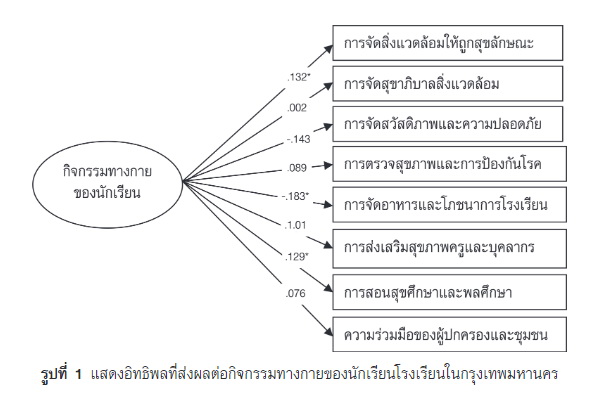
ผลการวิจัย พบว่า (1) ผลการตรวจสอบอิทธิพลของตัวแปรโดยใช้โมเดลสมการโครงสร้าง พบว่า มีค่าความสอดคล้องกับข้อมูลเชิงประจักษ์ (χ2=24.31, df =13, p=.06, CFI=.95, RMSEA=.03, SRMR=.04) โดยมี 2 องค์ประกอบของการบริหารโปรแกรมสุขภาพในโรงเรียนที่ส่งผลทางบวกต่อกิจกรรมทางกาย คือ การจัดสิ่งแวดล้อมให้ถูกสุขลักษณะ และการเรียนการสอนสุขศึกษาและพลศึกษา และมี 1 องค์ประกอบที่ส่งผลทางลบ คือ การจัดอาหารและโภชนาการ (2) ผลการสังเคราะห์กลยุทธ์ส่งเสริมกิจกรรมทางกาย ได้แก่ จัดพื้นที่โล่งหรือสนามให้นักเรียนได้เล่น จัดสอนสุขศึกษาและพลศึกษาอย่างน้อย 1-2 คาบ/สัปดาห์ จัดเวลาให้นักเรียนมีโอกาสเล่นหลังรับประทานอาหารกลางวัน
สรุปผลการวิจัย ผลการศึกษาแสดงให้เห็นว่ามี 3 องค์ประกอบสำคัญของการบริหารโปรแกรมสุขภาพในโรงเรียน ได้แก่ การจัดการสิ่งแวดล้อม การเรียนการสอนสุขศึกษาและพลศึกษา และการจัดอาหารและโภชนาการ ส่งผลต่อกิจกรรมทางกายของนักเรียนประถมศึกษา
Article Details
เอกสารอ้างอิง
Bonde, H. B. (2015). Measuring Physical Activity Health Literacy in Children–Not a Piece of Cake.Research on Health Education. (Online). Retrieved October 13, 2016, European Educational Research Association Website:https://www.eera-ecer.de/ecerprogrammes/conference/20/contribution/34250/.
Centers for Disease Control and Prevention. (2017). School Health Index: A Self-Assessment and Planning Guide (Elementary school version). Atlanta: Georgia. (Mimeographed)
Erawan, P. (2015). Healthy Schools Promotion: An Experience in Thailand. Procedia–Social and Behavioral Sciences, 186, 513-521.
Hillman, C. H., Pontifex, M. B., Raine, L. B., Castelli, D. M., Hall, E. E., and Kramer, A. F. (2009). The effect of acute treadmill walking on cognitive control and academic achievement in preadolescent children. Neuroscience, 159(3), 1044-1054.
Institute for Population and Social Research, Mahidol University. (2017). Thai Health 2017: Empowering Vulnerable Populations Creating an Inclusive Society. Nakhon Pathom: Amarin Printing & Publishing Public Co., Ltd.
Kuna-apisit, W. (2015). The development of Physical Activity Curriculum for Students in Thailand. Bangkok: Physical Activity Research Center.
Lewallen, T. C., Hunt, H., William, P. D., Zaza, S., and Giles, W. (2015). The Whole School, Whole Community, Whole Child Model: A New Approach for Improving Educational Attainment and Healthy Development for Students. journal school health, 85(11), 729-739.
National Statistical Office. (2016). The 2015 physical activity survey. (Online). Retrieved October 13, 2016, National Statistical Office of Thailand Website: https://service.nso.go.th/nso/web/survey/surpop2-4-15.html.
Pavelka, J., Erik, S., Sigmundová, D. (2014). An analysis of conditions for physical activity and physical education in the Czech Republic. Telesná Kultura, 37(1), 9-22.
Sarayuthpitak, J. (2018). School Health Program (3 rd. Ed.). Bangkok: Chulalongkorn University Printing House.
Sarayuthpitak, J., (2014). The Development of a Teaching – Learning Model Based on Affective Domain to Promote in Lower Secondary School Students’ Health. Journal of Education Studies, 42(4), 43-62.
Schaller, A., Dejonghe, L., Goebbels, A. A., Biallas, B. and Froboese, I. (2016). Promoting physical activity and health literacy: study protocol for a longitudinal, mixed methods evaluation of a cross provider workplace-related intervention in Germany (The AtRisk study). BMC Public Health, 16(16), 626.
Soper, D.S. (2016). A-priori Sample Size Calculator for Structural Equation Models. (Online). Retrieved October 13, 2016, Website: https://www.danielsoper.com/statcalc/calculator.aspx?id=89.
Sriramart, S. (2014). Physical activities for wellness. Bangkok: Chulalongkorn University Printing House.
Tangsujjapoj, S. (2012). Organizing physical activities for recreation in educational institutions. (Online). Retrieved October 13, 2016, Website: https://ped.edu.ku.ac.th/home/research/data/29_08_2015_21_16_24.pdf
Thai Health Promotion Foundation. (2016). What is the Physical Activity?. (Online). Retrieved October 13, 2016, Thai Health Promotion Foundation Website: https://www.thaihealth.or.th/Content/32561-%60
Tipwong, A., and Numpoon, J. (2014). The Associations between Health Literacy Related to Obesity and Health Behaviour: Eating and Exercise in over nutritional Children, Bangkok. Journal of Public Health Nursing, 28(2), 1-11.
Udakan, Y., Sangsutthipong, P., Kasiyaphat, A., Thummajunta, K., Sumranbumrung, P., Sritubtim, P., Kosanpipat, P., Treesopanakorn, K., Chaiyamang, A., and Pattanakul, N. (2017). Physical activities for students in border patrol police schools and remote area schools. Journal of Graduate Research, 8(1), 141-154.
Wimonpeerapattana, W., Kijboonchoo, K., Thasanasuwan, W., and Pongurgsorn, C. (2013). Development and Validation of the Physical Activity Questionnaire for Thai Children. KKU Journal, 18(3), 548-557.
World Health Organization (WHO). (2017a). School and youth health. (Online). Retrieved October 13, 2016, World Health Organization Website: https://www.who.int/school youth_health/gshi/hps/en/.
World health organization (WHO). (2017b), Physical activity. (Online). Retrieved October 13, 2016, World Health Organization Website: https://www.who.int/topics/physical_activity/en/.
Zoellner, J. M., Hill, J., You, W., Brock, D., Frisard, M., Alexander, R., Silva, F., Price, B., Marshall, R., and Estabrooks, P. A. (2017). The Influence of Parental Health Literacy Status on Reach, Attendance, Retention, and Outcomes in a Family-Based Childhood Obesity Treatment Program, Virginia, 2013-2015. Preventing Chronic Disease (PCD), 14(87), 1-10.
