การวิเคราะห์กลยุทธ์และคุณลักษณะของความสามารถในการว่ายน้ำในการแข่งขันกีฬาแห่งชาติครั้งที่ 45
Article Sidebar
Main Article Content
บทคัดย่อ
วัตถุประสงค์ : เพื่อศึกษาและเปรียบเทียบกลยุทธ์และคุณลักษณะของความสามารถในการว่ายน้ำระหว่างนักกีฬาชายและนักกีฬาหญิงที่เข้าร่วมการแข่งขันกีฬาแห่งชาติครั้งที่ 45
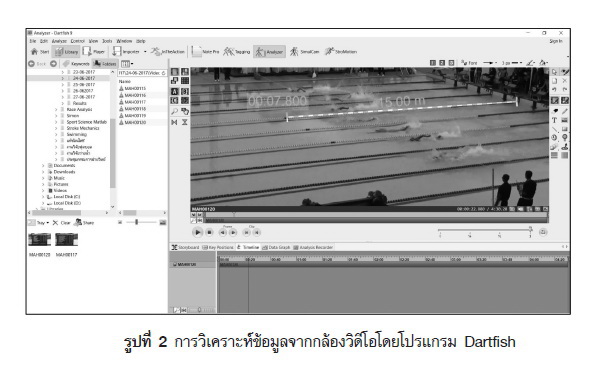
วิธีดำเนินการวิจัย : กลุ่มตัวอย่างเป็นนักกีฬาว่ายน้ำที่แข่งขันในรอบชิงชนะเลิศกีฬาแห่งชาติครั้งที่ 45 จำนวน 256 คน (ชาย 128 น หญิง 128 คน) บันทึกภาพการแข่งขันว่ายน้ำโดยใช้กล้องวิดีโอจำนวน 1 ตัวที่ความถี่ 50 เฮิร์ซ วิเคราะห์ข้อมูลกลยุทธ์และคุณลักษณะของความสามารถในการว่ายน้ำ โดยโปรแกรม Dartfish วิเคราะห์ค่าเฉลี่ยและส่วนเบี่ยงเบนมาตรฐานของคุณลักษณะของความสามารถในการว่ายน้ำ และร้อยละของตัวแปรด้านกลยุทธในการว่ายน้ำ ทำการเปรียบเทียบระหว่างนักกีฬาว่ายน้ำชายและหญิงโดยใช้สถิติค่าทีแบบสองกลุ่มที่เป็นอิสระต่อกัน (Independent sample t-test) ที่ระดับนัยสำคัญทางสถิติ 0.05
ผลการวิจัย : ค่าเฉลี่ย ร้อยละของเวลาที่ใช้ในการว่ายน้ำ มีค่ามากสุดเทียบกับองค์ประกอบอื่นๆของกลยุทธที่ใช้ในการว่ายน้ำ (61.94-72.19%) ค่าเฉลี่ย ร้อยละของเวลาของการออกตัวมีค่าสูงในระยะสั้น (50-100 เมตร) เวลาที่ใช้ในการกลับตัวมีค่าสูงในระยะกลางจนถึงระยะไกล (200-1,500 เมตร) ทั้งนักกีฬาชายและหญิง คุณลักษณะของความสามารถในการว่ายน้ำในนักกีฬาชายมีค่ามากกว่านักกีฬาหญิง อัตรารอบแขนที่หมุนต่อนาทีมีค่าเฉลี่ยสูงในระยะทาง 50 เมตร (ชาย; กบ 50 เมตร : 64.36 รอบ/นาที และหญิง ; ผีเสื้อ 50 เมตร 58.65 รอบ/นาที) ระยะทางที่ได้จากการหมุนแขนในครั้งเดียวไม่มีค่าแตกต่างกันทางสถิติระหว่างเพศ ค่าสูงสุดในนักกีฬาชายพบในท่าฟรีสไตล์ 1,500 เมตร (2.54 เมตร) และฟรีสไตล์ 800 เมตร (2.26 เมตร) ในนักกีฬาหญิง ดัชนีชี้วัดความสามารถในการว่ายน้ำในนักกีฬาชาย มีค่าสูงสุดในท่าฟรีสไตล์ 50 เมตร (4.61 เมตร2/รอบ*วินาที) และรายการเดี่ยวผสม 200 เมตร (3.87เมตร2/รอบ*วินาที) ในนักกีฬาหญิง
สรุปผลการวิจัย : กลยุทธ์ในการว่ายน้ำและคุณลักษณะของความสามารถในการว่ายน้ำในนักกีฬาที่แข่งขันนักกีฬาแห่งชาติครั้งที่ 45 มีความแตกต่างกันทางสถิติระหว่างเพศ ท่าในการว่ายน้ำ ระยะทางในการว่ายน้ำ และกลยุทธของนักกีฬาแต่ละคน ดังนั้นข้อมูลที่ได้จากงานวิจัยนี้ สามารถใช้เป็นแนวทางสำหรับการพัฒนาความสามารถในการว่ายน้ำ กลยุทธในการว่ายน้ำ และวิธีการในการฝึกซ้อมของนักกีฬาเป็นรายบุคคลต่อไป
Article Details
เอกสารอ้างอิง
Arellano, R., Brown, P., Cappaert, J., and Nelson, R. C. (1994). Analysis of 50-, 100-, and 200-m freestyle swimmers at the 1992 Olympic Games. Journal of Applied Biomechanics, 10(2), 189-199.
Arellano, R., Cossor, J., Wilson, B., Cjatard, J., Riewald, S., and Mason, B. (2001). Modelling competitive swimming in different strokes and distances upon regression analysis: a study of the female participants of Sydney 2000 Olympic Games. Paper presented at the ISBS-Conference Proceedings Archive.
Costill, D., Kovaleski, J., Porter, D., Kirwan, J., Fielding, R., and King, D. (1985). Energy Expenditure During Front Crawl Swimming: Predicting Success in Middle-E. International Journal of Sports Medicine 6, 266-270.
Craig, A., and Pendergast, D. R. (1979). Relationships of stroke rate, distance per stroke, and velocity in competitive swimming. Medicine and Science in Sports and Exercise, 11(3), 278-283.
Fleiss, J. L., Levin, B., and Paik, M. C. (2004). Determining sample sizes needed to detect a difference between two proportions. Statistical Methods for Rates and Proportions, 3 rd Edition, John Wiley & Sons, Inc. 64-85.
Foster, C., Snyder, A. C., Thompson, N. N., Green, M. A., Foley, M., and Schrager, M. (1993). Effect of pacing strategy on cycle time trial performance. Medicine and Science in Sports and Exercise, 25(3), 383-388.
Guimaraes, A. C., and Hay, J. G. (1985). A mechanical analysis of the grab starting technique in swimming. International Journal of Sport Biomechanics, 1(1), 25-35.
Jesus, S., Costa, M. J., Marinho, D. A., Garrido, N. D., Silva, A. J., and Barbosa, T. M. (2011). The 13th FINA World Championship finals: stroke kinematics and race times according to performance, gender and event. Portuguese Journal of Sport Sciences, 11(Suppl.2), 275-278.
Lyttle A., Benjanuvatra N. (2005) Start Right? A Biomechanical Review of Dive Start Performance. Available from URL: https://www.coachesinfo.com/category/swimming/321/
Mason, B., and Cossor, J. (2001). Swim Start performances at the Sydney 2000 Olympic Games. Biomechanics Symposia, University of San Francisco.
McCabe, C. B., Psycharakis, S., and Sanders, R. (2011). Kinematic differences between front crawl sprint and distance swimmers at sprint pace. Journal of Sports Sciences, 29(2), 115-123.
Okuno, K. (2003). Stroke characteristics of world class male swimmers in free style events of the 9th FINA world swimming championships 2001 Fukuoka. Biomechanics and Medicine in swimming, 157-162.
Robertson, E. Y., Pyne, D. B., Hopkins, W. G., and Anson, J. M. (2009). Analysis of lap times in international swimming competitions. Journal of Sports Sciences, 27(4), 387-395.
Sanchez, J. A., and Arellano, R. (2002). Stroke index values according to level, gender, swimming style and event race distance. Paper presented at the ISBS-Conference Proceedings Archive Caceres, Exlremadura, Spain.
Smith, D. J., Norris, S. R., and Hogg, J. M. (2002). Performance evaluation of swimmers. Sports Medicine, 32(9), 539-554.
Thompson, K., Haljand, R., and MacLaren, D. (2000). An analysis of selected kinematic variables in national and elite male and female 100-m and 200-m breaststroke swimmers. Journal of Sports Sciences, 18(6), 421-431.
Thow, J. L., Naemi, R., and Sanders, R. H. (2012). Comparison of modes of feedback on glide performance in swimming. Journal of Sports Sciences, 30(1), 43-52.
Tor, E., Pease, D. L., Ball, K. A., and Hopkins, W. G. (2014). Monitoring the effect of race-analysis parameters on performance in elite swimmers. International Journal of Sports Physiology and Performance, 9(4), 633-636.
Vilas-Boas, J. P., Cruz, J., Sousa, F., Conceicao, F., Fernandes, R., and Carvalho, J. (2003). Biomechanical analysis of ventral swimming starts: comparison of the grab start with two track-start techniques. Paper presented at the IXth World Symposium on Biomechanics and Medicine in Swimming. Saint Etienne: University of Saint Etienne.
Welsh, A. H., and Knight, E. J. (2015). Magnitude-based inference: a statistical review. Medicine and Science in Sports and Exercise, 47(4), 874.
