
การวิเคราะห์ข้อมูลทางคิเนมาติกส์ของการออกตัวแบบเท้านำเท้าตามในนักกีฬาว่ายน้ำชายระดับมหาวิทยาลัย
Article Sidebar
Main Article Content
บทคัดย่อ
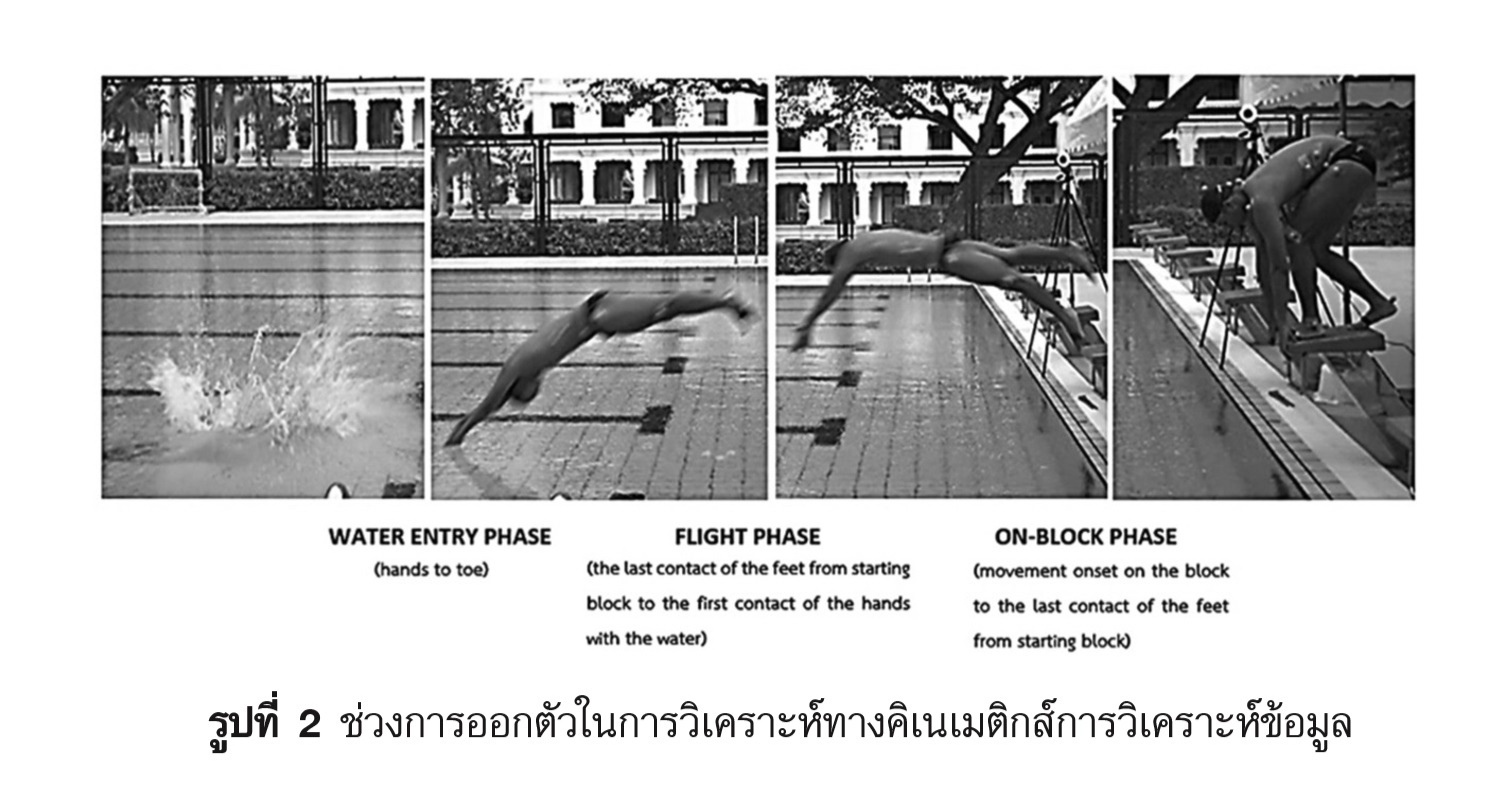
วัตถุประสงค์ : การวิจัยครั้งนี้มีวัตถุประสงค์เพื่อวิเคราะห์และเปรียบเทียบข้อมูลทางคิเนมาติกส์ของการออกตัวแบบเท้านำเท้าตามที่ระยะทางใกล้ที่สุด และระยะทางไกลที่สุดที่นักกีฬาสามารถทำได้ (Maximum Effort)
วิธีดำเนินการวิจัย : กลุ่มตัวอย่างคือ นักกีฬาว่ายน้ำชายจุฬาลงกรณ์มหาวิทยาลัย จำนวน 13 คน ทำการออกตัวแบบเท้านำเท้าตามด้วยความเร็วในการออกตัวสูงสุดจำนวน 10 ครั้ง เลือกครั้งที่ออกตัวได้ระยะทางใกล้ที่สุด จำนวน 1 ครั้ง และระยะทางไกลที่สุดที่นักกีฬาสามารถทำได้ จำนวน 1 ครั้ง บันทึกข้อมูลการเคลื่อนไหวด้วยกล้องวิเคราะห์การเคลื่อนไหวแบบ 3 มิติ ทำการติดมาร์คเกอร์ตามรูปแบบ Plug-In Gait Body Marker Placement จำนวน 4 จุด ส่วนยอดของกะโหลกศีรษะ, ปลายนิ้วกลางข้างซ้าย, ปุ่มกระดูกอุ้งเชิงกรานข้างซ้าย และส่วนปลายของนิ้วเท้าที่ห้าข้างซ้าย นำค่าเฉลี่ย ส่วนเบี่ยงเบนมาตรฐาน ของข้อมูลทางคิเนเมติกส์เปรียบเทียบผลระหว่างการออกตัวแบบเท้านำเท้าตามระยะทางใกล้ที่สุด และระยะทางไกลที่สุด ด้วยค่าทีรายคู่ (Paired t-test) โดยกำหนดระดับนัยสำคัญที่ระดับ .05
ผลการวิจัย : ความเร็วในแนวราบขณะออกตัวมุมในการออกตัว ระยะเวลาในการลอยตัวมุมในการลงสู่น้ำ และระยะเวลาในการมุดน้ำ ระหว่างการออกตัวแบบเท้านำเท้าตามระยะทางใกล้ที่สุด และ ระยะทางไกลที่สุด มีความแตกต่างกันอย่างมีนัยสำคัญทางสถิติ โดยเมื่อระยะทางในการออกตัวเพิ่มขึ้น ทำให้ระยะเวลาในการลอยตัวเพิ่มขึ้น ขณะที่มุมในการลงสู่น้ำ และระยะเวลาในการมุดน้ำน้อยลง อย่างไรก็ตาม ความเร็วในแนวราบขณะลงสู่น้ำออกตัวไม่แตกต่างกันอย่างมีนัยสำคัญทางสถิติที่ระดับ .05
สรุปผลการวิจัย : การกระโดดออกตัวแบบเท้านำเท้าตามที่มีประสิทธิภาพ ควรมีระยะทางในการกระโดดออกตัวไกลที่สุดเท่าที่นักกีฬาสามารถทำได้ ซึ่งจะส่งผลให้สามารถลงสู่น้ำได้อย่างรวดเร็ว ซึ่งควรมีระยะประมาณ 2 เท่าของความสูงของนักกีฬา
Article Details
เอกสารอ้างอิง
Alptekin, A. (2014). Body Composition and Kinematic Analysis of the Grab Start in Youth Swimmers Journal of Human Kinetics, 42, 15-26. doi:10.2478/hukin-2014-0057
Arellano, R., Cossor, J., Wilson, B., Cjatard, J., Riewald, S., & Mason, B. (2001). Modelling competitive swimming in different strokes and distances upon regression analysis: a study of the female participants of Sydney 2000 Olympic Games. Blackwell JR, Sanders RH XIXth International Symposium on Biomechanics in Sports. San Francisco; University of California, 53-56.
Blanksby, B., Nicholson, L., & Elliott, B. (2002). A biomechanical comparison of the grab, swing and track starts in swimming. Journal of Human Movement Studies, 39, 277-293.
Cossor, J., & Mason, B. (2001). Swim start performances at the Sydney 2000 Olympic Games. Paper presented at the XIXth International Symposium on Biomechanics in Sports, San Francisco.
Costill D.L. (1992). Handbook of sports medicine and science: swimming. Oxford, Blackwell Scientific.
Counsilman, J., Nomura, T., Endo, M., & Counsilman, B. (1988). A study of three types of grab start for competitive swimming. National Aquatics Journal, 4 (2), 2-6
Guimaraes, A., & Hay, J. (1985). A mechanical analysis of the grab starting technique in swimming. International Journal of Sport Biomechanics, 1, 25-35
Hay, J.C. (1986). Swimming Biomechanics: A brief review. Swimming Technique. Journal of Biomechanics, 23(3), 15-21.
Honda, K., Sinclair, P., Mason, B., & Pease, D. (2010). A biomechanical comparison of elite swimmers start performance using the traditional track start and the new kick start. Retrieved 18 February 2017 from https://www.coachesinfo.com/index.php?option=com_content&view=article&id=10308:a-biomechanical-comparisonof-eliteswimmers-start-performance-usingthe-traditional-track-start-and-the-newkick-start&catid=34:swimming-generalarticles&Itemid=334
Jorgic, B., Puletic, M., Stankovic, R., Okicic, T., Bubanj, S., & Bubanj, R. (2010). The kinematic analysis of the grab and track start in swimming. Journal of Physical Education and Sport, 8(10), 31-36
Kirner, K., Bock, M., & elch, J. (1989). A comparison of four different start combinations. Journal of Swimming Research, 5(2), 5-11
Kiuchi, H., Nakashima, M., Cheng, K., & Hubbard, M. (2010). Modeling fluid forces in the dive start of competitive swimming. Journal of Applied Biomechanics and Engineering, 5(4), 314-328.
Lee, C.Y., Huang, C.F., & Lee, C.W. (2012). Biomechanical analysis of the grab and track swimming starts. Paper presented at the 30th Annual Conference of Biomechanics in Sports Melbourne, Australia.
Lyttle, A., & Benjanuvatra, N. (2005). Start right? A biomechanical review of dive start performance. Retrieved from: https://coachesinfo.com/index.php?option=com_content&view=article&id=89:swimming-start-style&catid=g&Itemid=86
Maglischo, E. (2003). Swimming Fastest. Human Kinetics. Champaign, Illinois, U.S.A.
Murrell, D., & Dragunas, A. (2012). A comparison of two swimming start techniques from the Omega OSR11 Block. Western Undergraduate Research Journal: Health and Natural Sciences, 3. doi:10.5206/wurjhns.2012-13.1
Slawson, S., Conway, P., Justham, L., Le Sage, T., & West, A. (2010). Dynamic signature for tumble turn performance in swimming. Procedia Engineering, 2(2), 3391-3396.
Slawson, S., Conway, P., Cossor, J., Chakravorti, N., & West, A. (2013). The categorisation of swimming start performance with reference to force generation on the main block and footrest components of the Omega OSB11 start blocks. Journal of Sports Sciences, 31(5), 468-478.
Vantorre, J., Chollet, D., & Seifert, L. (2014). Biomechanical analysis of the swim start: A review Sports Science and Medicine, 13(2), 223-231.
Welcher, R. L., Hinrichs, R. N., & George, T. R. (2008). Front or rearweighted track start or grab start: which is the best for female swimmers? Sports Biomechanics, 7(1), 100-113.
