การเปรียบเทียบผลการฝึกสตาร์เอ๊กเคิลชั่นบาลานเทรนนิ่งแบบใช้และไม่ใช้แอนเคิลดิสก์ต่อการทรงตัวแบบเคลื่อนที่ในนักกีฬาบาสเกตบอลวัยรุ่นที่มีภาวะความไม่มั่นคงของข้อเท้าเรื้อรัง
Article Sidebar
Main Article Content
บทคัดย่อ
วัตถุประสงค์ : การวิจัยครั้งนี้มีวัตถุประสงค์เพื่อเปรียบเทียบผลของสตาร์เอ๊กเคิลชั่นบาลานเทรนนิ่งบนพื้นราบร่วมกับแอนเคิลดิสก์ (พื้นที่ไม่มั่นคง) ในนักกีฬาบาสเกตบอลวัยรุ่นที่มีภาวะความไม่มั่นคงของข้อเท้าเรื้อรัง
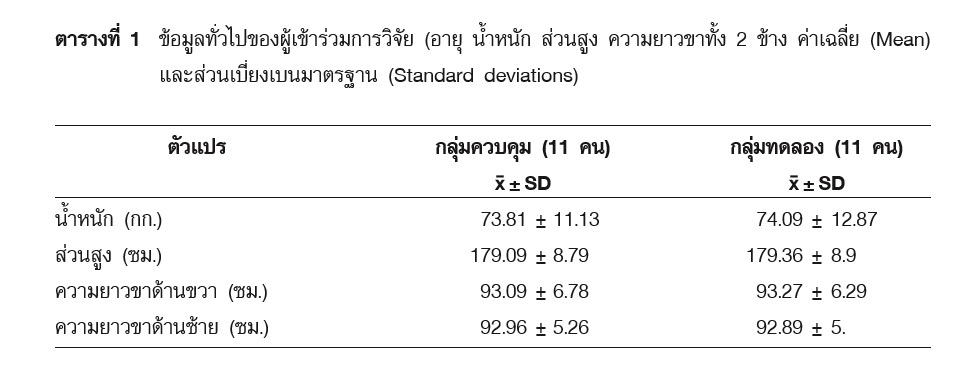
วิธีดำเนินการวิจัย : กลุ่มตัวอย่างที่ใช้ในการวิจัยครั้งนี้ เป็นนักกีฬาบาสเกตบอลชายระดับมัธยมศึกษาอายุ 13-16 ปี จำนวน 22 คน แบ่งออกเป็น 2 กลุ่ม สตาร์เอ๊กเคิลชั่นบาลานเทรนนิ่งร่วมกับแอนเคิลดิสก์ กลุ่มละ 11 คน คือ กลุ่มทดลอง ทำการฝึกด้วย (SEBTR+AD) และกลุ่มควบคุม ทำการฝึกด้วยสตาร์เอ๊กเคิลชั่นบาลานเทรนนิ่งอย่างเดียว (SEBTR) โดยทั้ง 2 กลุ่ม ทำการฝึก 3 วันต่อสัปดาห์ เป็นระยะเวลา 4 สัปดาห์ ก่อนและหลังการฝึก ทำการทดสอบประสิทธิภาพการทำงานของข้อเท้า ความสามารถในการทรงตัวด้วยวิธี Modified Clinical Test of Sensory Integration and Balance (m-CTSIB) และ ความสามารถในการทรงตัวด้วยวิธี Athletic single leg stability test จากนั้นนำผลมาวิเคราะห์ทางสถิติ โดยหาค่าเฉลี่ย ส่วนเบี่ยงเบนมาตราฐาน และเปรียบเทียบความแตกต่างระหว่างก่อนและหลังการทดลองโดยใช้การทดสอบที (T-test) กำหนดระดับนัยสำคัญทางสถิติที่ .05
ผลการวิจัย : หลังการฝึก 4 สัปดาห์ ไม่พบความแตกต่างอย่างมีนัยสำคัญทางสถิติที่ .05 ของทุกตัวแปรด้านการทรงตัวและประสิทธิภาพการทำงานของเท้าระหว่างกลุ่มทดลองและกลุ่มควบคุม
สรุปผลการวิจัย : การฝึกสตาร์เอ๊กเคิลชั่นบาลานเทรนนิ่งแบบใช้และไม่ใช้แอนเคิลดิสก์ ช่วยพัฒนาด้านการทรงตัวและประสิทธิภาพการทำงานของเท้าที่ไม่แตกต่างกันในนักกีฬาบาสเกตบอลที่มีภาวะความไม่มั่นคงของข้อเท้าเรื้้อรัง
Article Details
เอกสารอ้างอิง
Boccolini, G., Brazzit, A., Bonfanti, L., & Alberti, G. (2013). Using balance training to improvet the performance of youth basketball players. Sports Sciences for Health 9(2):37-42.
Borao, O., Planas, A., Beltran V., & Corbi, F. (2015). Effects of a 6-week neuromuscular ankle training program on the Star Excursion Balance Test for basketball players. Apunts. Medicina de l’Esport 50(187): 95-102.
Chan, K., Ding, B., & Mrocek, K.(2011). Acute and chronic lateral ankle instability in the athlete. Bulletin of the NYU hospital for Joint Diseases 69(1): 17.
Chaiwanisiri, D., Lorprayoon, E., & Noomanoch, L. (2005). Star Excursion Balance Training: Effects o Ankle Functional Stability after Ankle Sprain. Journal of the Medical Association of Thailand. 88 (4): 90-94.
Clark, V.M., & Burden, A.M. (2005). A 4-week wobble board exercise programme improved muscle onset latency and perceived stability in individuals with a functionally unstable ankle. Physical Therapy in Sport 6(4): 181-187.
Czajka, C., Tran, E., Cia, A., & DiPerta, J.(2014). Ankle sprains and instability. Medical Clinics of North America 98(2): 313-329.
Gutierrez, G., Kaminski, T., & Douex, A. (2009). Neuromuscular control and ankle instability. PM&R 1(4): 359-365.
Gauffin, H., Troop, H., & Odenrick, P. (1988). Effect of Ankle Disk Training on Postural Control in Patients with Functional Instability of the Ankle Joint. International Journal of Sports Medicine 09(2): 141-144.
Hertel, J. (2002). Functional anatomy, pathomechanics, and pathophysiology of lateral ankle instability. Journal of Athletic Training 37(4): 364.
Hootman, J.M., Dick, R., & Agel, J.(2007). Epidemiology of Collegiate Injuries for 15 Sports: Summary and Recommendations for Injury Prevention Initiatives. Journal of Athletic Training 42(2): 311-319.
Hoffman, J. R. (2008). Physiology of basketball. Handbook of sports medicine and science: Basketball: 12-24.
Holmes, A., & Delahunt, E.(2009). Treatment of common deficits associated with chronic ankle instability. Sports Medicine 39(3): 207-224.
Kaminski, T., Hertrl, J., Amendola, N., Docherty, C., Dolan, C., Hopkins, J., .... Richie, D.(2013). National Athletic Trainers’ Association position statement: conservative management and prevention of ankle sprains in athletes. Journal of Athletic Training 48(4): 528-545.
Klers, H., Brumagne, S., & Van Dieen, J.(2012). Ankle proprioception is not targeted by exercises on an unstable surface. European Journal of Applied Physiology 112(4): 1577-1585.
Martin, R., Davenport, T., Paulseth S., Wukish, M., & Godges, J.(2013). Ankle stability and movement coordination impairments: Ankle ligament sprains. Journal of Orthopaedic & Sports Physical Therapy.
McKeon, P., Ingersoll, C., Kerrigan, D., Saliba, F., Bennett, B., & Hertel, J.(2008). Balance training improves function and postural control in those with chronic ankle instability. Medicine Science in Sports and Exercise 40(10): 1810.
Mettler, A., Chinn., L., Susan, A., Saliba, A., McKeon, P., & Hertel, J.(2015). Balance training and center-of-pressure location in participants with chronic ankle instability. Journal of Athletic Training 50(4): 343-349.
Riva, D., Bianchi, R., Rocca, F., & Mamo, C.(2016). Proprioceptive training and injury prevention in a professional men’s basketball team: a six-year prospective study. Journal of Strength and Conditioning Research 30(2): 461.
Roijezon, U., Nicholas, C., & Treleaven, J.(2015). Proprioception in musculoskeletal rehabilitation. Part 1: Basic science and principles of assessment and clinical interventions. Manual Therapy 20( 3): 368-377.
