ผลฉับพลันของการแบกน้ำหนักกระโดดด้วยความหนักแตกต่างกันที่มีต่อพลังสูงสุดในนักกีฬาวอลเลย์บอลหญิง
Article Sidebar
Main Article Content
บทคัดย่อ
วัตถุประสงค์ : การวิจัยครั้งนี้มีวัตถุประสงค์เพื่อทดสอบการตอบสนองฉับพลันของการแบกน้ำหนักกระโดดด้วยความหนักแตกต่างกันที่มีต่อพลังสูงสุดในนักกีฬาวอลเลย์บอลหญิง
วิธีดำเนินการวิจัย : กลุ่มตัวอย่างเป็นนักกีฬาวอลเลย์บอล เพศหญิงช่วงอายุ 18-25 ปี จำนวน 10 คน โดยให้กลุ่มตัวอย่างแบกน้ำหนักกระโดดด้วยความหนักต่างกัน 3 รูปแบบ คือ ความหนัก 0 เปอร์เซ็นต์ 10 เปอร์เซ็นต์ และ 20 เปอร์เซ็นต์ ของ 1 อาร์เอ็ม โดยเว้นระยะห่างของการทดสอบอย่างน้อย 72 ชั่วโมง โดยในการทดสอบแต่ละเงื่อนไข จะกระโดดจำนวน 20 ครั้ง พักระหว่างการกระโดดแต่ละครั้ง 5 วินาที โดยใช้การถ่วงดุลลำดับ ทดสอบพลังสูงสุด แรงสูงสุด ความเร็ว สูงสุด โดยใช้เครื่อง FT 700 power system นำข้อมูลที่ได้มาวิเคราะห์ทางสถิติโดยหาค่าเฉลี่ย ส่วน เบี่ยงเบนมาตรฐาน วิเคราะห์ความแปรปรวนทางเดียวชนิดวัดซ้ำ เปรียบเทียบค่าเฉลี่ยของแต่ละรูปแบบ
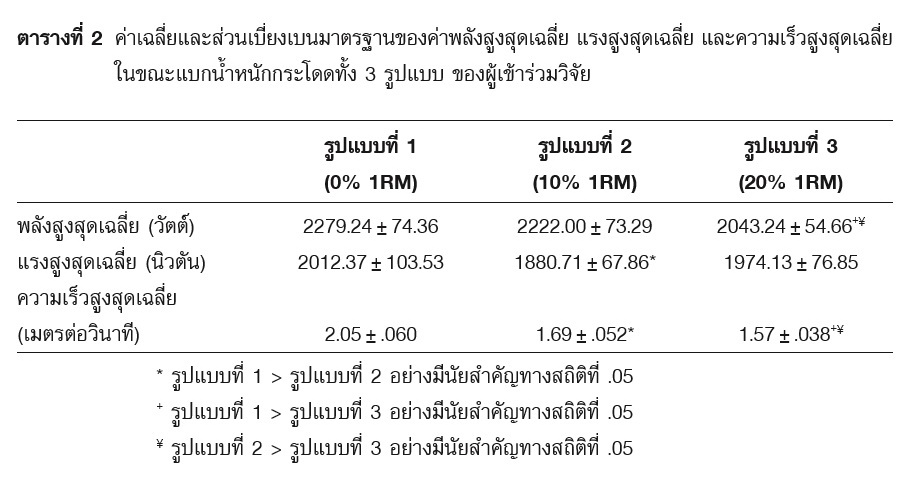
ผลการวิจัย : การกระโดดแบกน้ำหนักที่ ความหนัก 0 และ 10 เปอร์เซ็นต์ของ 1 อาร์เอ็ม ทำให้เกิดพลังสูงสุดเฉลี่ย มากกว่าความหนัก 20 เปอร์เซ็นต์ของ 1 อาร์เอ็ม อย่างมีนัยสำคัญทางสถิติที่ ระดับ .05 นอกจากนี้ การกระโดดแบกน้ำหนักที่ความหนัก 0 เปอร์เซ็นต์ของ 1 อาร์เอ็ม ทำให้เกิดแรงสูงสุดเฉลี่ยมากกว่าที่ความหนัก 10 เปอร์เซ็นต์ อย่างมีนัยสำคัญทางสถิติที่ระดับ .05 และทำให้เกิดความเร็วสูงสุดเฉลี่ยมากกว่าความหนัก 10 และ 20 เปอร์เซ็นต์ ของ 1 อาร์เอ็ม อย่างมีนัยสำคัญทางสถิติที่ระดับ .05
สรุปผลการวิจัย : การแบกน้ำหนักกระโดดด้วยความหนัก 0 เปอร์เซ็นต์ ของ 1 อาร์เอ็ม มีประสิทธิภาพ ทำให้เกิดพลังสูงสุดได้มากที่สุดในนักกีฬาวอลเลย์บอลหญิง
Article Details
เอกสารอ้างอิง
of Strength and Conditioning Research, 15(1), 92–97.
Bevan, H. R., Bunce, P. J., Owen, N. J., Bennett, M. A., Cook, C. J., Cunningham, D. J., and Kilduff, L. P. (2010). Optimal loading for the development of peak power output in professional rugby players. Journal of Strength and Conditioning Research, 24(1), 43-47.
Bompa, T., and Carrera, M. J. I. (2005). Periodization training for sports. Champaign, IL: Human Kinetics. 259.
Bompa, T. O., and Calcina, O. (1993). Periodization of strength: The new wave in strength training. Toronto : Veritas Publishing.
Cormie, P., McCaulley, G.O., and McBride, J.M. (2007). Power versus strength-power jump squat training: Influence on the loadpower relationship. Medicine and Science in Sports and Exercise, 39(6), 996-1003.
Cormie, P., Mccaulley, G.O., Tritlett, N.T., and Mcbride, J. M. (2007). Optimal loading for maximal power output during lowerbody resistance exercises. Medicine and Science in Sports and Exercise, 39(2), 340–349.
Harris, G. R., Stone, M. H., O’bryant, H. S., Proulx, C. M., and Johnson, R. L. (2000).Short-term performance effects of high power, high force, or combined weighttraining methods. Journal of Strength Conditioning Research, 14(1), 14-20.
Hoffman, J. R., Ratamess, N. A., Cooper, J. J., and Kang, J. (2005). Comparison of loaded and unloaded jump squat training on strength/power performance in college football players. Journal of Strength and Conditioning Research, 19(4), 810.
Poothong, S., and Intiraporn, C. (2017). Acute effect of complex training with different repetition and rest interval on peak power, force and velocity during jump
squat. Journal of Sports Science and Health, 18 (3), 63-72.
Purkhris, E., Krustrup, P., and Mohr, M. (2016). High-intensity training improves exercise performance in elite women volleyball players during a competitive season. Journal of Strength and Conditioning Research, 30(11), 3066-3072.
Sheppard, J.M., Dingley, A.A., Janssen, I., Spratford, W., Chapman, D.W., and Newton, R.U. (2011). The effect of assisted jumping on vertical jump height in high-performance volleyball players. Journal of Science and Medicine in Sport, 14(1), 85-89.
O'Bryant, H.S., McCoy, L., Coglianese, R., Lehmkuhl, M., and Schilling, B. (2003). Power and maximum strength relationships during performance of
dynamic and static weighted jumps.Journal of Strength and Conditioning Research, 17(1), 140–147.
Thomas, G. A., Kraemer, W. J., Spiering, B. A., and Volek, J. S. (2007). Maximal power at different percentages of one repetition maximum: influence of resistance and gender. Journal of Strength and Conditioning Research, 21(2), 336.
Wagner, H., Tilp, M., Duvillard, S. V., and Mueller, E. (2009). Kinematic analysis of volleyball spike jump. International Journal of Sports Medicine, 30(10), 760.
