การประยุกต์ใช้การฝึกการจำกัดการไหลเวียนเลือดร่วมกับการออกกำลังกายแบบใช้แรงต้านและแอโรบิก
Article Sidebar
Main Article Content
บทคัดย่อ
การจำกัดการไหลเวียนเลือด เป็นรูปแบบการฝึกรูปแบบใหม่ที่ใช้ความหนักในการฝึกอยู่ในระดับต่ำ แต่สามารถกระตุ้นการปรับตัวของระบบต่างๆ ในร่างกาย ได้เช่นเดียวกับการฝึกที่ความหนักระดับสูง โดยการฝึกการจำกัดการไหลเวียนเลือดนั้นมักจะทำร่วมกับการฝึกออกกำลังกายรูปแบบอื่นๆ อาทิเช่น การฝึกด้วยแรงต้าน หรือแอโรบิก โดยวิธีการในการฝึกคือจะนำเอาสายรัดมารัดไว้ที่บริเวณรยางค์ขาหรือแขนที่ใช้ในการออกกำลังกาย เพื่อให้เกิดภาวะการคั่งของเลือดที่กล้ามเนื้อบริเวณนั้นหรือกล้ามเนื้อส่วนปลายจากบริเวณที่รัด โดยส่วนใหญ่จะใช้สายรัดที่สามารถปรับแรงดันได้ ซึ่งการกดทับหลอดเลือดในลักษณะนี้จะส่งผลให้ลดการไหลของเลือดแดงมาสู่กล้ามเนื้อที่ทำงาน และลดเลือดดำที่ไหลกลับสู่หัวใจ ส่งผลให้การลำเลียงออกซิเจนเข้าสู่กล้ามเนื้อลดลง และมีการกำจัดของเสียจากระบบเผาผลาญพลังงานลดลง จนเกิดสภาวะไม่สมดุลของออกซิเจนในกล้ามเนื้อ ทำให้เนื้อเยื่อกล้ามเนื้อขาดออกซิเจน ส่งผลให้ระบบเผาผลาญพลังงานและระบบกล้ามเนื้อถูกกระตุ้นมากยิ่งขึ้น จนเกิดการตอบสนองของระบบไหลเวียนเลือดเพิ่มมากขึ้น ทำให้ร่างกายทำงานหนักขึ้น โดยที่ความหนักที่ใช้ในการออกกำลังกายต่ำ จึงส่งผลให้เกิดการปรับตัวของร่างกายเช่นเดียวกับการออกกำลังกายที่ความหนักระดับสูงกว่า อาทิเช่น เกิดการสร้างเนื้อเยื่อกล้ามเนื้อเพิ่มมากขึ้น ความแข็งแรงของกล้ามเนื้อเพิ่มมากขึ้น และเพิ่มสมรรถภาพทางแอโรบิกและแอนแอโรบิก ข้อดีของการฝึกการจำกัดการไหลเวียนเลือด คือ ช่วยลดความหนักของการฝึกลง ซึ่งเป็นประโยชน์อย่างมาก สำหรับผู้ที่มีข้อจำกัดในการฝึกออกกำลังกายที่มีความหนักระดับสูง โดยการฝึกรูปแบบนี้ไม่ก่อให้เกิดอันตรายต่อร่างกายของผู้ฝึก
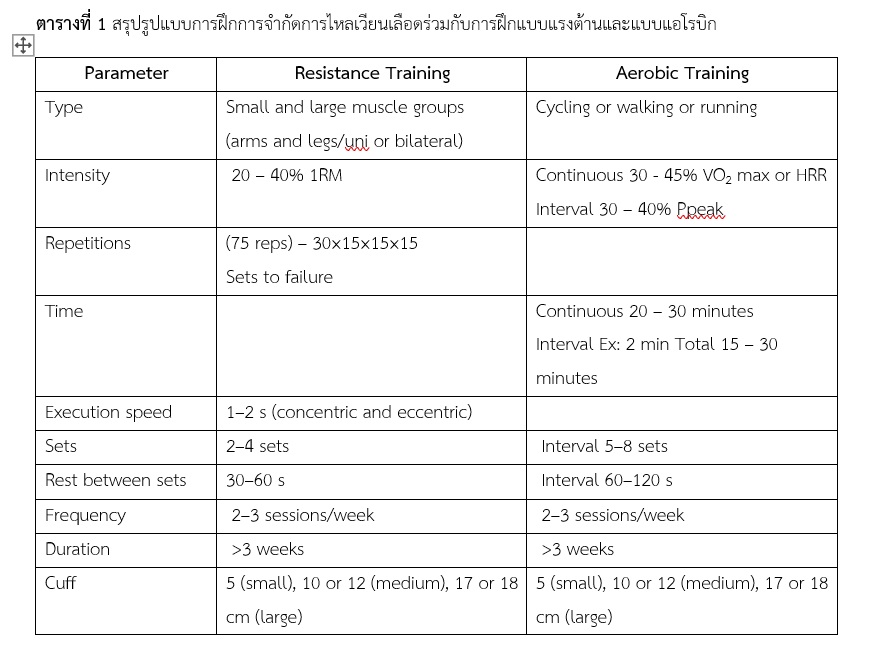
ดังนั้น บทความนี้มีวัตถุประสงค์เพื่อ 1) สรุป หลักการของอุปกรณ์และแรงดันในการจำกัดการไหลเวียนเลือด 2) สรุปหลักการในการฝึกการจำกัดการไหลเวียนเลือดควบคู่กับการออกกำลังกายแบบแรงต้าน และ 3) สรุปหลักการในการฝึกการจำกัดการไหลเวียนเลือด ควบคู่กับการออกกำลังกายแบบแอโรบิก เพื่อที่ผู้ปฏิบัติจะได้ทำความเข้าใจและสามารถนำการฝึกการจำกัดการไหลเวียนเลือดไปปฏิบัติต่อไปได้ และได้รับประโยชน์จากการฝึกการจำกัดการไหลเวียนเลือด
Article Details
เอกสารอ้างอิง
Abe, T., Fujita, S., Nakajima, T., Sakamaki, M.,Ozaki, H., Ogasawara, R., et al. (2010).Effects of low-intensity cycle training with restricted leg blood flow on thigh muscle volume and VO 2max in young men. Journal of Science and Medicine in Sport 9,452-458.
Abe, T., Kearns, C. F., and Sato, Y. (2006). Muscle size and strength are increased following walk training with restricted venous blood flow from the leg muscle, KAATSU-walk training. Journal of Applied Physiology 100, 1460-1466.
Bennett H1, Slattery F. (2019). Effects of Blood Flow Restriction Training on Aerobic Capacity and Performance: A Systematic Review. The Journal of Strength & Conditioning Research, 33(2):572-583.
Brandner, C. R., Kidgell, D. J., and Warmington, S. A. (2015). Unilateral bicep curl hemodynamics: low-pressure continuous vs high-pressure intermittent blood flow restriction. Scandinavian Journal in Medicine and Science in Sports 25,770-777.
Buckner, S. L., Dankel, S. J., Counts, B. R., Jessee, M. B., Mouser, J. G., Mattocks, K.T., et al. (2017). Influence of cuff material on blood flow restriction stimulus in the upper body. Journal of Physiological Sciences 67,207-215.
Centner, C., Wiegel, P., Gollhofer, A., and König, D. (2018a). Effects of blood flow restriction training on muscular strength and hypertrophy in older individuals: a systematic review and meta-analysis. Sports Medicine 49, 95-108.
Christiansen, D., Murphy, R. M., Bangsbo, J., Stathis, C. G., and Bishop, D. J. (2018). Increased FXYD1 and PGC-1α mRNA after blood flow-restricted running is related to fibre type-specific AMPK signalling and oxidative stress in human muscle. Acta Physiologica 223:e13045.
Conceição, M.S., Junior, E.M.M., Telles, G.D., Libardi, C.A., Castro, A., Andrade, A. L. L., et al. (2019). Augmented anabolic responses after 8-wk cycling with blood flow restriction. Medicine and Science In Sports and Exercise 51, 84-93.
Cook, S. B., Clark, B. C., and Ploutz-Snyder, L. L. (2007). Effects of exercise load and blood-flow restriction on skeletal muscle function. 39,1708-1713.
Corvino, R. B., Rossiter, H. B., Loch, T., Martins, J. C., & Caputo, F. (2017). Physiological responses to interval endurance exercise at different levels of blood flow restriction. European Journal of Applied Physiology, 117(1), 39-52.
Dankel, S. J., Jessee, M. B., Abe, T., and Loenneke, J. P. (2016). The effects of blood flow restriction on upper-body musculature located distal and proximal to applied pressure. Sports Medicine 46,23-33.
de Oliveira, M. F. M., Caputo, F., Corvino, R. B., and Denadai, B. S. (2016). Short-term low-intensity blood flow restricted interval training improves both aerobic fitness and muscle strength. Scandinavian Journal in Medicine and Science in Sports 26, 1017-1025.
Fahs, C. A., Loenneke, J. P., Thiebaud, R. S., Rossow, L. M., Kim, D., Abe, T., et al. (2015). Muscular adaptations to fatiguing exercise with and without blood flow restriction. Clinical Physiology and Functional Imaging 35, 167-176.
Fitschen PJ1, Kistler BM, Jeong JH, Chung HR, Wu PT, Walsh MJ, Wilund KR. (2014). Perceptual effects and efficacy of intermittent or continuous blood flow restriction resistance training. Clinical Physiology and Functional Imaging 34(5):356-63.
Fujita, T., Brechue, W., Kurita, K., Sato, Y., and Abe, T. (2008). Increased muscle volume and strength following six days of low-intensity resistance training with restricted muscle blood flow. International Journal of KAATSU Training Research 4,1-8.
Hughes, L., Paton, B., Rosenblatt, B., Gissane, C., and Patterson, S.D. (2017). Blood flow restriction training in clinical musculoskeletal rehabilitation: a systematic review and meta-analysis. British Journal of Sports Medicine 51, 1003-1011.
Jessee, M. B., Buckner, S. L., Dankel, S. J., Counts, B. R., Abe, T., and Loenneke, J. P. (2016). The influence of cuff width, sex, and race on arterial occlusion: implications for blood flow restriction research. Sports Medicine 46, 913-921.
Jessee, M. B., Dankel, S. J., Buckner, S. L., Mouser, J. G., Mattocks, K. T., and Loenneke, J. P. (2017). The cardiovascular and perceptual response to very low load blood flow restricted exercise. International Journal of Sports Medicine 38, 597-603.
Kacin, A., Rosenblatt, B., Zargi, T.G., and Biswas, A. (2015). Safety considerations with blood flow restricted resistance training. Varna Uporaba Vadbe Z Zmanjšanim PretokomKrvi. Ann. Kinesiology 6,3-26.
Keramidas ME, Kounalakis SN, Geladas ND. (2012). The effect of interval training combined with thigh cuffs pressure on maximal and submaximal exercise performance. Clinical Physiology and Functional Imaging 32: 205-213.
Kubota, A., Sakuraba, K., Koh, S., Ogura, Y., and Tamura, Y. (2011). Blood flow restriction by low compressive force prevents disuse muscular weakness. Journal of Science and Medicine in Sport 14,95-99.
Ladlow, P., Coppack, R.J., Dharm-Datta, S., Conway, D., Sellon, E., Patterson, S.D., et al. (2018). Low-load resistance training with blood flow restriction improves clinical outcomes in musculoskeletal rehabilitation: a single-blind randomized controlled trial. Frontiers in Physiology 9:1269.
Lixandrao, M. E., Ugrinowitsch, C., Berton, R., Vechin, F. C., Conceicao, M. S., Damas, F., et al. (2018). Magnitude of muscle strength and mass adaptations between high-load resistance training versus low-load resistance training associated with blood flow restriction: a systematic review and meta-analysis. Sports Medicine ????
Lixandrao, M. E., Ugrinowitsch, C., Laurentino, G., Libardi, C. A., Aihara, A. Y., Cardoso, F.N.,et al. (2015). Effects of exercise intensity and occlusion pressure after 12 weeks of resistance training with blood- flow restriction. European Journal of Applied Physiology 115,2471-2480.
Loenneke, J. P., Loprinzi, P. D., Abe, T., Thiebaud, R. S., Allen, K. M., Grant Mouser, J., et al. (2016). Arm circumference influences blood pressure even when applying the correct cuff size: is a further correction
needed? International Journal of Cardiology 202,743-744.
Loenneke, J. P., Thiebaud, R. S., Fahs, C. A., Rossow, L. M., Abe, T., and Bemben, M. G. (2014). Blood flow restriction: effects of cuff type on fatigue and perceptual responses to resistance exercise. Acta Physiologica Hungarica 101, 158-166.
Loenneke, J. P., Wilson, J. M., Marín, P. J., Zourdos, M. C., and Bemben, M. G. (2012). Low intensity blood flow restriction training: a meta-analysis. European Journal of Applied Physiology 112,1849-1859.
Loenneke, J.P., Allen, K.M., Mouser, J.G., Thiebaud, R.S., Kim,D., Abe, T., et al. (2015). Blood flow restriction in the upper and lower limbs is predicted by limb circumference and systolic blood pressure. European Journal of Applied Physiology 115, 397-405.
Mattocks, K. T., Jessee, M. B., Counts, B. R., Buckner, S. L., Grant Mouser, J., Dankel, S. J., et al. (2017). The effects of upper body exercise across different levels of blood flow restriction on arterial occlusion pressure and perceptual responses. Physiology & Behavior 171,181-186.
McEwen, J. A., Owens, J. G., and Jeyasurya, J. (2018). Why is it crucial to use personalized occlusion pressures in bloodflow restriction (BFR) rehabilitation? Journal of Medical and Biological Engineering39,7-11.
Nielsen, J. L., Aagaard, P., Bech, R. D., Nygaard, T., Hvid, L. G., Wernbom, M., et al. (2012). Proliferation of myogenic stem cells in human skeletal muscle in response to low-load resistance training with blood flow restriction. Journal of Physiology 590, 4351-4361.
Nielsen, J. L., Frandsen, U., Prokhorova, T., Bech, R. D., Nygaard, T., Suetta, C., et al. (2017). Delayed effect of blood flow-restricted resistance training on rapid force capacity. Medicine and Science In Sports and Exercise 49, 1157-1167.
Ozaki, H., Yasuda, T., Ogasawara, R., Sakamaki-Sunaga, M., Naito, H., and Abe, T. (2013). Effects of high-intensity and blood flowrestricted low-intensity resistance training on carotid arterial compliance: role of blood pressure during training sessions. European Journal of Applied Physiology 113,167-174.
Park, S., Kim, J. K., Choi, H. M., Kim, H. G., Beekley, M. D., and Nho, H. (2010). Increase in maximal oxygen uptake following 2-week walk training with blood flow occlusion in athletes. European Journal of Applied Physiology 109, 591-600.
Paton CD, Addis SM, Taylor LA. The effects of muscle blood flow restriction during running training on measures of aerobic capacity and run time to exhaustion. (2017). European Journal of Applied Physiology 117: 2579-2585.
Patterson SD, Hughes L, Warmington S, Burr J, Scott BR, Owens J, Abe T, Nielsen JL, Libardi CA, Laurentino G, Neto GR, Brandner C, Martin-Hernandez J, Loenneke J. (2019). Blood Flow Restriction Exercise: Considerations of Methodology, Application, and Safety. Frontiers in Physiology 22, 10: 1332.
Pearson, S. J., and Hussain, S. R. (2015). A review on the mechanisms of blood flow restriction resistance training-induced muscle hypertrophy. Sports Medecine. 45,187-200.
Pope, Z. K., Willardson, J. M., & Schoenfeld, B. J. (2013). Exercise and blood flow restriction. The Journal of Strength & Conditioning Research, 27(10), 2914-2926.
Rossow, L. M., Fahs, C. A., Loenneke, J. P., Thiebaud, R. S., Sherk, V. D., Abe, T., et al. (2012). Cardiovascular and perceptual responses to blood-flow-restricted resistance exercise with differing restrictive cuffs.Clinical Physiology and Functional Imaging 32,331-337.
Scott, B. R., Loenneke, J. P., Slattery, K. M., and Dascombe, B. J. (2015). Exercise with blood flow restriction: an updated evidence-based approach for enhanced muscular development. Sports Medicine. 45, 313-325.
Scott, Loenneke, Slattery, & Dascombe. (2016). Blood flow restricted exercise for athletes: A review of available evidence. Journal of Science and Medicine in Sport, 19(5), 360-367
Slysz, J., Stultz, J., and Burr, J. F. (2016). The efficacy of blood flow restricted exercise: a systematic review & meta-analysis. Journal of Science and Medicine in Sport 19, 669-675.
Suga T, Okita K, Morita N, Yokota T, Hirabayashi K, Horiuchi M, Takada S, Omokawa M, Kinugawa S, Tsutsui H. (2010). Doseeffect on intramuscular metabolic stress during low-intensity resistance exercise with blood flow restriction. Journal of Applied Physiology 108:1563-1567.
Takarada, Y., Sato, Y., and Ishii, N. (2002). Effects of resistance exercise combined with vascular occlusion on muscle function in athletes. European Journal of Applied Physiology 86, 308-314.
Taylor, C. W., Ingham, S.A., and Ferguson, R.A. (2016). Acute and chronic effect of sprint interval training combined with post exercise blood-flow restriction in trained individuals. Experimental Physiology 101,143-154.
Yasuda, T., Loenneke, J. P., Ogasawara, R., and Abe, T. (2013). Influence of continuous or intermittent blood flow restriction on muscle activation during low-intensity multiple sets of resistance exercise. Acta Physiologica Hungarica. 100, 419-426.
