ผลของการฝึกด้วยแรงต้านต่ำภายใต้ภาวะออกซิเจนเบาบางระดับปานกลางที่มีต่อความแข็งแรงและพลังของกล้ามเนื้อในนักกีฬาหญิงประเภททีมระดับมหาวิทยาลัย
Article Sidebar
Main Article Content
บทคัดย่อ
วัตถุประสงค์ : การวิจัยครั้งนี้มีวัตถุประสงค์เพื่อศึกษาและเปรียบเทียบผลของการฝึกด้วยแรงต้านต่ำภายใต้ภาวะออกซิเจนเบาบางที่มีต่อความแข็งแรงและพลังของกล้ามเนื้อในนักกีฬาหญิงประเภททีมระดับมหาวิทยาลัย
วิธีดำเนินการวิจัย : กลุ่มตัวอย่างเป็นนักกีฬาหญิงประเภททีม อายุระหว่าง 19-23 ปี จำนวน 19 คน ของมหาวิทยาลัยราชภัฏอุบลราชธานี ได้จากการเลือกแบบเจาะจง (Purposive sampling) แบ่งเป็น 2 กลุ่ม ได้แก่ กลุ่มทดลอง (Hypoxic group, n = 10) ทำการฝึกภายใต้ภาวะออกซิเจนเบาบางระดับปานกลาง (F1O2 = 15.8%) และกลุ่มควบคุม (Normoxic group, n = 9) ทำการฝึกในภาวะออกซิเจนปกติ (F1O2 = 20.9%) ทั้งสองกลุ่มทำการฝึกออกกำลังกายด้วยแรงต้านต่ำ 50% 1RM ในท่า Knee extension และ Knee flexion จำนวนท่าละ 3 เซทๆละ 15 ครั้ง ระยะเวลาในการพักระหว่างเซท 1 นาที จำนวน 3 วันต่อสัปดาห์ เป็นระยะเวลา 5 สัปดาห์ ทำการทดสอบองค์ประกอบของร่างกาย ความแข็งแรงสูงสุดของกล้ามเนื้อ ความอดทนของกล้ามเนื้อ พลังของกล้ามเนื้อ และสมรรถภาพการใช้ออกซิเจนสูงสุด ก่อนและหลังการทดลอง 5 สัปดาห์
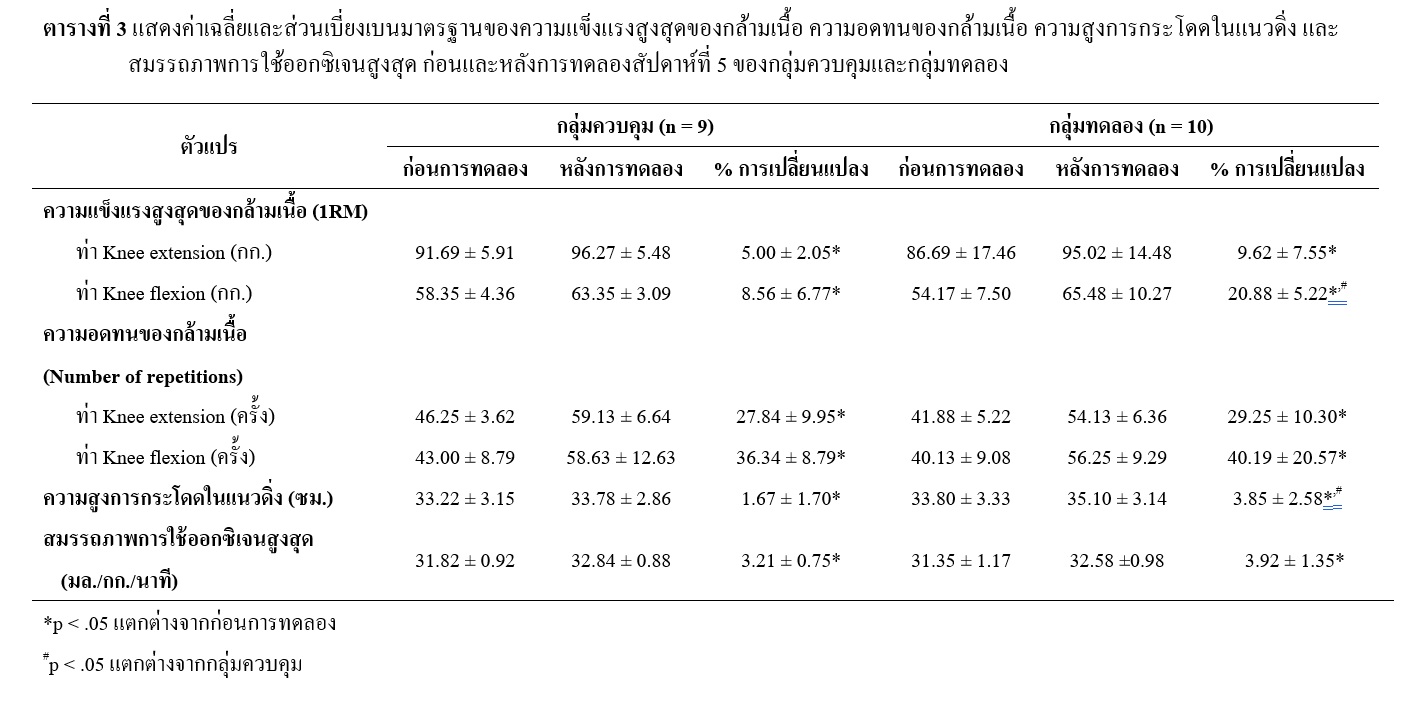
ผลการวิจัย : ความแข็งแรงสูงสุดของกล้ามเนื้อในท่า Knee flexion และความสูงการกระโดดในแนวดิ่งเพิ่มขึ้นในกลุ่มทดลอง (20.88% และ 3.85%) เมื่อเปรียบเทียบกับกลุ่มควบคุม (8.56% และ 1.67%, p < 0.05) นอกจากนี้ ค่าร้อยละมวลไขมันและมวลที่ปราศจากไขมันของกลุ่มทดลองดีขึ้น เมื่อเปรียบเทียบกับก่อนการฝึก (-3.48% และ 2.34%) โดยไม่พบความแตกต่างระหว่างกลุ่ม (p > 0.05)
สรุปผลการวิจัย : การออกกำลังกายด้วยแรงต้านต่ำ (50% 1RM) ภายใต้ภาวะออกซิเจนเบาบางระดับปานกลาง (F1O2 = 15.8%) มีประสิทธิภาพในการเพิ่มความแข็งแรงและพลังของกล้ามเนื้อได้ จึงเป็นอีกหนึ่งทางเลือกในการฝึกที่ช่วยลดความเสี่ยงที่อาจจะเกิดการบาดเจ็บและเพื่อพัฒนาสมรรถภาพกล้ามเนื้อในนักกีฬาหญิงประเภททีมได้เป็นอย่างดี
Article Details
เอกสารอ้างอิง
American College of Sports Medicine position stand. (2009). American College of Sports Medicine position stand. Progression models in resistance training for healthy adults. Medicine & Science in Sports & Exercise, 41(3), 687-708.
Brzycki, M. (1988). A practical approach to strength training. Illinois: Master Press.
Cohen, J. (1988). Statistical Power Analysis for the Behavioral Sciences. 2nd ed. Hillsdale, New Jersey: Erlbaum.
Cook, S. B., Scott, B. R., Hayes, K. L., & Murphy, B. G. (2018). Neuromuscular Adaptations to Low-Load Blood Flow Restricted Resistance Training. Journal of Sports Science & Medicine, 17, 66-73.
Dufour, S. P., Ponsot, E., Zoll, J., Doutreleau, S., Lonsdorfer-Wolf, E., Geny, B., Lampert, E., Flück, M., Hoppeler, H., Billat, V. Mettauer, B., Richard, R., & Lonsdorfer, J. (2006). Exercise training in normobaric hypoxia in endurance runners. I. Improvement in aerobic performance capacity. Journal of Applied Physiology, 100(4), 1238-1248.
Gonzalez, A. M., Hoffman, J. R., Stout, J. R., Fukuda, D. H., & Willoughby, D. S. (2016). Intramuscular Anabolic Signaling and Endocrine Response Following Resistance Exercise: Implications for Muscle Hypertrophy. Sports Medicine, 46(5), 671-685.
Hakkinen, K., & Komi, P. (1983). Electromyographic changes during strength training and detraining. Medicine & Science in Sports & Exercise, 15(6), 455-460.
Heinonen, I., Bucci, M., Kemppainen, J., Knuuti, J., Nuutila, P., Boushel, R., & Kalliokoski, K. K. (2012). Regulation of subcutaneous adipose tissue blood flow during exercise in humans. Journal of Applied Physiology, 112(6), 1059-1063.
Hoppeler, H., Vogt, M., Weibel, E. R., & Flück, M. (2003). Response of Skeletal Muscle Mitochondria to Hypoxia. Experimental Physiology, 88(1), 109-119.
Kon, M., Ohiwa, N., Honda, A., Matsubayashi, T., Ikeda, T., Akimoto, T., Suzuki, Y., Hirano, Y., & Russell, A. P. (2014). Effects of systemic hypoxia on human muscular adaptations to resistance exercise training. Physiological Reports, 2(6), e12033.
Kurobe, K., Huang, Z., Nishiwaki, M., Yamamoto, M., Kanehisa, H., & Ogita, F. (2015). Effects of resistance training under hypoxic conditions on muscle hypertrophy and strength. Clinical Physiology and Functional Imaging, 35(3), 197-202.
Manimmanakorn, A., Hamlin, M. J., Ross, J. J., Taylor, R., & Manimmanakorn, N. (2013). Effects of low-load resistance training combined with blood flow restriction or hypoxia on muscle function and performance in netball athletes. Journal of Science and Medicine in Sport, 16(4), 337-342.
Mazzeo, R. S. (2008). Physiological Responses to Exercise at Altitude: An Update. Sports Medicine, 38(1), 1-8.
Namboonlue, C., Hamlin, M. J., Sirasaporn, P., Manimmanakorn, N., Wonnabussapawich, P., Thuwakum, W., Sumethanurakkhakun, W., & Manimmanakorn, A. (2020). Optimal degree of hypoxia combined with low-load resistance training for muscle strength and thickness in athletes. Journal of Physical Education and Sport, 20(2), 828-838.
Nishimura, A., Sugita, M., Kato, K., Fukuda, A., Sudo, A., & Uchida, A. (2010). Hypoxia Increases Muscle Hypertrophy Induced by Resistance Training. International Journal of Sports Physiology and Performance, 5(4), 497-508.
Powell, K. E., Heath, G. W., Kresnow, M.-J., Sacks, J. J., & Branche, C. M. (1998). Injury rates from walking, gardening, weightlifting, outdoor bicycling, and aerobics: Medicine & Science in Sports & Exercise, 30(8), 1246-1249.
Romijn, J. A., Coyle, E. F., Sidossis, L. S., Gastaldelli, A., Horowitz, J. F., Endert, E., & Wolfe, R. R. (1993). Regulation of endogenous fat and carbohydrate metabolism in relation to exercise intensity and duration. American Journal of Physiology-Endocrinology and Metabolism, 265(3), E380-E391.
Scott, B. R., Goods, P. S. R., & Slattery, K. M. (2016). High-Intensity Exercise in Hypoxia: Is Increased Reliance on Anaerobic Metabolism Important? Frontiers in Physiology, 7, 1-4.
Thuwakum, W., Hamlin, M. J., Manimmanakorn, N., Leelayuwat, N., Wonnabussapawich, P., Boobpachat, D., & Manimmanakorn, A. (2017). Low-load resistance training with hypoxia mimics traditional strength training in team sport athletes. Journal of Physical Education and Sport, 17(1), 240-247.
Tschöp, M., Strasburger, C. J., Hartmann, G., Biollaz, J., & Bärtsch, P. (1998). Raised leptin concentrations at high altitude associated with loss of appetite. Lancet, 312, 1119-1120.
Wernbom, M., Augustsson, J., & Raastad, T. (2008). Ischemic strength training: A low-load alternative to heavy resistance exercise?: Ischemic strength training. Scandinavian Journal of Medicine & Science in Sports, 18(4), 401-416.
West, J. B. (1996). Prediction of barometric pressures at high altitudes with the use of model atmospheres. Journal of Applied Physiology, 81(4), 1850-1854.
Wiesner, S., Haufe, S., Engeli, S., Mutschler, H., Haas, U., Luft, F. C., & Jordan, J. (2010). Influences of Normobaric Hypoxia Training on Physical Fitness and Metabolic Risk Markers in Overweight to Obese Subjects. Obesity, 18(1), 116-120.
Yan, B., Lai, X., Yi, L., Wang, Y., & Hu, Y. (2016). Effects of Five-Week Resistance Training in Hypoxia on Hormones and Muscle Strength: Journal of Strength and Conditioning Research, 30(1), 184-193.
