ผลของระยะเวลาพักต่อการตอบสนองของแรงดันหายใจเข้าสูงสุดและอัตราการ เต้นของหัวใจขณะออกกำลังกายแบบมวยไทยในผู้หญิงที่มีภาวะอ้วน
Article Sidebar
Main Article Content
บทคัดย่อ
วัตถุประสงค์การวิจัย:
เพื่อศึกษาผลของความแตกต่างของระยะเวลาพักระหว่างการออกกำลังกายมวยไทย ที่มีต่อการตอบสนองของค่าแรงดันหายใจเข้าสูงสุดและอัตราการเต้นของหัวใจในผู้หญิงที่มีภาวะอ้วน
วิธีการดำเนินการวิจัย:
อาสาสมัครเพศหญิงที่มี ภาวะอ้วนระดับที่ 1 จำนวน 10 คน (อายุเฉลี่ย 21.5 ± 0.5 ปี) แต่ละคนทดสอบออกกำลังกายมวยไทย ทั้งหมด 3 โปรแกรม แต่ละโปรแกรมออกกำลังกาย ประกอบด้วยจำนวน 5 ยก ๆ 3 นาที โดยมีระยะเวลา พักระหว่างยกแตกต่างกันได้แก่ 2, 4 และ 6 นาที (3:2, 3:4, และ 3:6 ตามลำดับ) วัดค่าแรงดันหายใจ เข้าสูงสุดโดยเครื่องวัดแรงดันหายใจก่อนและหลังการ ออกกำลังกาย และวัดอัตราการเต้นของหัวใจโดย อุปกรณ์วัดอัตราการเต้นของหัวใจแบบไร้สายตลอด ช่วงทดสอบการออกกำลังกาย วิเคราะห์ข้อมูลทางสถิติ ด้วยการทดสอบความแปรปรวน 2 ทางชนิดวัดซ้ำและ เปรียบเทียบความแตกต่างระหว่างเงื่อนไขด้วยวิธีของ Bonferroni โดยกำหนดระดับนัยสำคัญทางสถิติที่ p < 0.05
ผลการวิจัย:
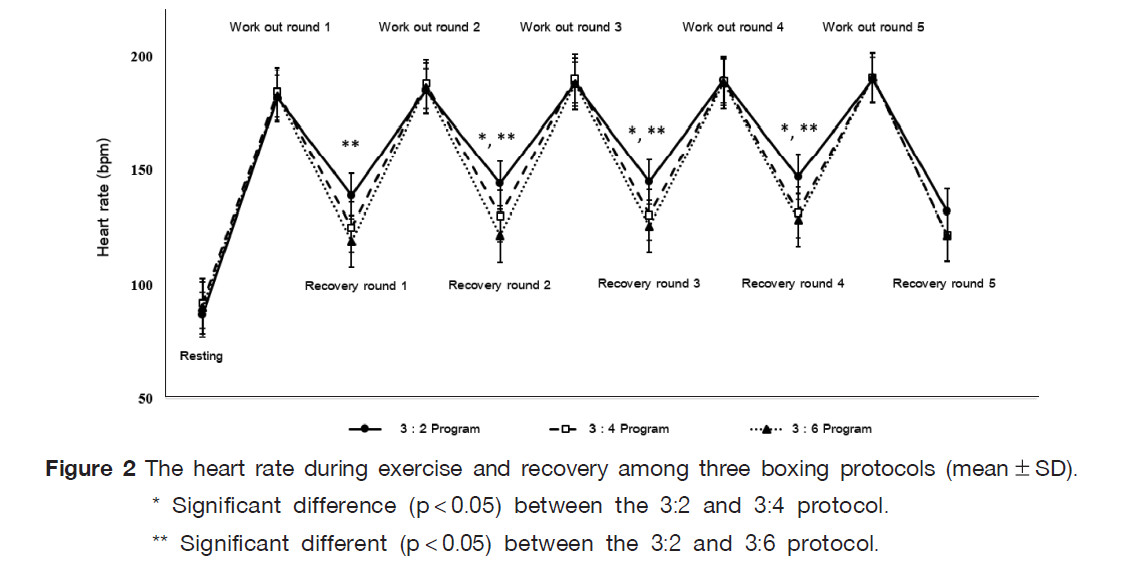
พบว่าทั้งสามโปรแกรมมีการตอบ สนองของค่าอัตราการเต้นหัวใจขณะออกกำลังกายสูง กว่าขณะพัก (p < 0.05) โดยโปรแกรมการออกกำลัง กายมวยไทยแบบ 3:2 มีค่าอัตราการเต้นของหัวใจขณะ พักระหว่างยกสูงกว่าเมื่อเทียบกับโปรแกรมการออก กำลังกายแบบ 3:4 และ 3:6 ตามลำดับ (p < 0.05) นอกจากนี้ การตอบสนองของค่าแรงดันหายใจเข้า สูงสุดหลังออกกำลังกาย ทุกโปรแกรมการมีค่าลดลง เมื่อเทียบกับก่อนการออกกำลังกาย (p < 0.05) อย่างไร ก็ตาม เปอร์เซ็นต์การเปลี่ยนแปลงของค่าแรงดัน หายใจเข้าสูงสุดหลังการการออกกำลังกาย พบว่าไม่มี ความแตกต่างกันเมื่อเปรียบเทียบระหว่างทุกโปรแกรม (p > 0.05)
สรุปผลการวิจัย:
ระยะเวลาการพักระหว่างออก กำลังกายแบบมวยไทยที่แตกต่างกัน ส่งผลต่อการ เปลี่ยนแปลงการตอบสนองของค่าอัตราการเต้นของ หัวใจ แต่ไม่มีผลต่อค่าแรงดันหายใจเข้าสูงสุดหลังออก กำลังกายในผู้ที่มีภาวะอ้วนระดับที่หนึ่ง
Article Details
เอกสารอ้างอิง
American Thoracic Society and European Respiratory Society. (2002). ATS/ERS statement on respiratory muscle testing. American Journal of Respiratory and Critical Care Medicine, 166(4), 518-624.
Bischoff SC, Boirie Y, Cederholm T, Chourdakis M, Cuerda C, Delzenne NM, et al. (2017). Towards a multidisciplinary approach to understand and manage obesity and related diseases. Clinical Nutrition, 36(4),917-938.
Chen TA, Baranowski T, Moreno JP, O’Connor TM, Hughes SO, Baranowski J, et al. (2016). Obesity status trajectory groups among elementary school children. BMC Public Health, 16, 526-538.
Chidnok W, DiMenna FJ, Fulford J, Bailey SJ, Skiba PF, Vanhatalo A, et al. (2013). Muscle metabolic responses during high intensity intermittent exercise measured by (31)P-MRS: relationship to the critical power concept. American Journal of Physiology-Regulatory, Integrative and Comparative Physiology, 305(9), 1085-1092.
Coast JR, Clifford PS, Henrich TW, Stray- Gundersen J and Johnson Jr RL. (1990). Maximal inspiratory pressure following maximal exercise in trained and untrained subjects. Medicine and Science in Sports and Exercise, 22(6), 811-815.
Cohen J. (1992). A power primer. Psychological Bulletin, 122(1), 155-159.
Crisafulli A, Vitelli S, Cappai I, Milia R, Tocco F, Melis F, et al. (2009). Physiological responses and energy cost during a simulation of a Muay Thai boxing match. Applied Physiology, Nutrition, and Metabolism, 34(2), 143-150.
de Lira CA, Peixinho-Pena LF, Vancini RL, de Freitas Guina Fachina RJ, de Almeida AA, Andrade Mdos S, et al. (2013). Heart rate response during a simulated olympic boxing match is predominantly above ventilator threshold 2: a cross sectional study. Open Access Journal of Sports Medicine, 4, 175-182.
El-Ashker S, Chaabene H, Negra Y, Prieske O and Granacher U. (2018). Cardiorespiratory endurance responses following a simulated 3 3 minutes amateur boxing contest in elite level boxers. Multidisciplinary Digital Publishing Institute, 6(4), 119-127.
Johnson BD, Aaron EA, Babcock MA and Dempsey JA. (1996). Respiratory muscle fatigue during exercise: implications for performance. Medicine and Science in Sports and Exercise, 28(9), 1129-1137.
Jones AM and Vanhatalo A. (2017). The ‘Critical Power’ Concept: Applications to Sports Performance with a Focus on Intermittent High-Intensity Exercise. Sports Medicine, 47(1), 65-78.
McQueen MA. (2009). Exercise aspects of obesity treatment. Ochsner Journal, 9(3),140-143.
Mongkol S. (2012). The effect of obesity on respiratory and cardiovascular system.Journal of Associated Medical Sciences, 45(3), 10-16.
Nassib S, Hammoudi-Nassib S, Chtara M, Mkaouer B, Maaouia G, Bezrati-Benayed I, et al. (2017). Energetics demands and physiological responses to boxing match and subsequent recovery. Journal of Sports Medicine and Physical Fitness, 57(1), 8-17.
Ozkaplan A, Rhodes EC, Sheel AW and Taunton JE. (2005). A comparison of inspiratory muscle fatigue following maximal exercise in moderately trained males and females. European Journal of Applied Physiology, 95(1), 52-56.
Rabec C, De P and Ramos L. (2011). Respiratory Complications of Obesity. Arch Bronconeumol, 47(5), 252-261.
Ramar K and Caples SM. (2010). Cardiovascular Consequences of Obese and Nonobese Obstructive Sleep Apnea. Medical Clinics of North America, 94(3), 465-478.
Ramírez-Vélez R, Hernández-Quiáones PA,Tordecilla-Sanders A, Álvarez C, Ramírez-Campillo R, Izquierdo M, et al. (2019).Effectiveness of HIIT compared to moderate continuous training inimproving vascular parameters in inactive adults. Lipids in Health and Disease, 18(1), 42.
Riebe D, Ehrman JK and Liguori G MM. (2017).ACSM’s guidelines for exercise testing and prescription (10 th ed.). Philadelphia: Wolters Kluwer.
Scano G, Stendardi L and Bruni GI. (2009). The respiratory muscles in eucapnic obesity. Respiratory Medicine, 103(9),1276-1285.
Sheel AW, Boushel R and Dempsey JA. (2018). Competition for blood flow distribution between respiratory and locomotor muscles: implications for muscle fatigue.Journal of Applied Physiology, 125(3),820-831.
Tarapong C, Thanaphongwisan P, Wichianwan P, Namwong R, Wiangkham T and Chidnok W. (2019). Effect of Thai boxing exercise training on maximal ventilation in obese subject. Journal of Sport and Health Science,20(1), 88-98.
Wewege M, van den Berg R, Ward RE and Keech A. (2017). The effects of high-intensity interval training vs. moderate-intensity continuous training on body composition in overweight and obese adults: a systematic review and metaanalysis. Obesity Reviews, 18(6), 635-646.
TU, Marty J, Kerherve H, Millet GY, Verges S and Spengler CM. (2015). Aspects of respiratory muscle fatigue in a mountain ultramarathon race. Medicine and Science in Sports and Exercise, 47(3),519-527.
Zammit C, Liddicoat H and Moonsie I. (2010).Obesity and respiratory disease. International Journal of General Medicine, 3, 335-343.
