ผลของระยะเวลาพักระหว่างเที่ยวที่มีต่อความสามารถในการวิ่งสปริ้นท์ซ้ำในนักฟุตบอลหญิง
Article Sidebar
Main Article Content
บทคัดย่อ
วัตถุประสงค์:
การวิจัยครั้งนี้มีวัตถุประสงค์เพื่อศึกษาผลของการฝึกสปริ้นท์ซ้ำที่อัตราส่วนการวิ่งต่อ การพัก 1:1, 1:2 และ 1:3 ที่มีต่อความสามารถในการสปริ้นท์ซ้ำในนักกีฬาฟุตบอลหญิง
วิธีดำเนินการวิจัย:
กลุ่มตัวอย่างเป็นนักกีฬาฟุตบอลหญิงอาชีพระดับสโมสรไทยลีกอายุ 18-24 ปี จำนวน 36 คน โดยการสุ่มแบ่งเป็น 3 กลุ่ม ๆ ละ 12 คน ได้แก่ กลุ่มที่ 1 ฝึกวิ่งสปริ้นท์ซ้ำที่อัตราส่วน การวิ่งต่อการพักเท่ากับ 1:1 กลุ่มที่ 2 ฝึกวิ่งสปริ้นท์ซ้ำที่อัตราส่วนการวิ่งต่อการพักเท่ากับ 1:2 และกลุ่ม ที่ 3 ฝึกวิ่งสปริ้นท์ซ้ำที่อัตราส่วนการวิ่งต่อการพักเท่ากับ 1:3 โดยทั้ง 3 กลุ่ม ได้รับการฝึกสัปดาห์ละ 2 วัน เป็นเวลา 6 สัปดาห์ ทำการทดสอบตัวแปรทางสรีรวิทยา ความสามารถในการวิ่งสปริ้นท์ซ้ำและเวลาที่ใช้ในการวิ่งเร็วสูงสุด ก่อนและหลังการฝึกวิเคราะห์ผลทางสถิติ โดยการทดสอบความแปรปรวนทางเดียว(One-way ANOVA) กำหนดระดับความมีนัยสำคัญที่ 0.05
ผลการวิจัย:
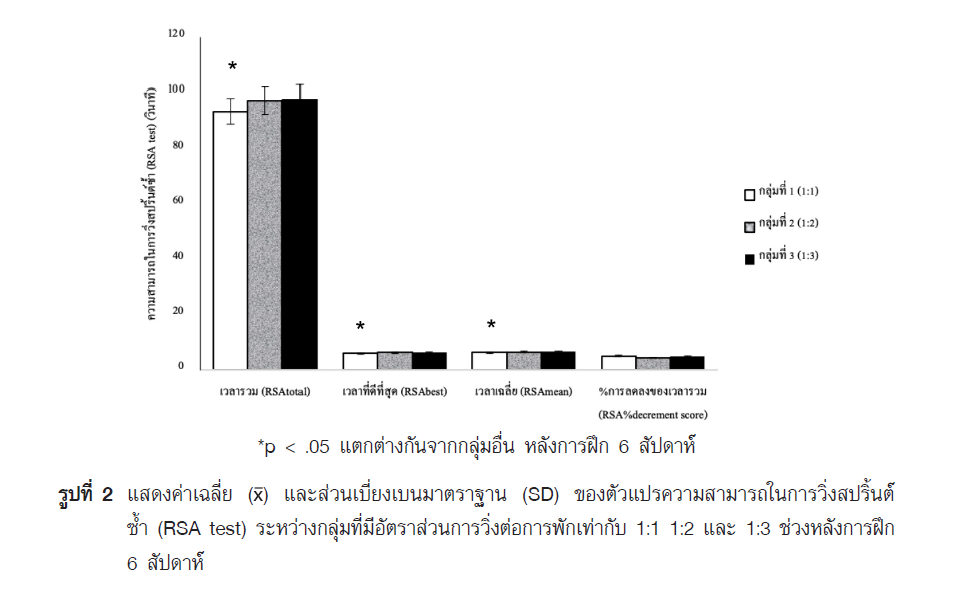
1. หลังจากการฝึก 6 สัปดาห์ พบว่า เวลารวมในการวิ่งสปริ้นท์ซ้ำเวลาที่ดีที่สุดในการวิ่งสปริ้นท์ซ้ำ เวลาเฉลี่ยในการวิ่งสปริ้นท์ซ้ำ และเปอร์เซ็นต์การลดลงของเวลารวมในการวิ่งสปริ้นท์ซ้ำ ของกลุ่มที่มีอัตราส่วนการวิ่งต่อการพักเท่ากับ 1:1 เท่านั้นที่ลดลงอย่างมีนัยสำคัญทางสถิติ ที่ระดับ.05 ส่วนเวลาในการวิ่งเร็วสูงสุดที่ระยะทาง 10 เมตร 20 เมตร และ 40 เมตรของทั้งสามกลุ่ม ลดลงหลังการฝึกอย่างมีนัยสำคัญทางสถิติ ที่ระดับ.05 2. เมื่อเปรียบเทียบระหว่างกลุ่มหลังการฝึกพบว่า เวลารวมในการวิ่งสปริ้นท์ซ้ำ เวลาที่ดีที่สุดในการวิ่งสปริ้นท์ซ้ำ เวลาเฉลี่ยในการวิ่งสปริ้นท์ซ้ำและเวลาในการวิ่งเร็วสูงสุดที่ระยะทาง 10 เมตร ของกลุ่มอัตราส่วนการวิ่งต่อการพักเท่ากับ 1:1 มีการลดลงมากกว่ากลุ่มอื่นอย่างมีนัยสำคัญทางสถิติ ที่ระดับ .05
สรุปผลการวิจัย:
การฝึกวิ่งสปริ้นท์ซ้ำด้วยความเร็วสูงสุดด้วยอัตราส่วนการวิ่งต่อการพักที่แตกต่างกันที่สุด ส่งผลดี ต่อความสามารถในการวิ่งสปริ้นท์ซ้ำและเวลาที่ใช้ในการวิ่งเร็วสูงสุดระยะสั้นโดยพบว่าอัตราส่วนการวิ่งต่อการพักเท่ากับ 1:1 เป็นรูปแบบที่เหมาะสมในการฝึกพัฒนาทักษะด้านดังกล่าว
Article Details
เอกสารอ้างอิง
Barnett, A. (2006). Using recovery modalities between training sessions in elite athletes: does it help. Journal of Sports Medicine,36(9), 781-796.
Barnett, C., Carey, M., Proietto, J., Cerin, E., Febbraio, M. A., & Jenkins, D. (2004).Muscle metabolism during sprint exercise in man: influence of sprint training. Journal Science and Medicine in Sport, 7(3), 314-322.
Beato, M., Coratella, G., Bianchi, M., Costa, M., & Merlini, M. (2019). Short-Term Repeated-Sprint Training (Straight Sprint vs. Changes of Direction) in Soccer Players. Journal of Human Kinetics, 70, 183-190.
Bishop, D., Girard, O., & Mendez-Villanueva, A. (2011). Repeated-sprint ability-part II: recommendations for training. Journal Science and Medicine in Sport, 41(9),741-756.
Bloomfield, J., Polman, R., & O’Donoghue, P.(2007). Physical demands of different positions in FA Premier League soccer. Journal Science and Medicine in Sport, 6,63-70.
Brian, D., Martin, F., Simon, G., Carmel, G., C.,M., & Keith, C. (1998). Changes in performance, muscle metabolites, enzymes and fiber types after short sprint training. European Journal of Applied Physiology, 78, 163-169.
Buchheit, M., & Laursen, P. (2013). High-intensity interval training, solutions to the programming puzzle: Part I: cardiopulmonary emphasis. Journal of Sports Medicine, 43(5), 313-338.
Burgess, D. J., Naughton, G., and Norton, K.I. (2006). Profile of movement demands of national football players in football players in Australia. Journal Science and Medicine in Sport, 9, 334-341.
David, B., Olivier, G., & Alberto, M. V. (2011). Repeated-Sprint Ability Part II. Journal of Sports Medicine, 41(9), 741-756.
De Salles, B. F., Simao, R., Miranda, F., Novaes, J. S., Lemos, A., & Willardson, J. M. (2009). Rest interval between sets in strength training. Journal of Sports Medicine, 39(9), 765-777.
Di Salvo, V., Baron, R., Tschan, H., Calderon Montero, F. J., Bachl, N., & Pigozzi, F. (2007). Performance characteristics according to playing position in elite soccer. International Journal of Sports Medicine, 28,222-227.
Dupont, G, McCall, A, Prieur, F, Millet, GP, and Berthoin, S. (2010). Faster oxygen uptake kinetics during recovery is related to better repeated sprinting ability. European Journal of Applied Physiology, 110, 627-634.
Edouard, P., Mendiguchia, J., Lahti, J., Arnal, P. J., Gimenez, P., Jiménez-Reyes, P., & Morin, J. B. (2018). Sprint acceleration mechanics in fatigue conditions: Compensatory role of gluteal muscles in horizontal force production and potential protection of hamstring muscles. Frontiers in Physiology, 9, 1706.
Gaitanos, G. C., Williams, C., Boobis, L. H., & S., B. (1993). Human muscle metabolism during intermittent maximal exercise. Journal of Applied Physiology, 75, 712-719.
Glaister, M. (2005). Multiple sprint work: Physiological responses, mechanisms of fatigue and the influence of aerobic fitness. Journal of Sports Medicine, 35, 757-777.
Glaister, M, Stone, MH, Stewart, AM, Hughes, M, and Moir, GL. (2004). The reliability and validity of fatigue measures during short-duration maximal-intensity intermittent cycling. Journal of Strength and Conditioning Research, 18, 459-462.
Glaister, M, Stone, MH, Stewart, AM, Hughes,M, and Moir, GL. (2005). The influence of recovery duration on multiple sprint cycling performance. Journal of Strength and Conditioning Research, 19, 831-837.
Hill-Haas, S., Bishop, D., Dawson, B., Goodman,C., & Edge, J. (2007). Effects of rest interval during high-repetition resistance training on strength, aerobic fitness, and repeated-sprint ability. Journal of Sports Sciences, 25(6), 619-628.
Iaia, F. M., Fiorenza, M., Perri, E., Alberti, G.,Millet, G. P., & Bangsbo, J. (2015). The Effect of two speed endurance training regimes on performance of soccer players. Public Library of science one, 10(9).
Iaia, F. M., Matteo, F., Luca, L., Giampietro, A., Gregiore, P. M., & G., O. (2017). Short or long rest intervals during repeated-sprint training in soccer. Public Library of science one.
kanang Srihirun. (2013). A comparison between on-court and off-court interval training on tolerance to fatigue and skilled tennis performance in youth tennis players.(Degree of Doctor of Philosophy Program). Chulalongkorn University.
Mohr, M., Krustrup, P., & Bangsbo, J. (2003).Match performance of high-standard soccer players with special reference to development of fatigue. Journal of Sports Sciences, 21(7), 519-528.
Morin, J.-B., Gimenez, P., Edouard, P., Arnal, P. J., Jimenez-Reyes, P., Samozino, P., et al. (2015). Sprint acceleration mechanics: the major role of hamstrings in horizontal force production. Frontier in Physiology. 6:404. doi: 10.3389/fphys.2015.00404
Pattarawut Khaosanit. (2017). Effects of highintensity intermittent training in normobaric hypoxic environment on aerobic and anaerobic performance in varsity futsal players. (Degree of Doctor Philosophy Program). Chulalongkorn University,
Rampinini, E., Bishop, D., Marcor, S. M., Ferrari, B. D., Sassi, R., & Impellizzeri, F. M. (2007).Validity of simple field tests as indicators of match-related physical performance in top-level professional soccer players. International Journal of Sports Medicine,28, 228-235.
Ross, A., Leveritt, M., & Riek, S. (2001). Neural influences on sprint running training adaptations and acute responses. Journal of Sports Medicine., 31(6), 409-425.
Saraslanidis, P., Petridou, A., Bogdanis, G. C.,Galanis, N., Tsalis, G., & Kellis, S. (2011). Muscle metabolism and performance improvement after two training programmes of sprint running differing in rest interval duration. Journal of Sports Medicine, 29(11), 1167-1174.
Spencer, M., Bishop, D., Dawson, B., & Goodman, C. (2005). Physiological and metabolic responses of repeated sprint activities: Specific to field-based team sports. Journal of Sports Medicine, 35, 1025-1044.
Spencer, M., Lawrence, S., Rechichi, C., Bishop, D., Dawson, B., & Goodman, C. (2004). Time-motion analysis of elite field hockey, with special reference to repeated-sprint activity. Journal of Sports Sciences, 22,843-850.
Taylor, J., Macpherson, T., McLaren, S., Spears, I., & Weston, M. (2016). Two Weeks of Repeated-Sprint Training in Soccer: To Turn or Not to Turn. Internal Journal of Sports Physiology and Performance, 11,998-1004.
Taylor, J., Macpherson, T., Spears, I., & Weston, M. (2015). The effects of repeated-sprint training on field-based fitness measures: a meta-analysis of controlled and non-controlled trials. Journal of Sports Medicine, 45(6), 881-891.
Zupan, M. F., Arata, A.W., Dawson, L., Wile, A.L., Payn, T.L., and Hannon M.E. (2009). Wingate Anaerobic Test peak power and anaerobic capacity classifications for men and women intercollegiate athletes. Journal of Strength and Conditioning Research, 23(9), 2598-2604.
