โครงสร้างของหลอดเลือดและสุขสมรรถนะของบุคคลวัยกลางคน : ผู้ที่มีภาวะเนือยนิ่งเทียบกับนักวิ่งมาราธอน
Article Sidebar
Main Article Content
บทคัดย่อ
วัตถุประสงค์:
เพื่อเปรียบเทียบโครงสร้างของหลอดเลือดและสุขสมรรถนะของบุคคลวัยกลางคน ระหว่างผู้ที่มีภาวะเนือยนิ่งและนักวิ่งมาราธอน
วิธีดำเนินการวิจัย:
กลุ่มตัวอย่างเป็นวัยกลางคน เพศชายและหญิง อายุเฉลี่ย 38.0±0.1 ปี แบ่งออก เป็น 2 กลุ่ม ได้แก่ กลุ่มผู้ที่มีภาวะเนือยนิ่งที่ไม่ได้ออกกำลังกาย จำนวน 10 คน (ชาย 4 คน หญิง 6 คน) และกลุ่มนักวิ่งมาราธอน จำนวน 12 คน (ชาย 8 คน หญิง 4 คน) โดยกลุ่มนักวิ่งมาราธอนมีโปรแกรมฝึกวิ่งมาราธอน ประกอบด้วยการฝึกวิ่ง 3 รูปแบบ : แบบสลับช่วงความเร็ว แบบควบคุมความเร็วคงที่ต่อเนื่อง และแบบวิ่งช้าระยะทางไกล รวม 3 วันต่อสัปดาห์ ร่วมกับการฝึกด้วยแรงต้านแบบใช้น้ำหนักตัว จำนวน 2 วันต่อสัปดาห์ ทดสอบตัวแปรทางสรีรวิทยาทั่วไป องค์ประกอบของร่างกาย สมรรถภาพของกล้ามเนื้อ สมรรถภาพทางแอโรบิก และโครงสร้างของหลอด เลือด ได้แก่ ความหนาของผนังหลอดเลือดแดงบริเวณ ลำคอและความแข็งของหลอดเลือดแดง นำข้อมูลที่ได้มา
วิเคราะห์ความแตกต่างระหว่างกลุ่มด้วยการทดสอบค่าทีแบบแบบอิสระ และทดสอบค่าสัมประสิทธิ์สหสัมพันธ์ กำหนดความมีนัยสำคัญทางสถิติที่ระดับ .05
ผลการวิจัย:
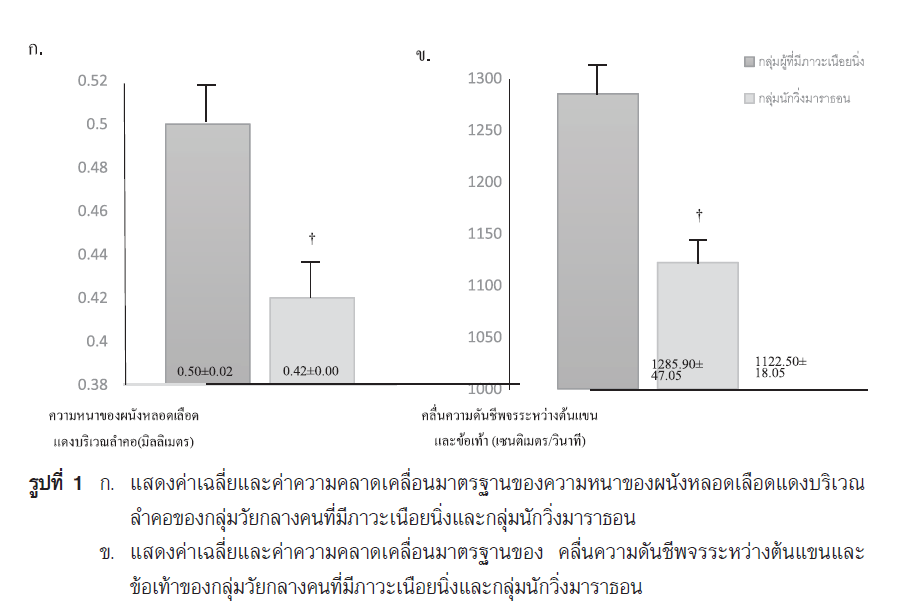
พบว่ากลุ่มนักวิ่งมาราธอนมีน้ำหนักตัว อัตราการเต้นของหัวใจขณะพัก มวลไขมัน ความหนา ของผนังหลอดเลือดแดงบริเวณลำคอและคลื่นความดันชีพจรระหว่างต้นแขนและข้อเท้าต่ำกว่า (0.7%, 1.8%, 4.29%, 1.39% และ 4.81% ตามลำดับ) กลุ่ม ผู้ที่มีภาวะเนือยนิ่งอย่างมีนัยสำคัญที่ระดับ .05 และ มีแรงสูงสุดในท่าเหยียดและงอเข่า แรงสูงสุดในการ ออกแรงท่าสควอท ความสามารถในการลุกนั่งต่อเนื่อง และความสามารถในการใช้ออกซิเจนสูงสุดที่สูงกว่า (6.44%, 10.04%, 12.14%, 10.08% และ 7.81% ตามลำดับ) กลุ่มผู้ที่มีภาวะเนือยนิ่งอย่างมีนัยสำคัญที่ ระดับ .05 นอกจากนี้ยังพบว่ามวลไขมันและเปอร์เซ็นต์ไขมันมีความสัมพันธ์เชิงลบกับความสามารถในการใช้ออกซิเจนสูงสุด (r = -0.59, p = .01; r = -0.78, p = .00) อีกทั้งพบว่ามวลกล้ามเนื้อมีความสัมพันธ์เชิงบวกกับความสามารถในการใช้ออกซิเจนสูงสุด (r = 0.52, p = .03)
สรุปผลการวิจัย:
ภาวะเนือยนิ่งส่งผลต่อบุลคคล วัยกลางคนให้มีสมรรถภาพทางแอโรบิกกล้ามเนื้อ และหลอดเลือดแย่กว่านักวิ่งมาราธอน แต่การฝึกด้วย แรงต้านร่วมกับการฝึกวิ่งมาราธอนส่งผลต่อบุลคลวัยกลางคนให้มีสุขสมรรถนะ ความแข็งแรงและทนทาน ของกล้ามเนื้อ สมรรถภาพทางแอโรบิก โครงสร้างและการทำงานของหลอดเลือดดีกว่าบุคคลวัยกลางคนที่มีภาวะเนือยนิ่ง โดยพบว่าองค์ประกอบของร่างกายมีความสัมพันธ์กับความสามารถในการใช้ออกซิเจนสูงสุดในบุคคลวัยกลางคน
Article Details
เอกสารอ้างอิง
American college of sport medicine. (2006). ACSM’s Advanced Exercise Physiology. Philadelphia: Lippincott Williams and Wilkins.
Ferrauti., A., Bergermann., M., & Fernandezfernandez., J. (2010). Effects of a concurrent strength and endurance training on running performance and running economy in recreational marathon runners. Journal of Strength and Conditioning Research, 24(10), 2770–2778.
Gonzales-GRoss. M, Melendes A. Sedentarism. (2013). Active lifestyle and sport: Impact on health and obesity prevention. Nutr Hosp, 28(5), 89-98.
Gutterman, D, D. (2002). Vascular dysfunction in hyperglycemia: is protein kinase C the culprit?. Circ Res, 90(1), 5-7.
Institute for population and social research. (2017). Statistics of running exercisers in Thailand in 2017. (20 november 2020). http://www.newsletter.ipsr.mahidol.ac.th.
Kozakai R, Nishita Y, Otsuka R, Ando F, Shimokata H. (2020). Age-Related Changes in Physical Fitness Among Community- Living Middle-Aged and Older Japanese: A 12-Year Longitudinal Study. Res Q Exerc Sport, 91(4), 662-675.
Maroto-Izquierdo S, D, Fernandez- Gonzalo R, Moreira OC, -Gallego J, de Paz JA. (2017). Skeletal muscle functional and structural adaptations after eccentric overload flywheel resistance training: a systematic review and meta-analysis.J Sci Med Sport. 20(10) 943-951.
Nijasri Charnnarong. (2009). Management of acute ischemic stroke. Bangkok. Chulalongkorn university printing house.
Olmez, I., & Ozyurt, H. (2012). Reactive oxygen species and ischemic cerebrovascular disease. Neurochem Int, 60(2), 208-212.
Ozaki H, Sawada S, Osawa T, Natsume T, Yoshihara T, Deng P, Machida S, Naito H. (2020). Muscle Size and Strength of the Lower Body in Supervised and in Combined Supervised and Unsupervised Low-Load Resistance Training. J Sports Sci Med. 19(4). 721-726.
Panda K, Krishna P. (2014). Physical exercise and cardiac autonomic activity in healthy adult men. Indian J Physiol Pharmacol. 58(4). 365-70.
Prakhinkit S, Suppapitiporn S, Tanaka H, Suksom D. (2014). Effects of Buddhism walking meditation on depression, functional fitness, and endotheliumdependent vasodilation in depressed elderly. J Altern Complement Med, 20(5), 411-6.
Prasad DS, Das BC. (2009). Physical inactivity: a cardiovascular risk factor. Indian J Med Sci, 63(1), 33-42.
Regulska-Ilow, B., Kosendiak, A., Konikowska, K., , D., Ilow, R., Kawicka, A., & Dudziak, K. (2014). Athletes’ body contents analysis before and after marathon by bioelectrical impedance. Polish Journal of Sport Medicine, 2(4), 93–102.
Schache, A. G., Blanch, P. D., Dorn, T. W., Brown, N. A., Rosemond, D. and Pandy, M. G. (2011). Effect of running speed on lower-limb joint kinetics. Med. Sci. Sports Exerc, 43, 1260-1271.
Short, K. R., Blackett, P. R., Gardner, A. W., & Copeland, K. C. (2009). Vascular health in children and adolescents: effects of obesity and diabetes. Vasc Health Risk Manag, 5, 973-990.
Stoppani, J. (2006). Encyclopedia of muscle & strength. Champaign, IL: Human Kinetics. Suksom, D., Phanpheng, Y., Soogarun, S., & Sapwarobol, S. (2014). Step aerobic combined with resistance training improves cutaneous
microvascular reactivity in overweight women. J Sports Med Phys Fitness. 55(12), 1547-1554.
Suksom, D., Siripatt, A., Lapo, P., & Patumraj, S. (2011). Effects of two modes of exercise on physical fitness and endothelial function in the elderly: exercise with a flexible stick versus Tai Chi. Journal of the Medical Association of Thailand= Chotmaihet thangphaet, 94(1), 123-132.
Takada, S. (2012). Blood flow restriction exercise in sprinters and endurance runners. Med Sci Sports Exercise, 44(3), 413-419.
Tanaka, H., & Seals, D. R. (2008). Endurance exercise performance in Masters athletes: age-associated changes and underlying physiological mechanisms. The Journal of physiology, 586(1), 55-63.
Teerasak Arpawatthanakul (2009). Science in sport training. Bangkok. Chulalongkorn university printing house.
Thanomwong Kritpet. (1993). Dictionaries of sports, Sports education and ccience. Bangkok. Chulalongkorn university printing house.
Tsuzuku S, Kajioka T, Sakakibara H, Shimaoka K. (2018). Slow movement resistance training using body weight improves muscle mass in the elderly: A randomized controlled trial. Scand J Med Sci Sports, 28(4), 1339-1344.
Ulloa, D., Feriche, B., Barboza, P., and Padial, P. (2015). Estudio comparado de la intensidad de entrenamiento sobre la máxima tasa de oxidación de grasas. [Effect of training intensity on the fat oxidation rate. Nutr. Hosp, 31(1), 421–429.
Wareerat Ketteng and Daroonwan Suksom. (2013). Comparing the effects of interval running on treadmill and on track upon physiological variables. Journal of Sports Science and Health, 14(3), 22-34
World Health Organization. (2020). WHO Guidelines on Physical Activity and Sedentary Behaviour. Geneva, Switzerland: World Health Organization.
Zaenker, P., Favret, F., Lonsdorfer, E., Muff, G., de Seze, J., & Isner-Horobeti, M. E. (2018). High-intensity interval training combined with body weight resistance training improves physiological capacities, strength and quality of life in multiple sclerosis patients. Eur J Phys Rehabil Med, 54(1), 58-67.
