
คุณลักษณะของคลื่นไฟฟ้ากล้ามเนื้อขณะโพส 7 ท่าบังคับมาตรฐานของนักกีฬาเพาะกายทีมชาติไทย
Article Sidebar
Main Article Content
บทคัดย่อ
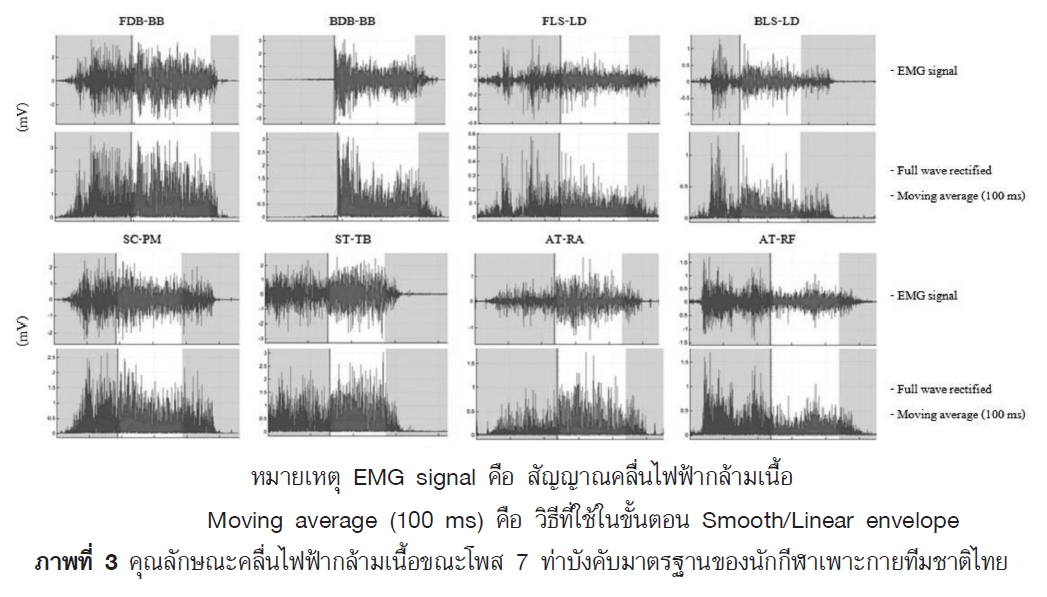
บทคัดย่อ วัตถุปรสงค์ : การวิจัยครั้งนี้มีวัตถุประสงค์เพื่อ ศึกษาคุณลักษณะและเปรียบเทียบคลื่นไฟฟ้ากล้ามเนื้อ เฉลี่ย (mean EMG) และคลื่นไฟฟ้ากล้ามเนื้อสูงสุด (peak EMG) ขณะโพส 7 ท่ามาตรฐานของนักกีฬา เพาะกายทีมชาติไทย วิธีดำเนินการวิจัย : กลุ่มตัวอย่างเป็นนักกีฬา เพาะกายทีมชาติไทย จำนวน 10 คน (แชมป์โลก 3 คน และแชมป์เอเชีย 7 คน) บันทึกการเคลื่อนไหว และบันทึกคลื่นไฟฟ้ากล้ามเนื้อ Biceps brachii (BB), Triceps brachii (TB), Latissimus dorsi (LD), Pectoralis major (PM), Rectus abdominis (RA) และ Rectus femoris (RF) ที่ความถี่ 2,400 Hz ขณะโพส Front double biceps (FDB), Back double biceps (BDB), Front lat spread (FLS), Back lat spread (BLS), Side chest (SC), Side triceps (ST) และ Abdominals and Thighs (AT) ข้อมูลและภาพวิดีโอที่บันทึกจะถูกคัดเลือกจากผู้ตัดสิน กีฬาเพาะกาย ของสมาคมกีฬาเพาะกายและฟิตเนส แห่งประเทศไทย พิจารณาเลือกท่าโพสที่ดีที่สุดและ ช่วงเวลาที่โพสท่า เพื่อนำมาวิเคราะห์ข้อมูลและ วิเคราะห์ทางสถิติ ผลการวิจัย : พบว่าค่า mean และ peak EMG ของกล้ามเนื้อ BB, RA, RF และ TB มีค่าสูงสุด เท่ากับ 30% MVIC และ 50% MVIC ตามลำดับ ขณะโพสท่า AT, FDB, BDB และ ST รองลงมาคือ กล้ามเนื้อ PM มีค่า mean EMG และ peak EMG เท่ากับ 15% MVIC และ 20% MVIC ตามลำดับ ขณะโพสท่า SC ส่วนคลื่นไฟฟ้ากล้ามเนื้อ LD ขณะ โพสท่า FLS และ BLS ไม่ถึง 10 %MVIC นอกจาก นี้ยังพบว่ากล้ามเนื้อ BB และ LD มีคลื่นไฟฟ้ากล้าม เนื้อไม่แตกต่างกันทั้งข้างซ้ายและข้างขวา ยกเว้นขณะ โพสท่า BDB สรุปผลการวิจัย : คุณลักษณะของคลื่นไฟฟ้า กล้ามเนื้อมีความแตกต่างกันในการโพสแต่ละท่า ข้อมูลนี้สามารถนำไปใช้อ้างอิงในการออกแรงเกร็ง กล้ามเนื้อขณะโพสท่าบังคับมาตรฐานของนักกีฬาเพาะ กายระดับแชมป์ และนำไปประยุกต์ใช้กับการฝึกโพส 7 ท่าบังคับแก่นักกีฬาเพาะกายฝึกใหม่ได้
Article Details
เอกสารอ้างอิง
Barclay, C. J. (2015). Energetics of Contraction. In Comprehensive Physiology, R. Terjung (Ed.). pp. 961-995.
Barré, A., & Armand, S. (2014). Biomechanical ToolKit: Open-source Framework to visualize and process biomechanical data. Computer Methods and Programs in Biomedicine, 114, 80-87. doi: 10.1016/j.cmpb.2014.01.012
Bauer, A. (2018). WBPF Rules Book Bodybuilding, Fitness Physique, Athletic Physique, Sport Physique, Model Physique and Mixed Pairs: World Bodybuilding & Physique Sport Federation.
Coratella, G., Tornatore, G., Caccavale, F., Longo, S., Esposito, F., & Cè, E. (2021). The activation of gluteal, thigh, and lower back muscles in different squat variations performed by competitive bodybuilders: Implications for resistance training. International Journal of Environmental Research and Public Health, 18(2). doi: 10.3390/ ijerph18020772
Coratella, G., Tornatore, G., Longo, S., Esposito, F., & Cè, E. (2020a). An Electromyographic Analysis of Lateral Raise Variations and Frontal Raise in Competitive Bodybuilders. International journal of environmental research and public health, 17(17), 6015. doi: 10.3390/ijerph17176015
Coratella, G., Tornatore, G., Longo, S., Esposito, F., & Cè, E. (2020b). Specific prime movers’ excitation during free-weight bench press variations and chest press machine in competitive bodybuilders. European Journal of Sport Sciences, 20(5), 571-579. doi: 10.1080/17461391.2019.1655101
Hermens, H. J., Freriks, B., Disselhorst-Klug, C., & Rau, G. (2000). Development of recommendations for SEMG sensors and sensor placement procedures. Journal of Electromyography and Kinesiology, 10(5), 361-374. doi: https://doi.org/10.1016/S1050-6411(00)00027-4
Konrad, P. (2005). The abc of EMG: A practical introduction to kinesiological electromyography. Noraxon Inc. USA, version 1.0.
Maeo, S., Takahashi, T., Takai, Y., & Kanehisa, H. (2013). Trainability of muscular activity level during maximal voluntary co-contraction: Comparison between bodybuilders and non-athletes. PloS one, 8, e79486. doi: 10.1371/ journal.pone.0079486
Marcolin, G., Panizzolo, F. A., Petrone, N., Moro,T., Grigoletto, D., Piccolo, D., & Paoli, A. (2018). Differences in electromyographic activity of biceps brachii and brachioradialis while performing three variants of curl. PeerJ, 6, e5165-e5165. doi: 10.7717/peerj.5165
Rash, G. (2002). Electromyography Fundamentals. International Encyclopedia of Ergonomics and Human Factors.
Santonja, R. (2017). IFBB Rules Section 2: Men’s Bodybuilding: International Federation of Bodybuilding & Fitness (IFBB).
Tesch, P. A., & Larsson, L. (1982). Muscle hypertrophy in bodybuilders. European Journal Applied Physiology, 49(3), 301-306.doi: 10.1007/bf00441291
