ผลของการฝึกแบบหนักสลับเบาที่มีต่อองค์ประกอบของร่างกาย สมรรถภาพปอด และความแข็งแรงของกล้ามเนื้อหายใจในผู้มีภาวะอ้วน
Article Sidebar
Main Article Content
บทคัดย่อ
วัตถุประสงค์
การวิจัยครั้งนี้มีวัตถุประสงค์เพื่อศึกษาผลของการฝึกแบบหนักสลับเบาที่มีต่อองค์ประกอบของร่างกายสมรรถภาพปอดและความแข็งแรงของกล้ามเนื้อหายใจในผู้มีภาวะอ้วน
วิธีดำเนินการวิจัย
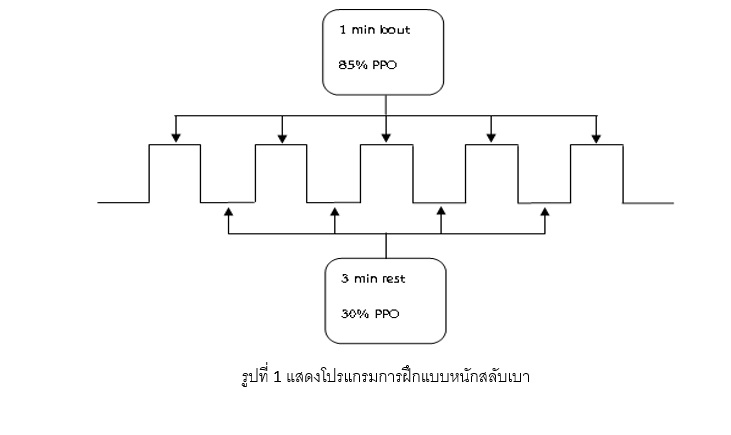
กลุ่มตัวอย่างที่ใช้ในการวิจัยครั้งนี้ คือ ผู้มีภาวะอ้วนที่เป็นนิสิตหรือบุคลากรจุฬาลงกรณ์มหาวิทยาลัย ทั้งเพศชายและเพศหญิง อายุ 18-45 ปี จำนวน 31 คน แบ่งเป็น 2 กลุ่ม ได้แก่ กลุ่มทดลอง จำนวน 15 คน ได้รับการฝึกแบบหนักสลับเบา 3 ครั้ง/สัปดาห์ เป็นเวลา 12 สัปดาห์ และกลุ่มควบคุม จำนวน 16 คน ใช้ชีวิตประจำวันตามปกติ เก็บข้อมูลตัวแปรด้านสรีรวิทยาและองค์ประกอบของร่างกาย ตัวแปรด้านสมรรถภาพปอด และตัวแปรด้านความแข็งแรงของกล้ามเนื้อหายใจ วิเคราะห์เปรียบเทียบค่าเฉลี่ยของตัวแปรก่อนและหลังการทดลองของแต่ละกลุ่มและระหว่างกลุ่มควบคุมและกลุ่มทดลอง โดยการทดสอบค่าทีแบบรายคู่ (Paired-T test) และการทดสอบค่าทีแบบอิสระ (Independent-T test) ที่ระดับความมีนัยสำคัญทางสถิติที่ .05
ผลการวิจัย
หลังการทดลอง 12 สัปดาห์กลุ่มที่ได้รับการฝึกหนักสลับเบา มีค่าเฉลี่ย น้ำหนักตัว ดัชนีมวลกาย อัตราการเต้นของหัวใจขณะพัก ความดันโลหิตขณะหัวใจบีบตัวความดันโลหิตขณะหัวใจคลายตัว น้ำหนักตัวที่ปราศจากไขมัน มวลไขมัน มวลกล้ามเนื้อเปอร์เซ็นต์ไขมัน ความสามารถในการใช้ออกซิเจนสูงสุด ปริมาตรสูงสุดของอากาศที่หายใจออกอย่างเร็วและแรงเต็มที่ ค่าปริมาตรของอากาศจากการหายใจเข้า-ออกเต็มที่ในเวลา 1 นาที ค่าแรงดันการหายใจเข้าสูงสุด และค่าแรงดันการหายใจออกสูงสุด เพิ่มขึ้นแตกต่างกับก่อนการทดลองอย่างมีนัยสำคัญทางสถิติที่ระดับ .05 และเมื่อเปรียบเทียบกับกลุ่มควบคุมพบว่า กลุ่มที่ได้รับการฝึกหนักสลับเบา มีน้ำหนักตัว อัตราการเต้นของหัวใจขณะพัก เปอร์เซ็นต์ไขมัน ความสามารถในการใช้ออกซิเจนสูงสุด อัตราการไหลของอากาศหายใจออกสูงสุด แรงดันการหายใจเข้าสูงสุด และแรงดันการหายใจออกสูงสุด เพิ่มขึ้นแตกต่างกับกลุ่มควบคุมอย่างมีนัยสำคัญทางสถิติที่ระดับ .05
สรุปผลการวิจัย
การฝึกแบบหนักสลับเบาเป็นระยะเวลา 12 สัปดาห์ สามารถช่วยพัฒนาองค์ประกอบของร่างกาย สมรรถภาพปอด และความแข็งแรงของกล้ามเนื้อหายใจในผู้มีภาวะอ้วนได้
Article Details

อนุญาตภายใต้เงื่อนไข Creative Commons Attribution-NonCommercial-NoDerivatives 4.0 International License.
เอกสารอ้างอิง
Amira P. T., Pandiaman P., Erna M., Andika P., Ella R., Efriyandi E. (2018). Impact of Lower-Limb Endurance Training on Dyspnea and Lung Functions in Patients with COPD. Open Access Maced Journal of Medical Science, 6(12): 2354-2358.
Azad A., Gharakhanlou R., Niknam A. and Ghanbari A. (2011). Effects of aerobic exercise on lung function in overweight and obese students. Tanaffos, 10(3): 24-31.
Enright S. J., Unnithan V. B., Heward C., Withnall L., Davies D. H. (2006). Effect of high intensity inspiratory muscle training on lung volumes, diaphragm thickness, and exercise capacity in subjects who are healthy. Physical Therapy, 86(3): 345-354.
Chlif M., Keochkerian D., Choquet D., Vaidie A., and Ahmaidi S. (2009). Effects of obesity on breathing pattern, ventilatory neural drive and mechanics. Respiratory Physiology and Neurobiology, 168: 198-202.
Christopher Z., Helen L., Ian M. and Himender M. (2010). Obesity and respiratory diseases. International Journal of General Medicine, 2010; 3: 335-343.
Chuensiri N., Suksom D., and Tanaka H. (2018). Effects of high-intensity intermittent training on vascular function in obese preadolescent boys. Childhood Obesity, 14(1): 41-49.
Department of Health: Ministry of Public Health. (2561). Body mass index by self-evaluation [Online]. Available from: http://nutrition.anamai.moph.go.th/imagesfiles/HLworkingage.pdf [2018, April 24].
Dunham C. and Harms C. A. (2012). Effects of high-intensity interval training on pulmonary function. European Journal of Applied Physiology, 112(8): 3061-3068.
Len Kravitz. (2014). ACSM Information on High-Intensity Interval Training. [Online]. Available from: https://www.bgifitness.com/merchant/118/files/ACSM_HIIT.pdf [September 25, 2018].
Herbert P., Hayes L. D., Sculthorpe N. F. and Grace F. M. (2017). HIIT produces increases in muscle power and free testosterone in male masters athletes. Endocrine Connections 6(7): 430-436.
Littleton S. W. (2012). Impact of obesity on respiratory function. Respirology: official journal of the Asian Pacific Society of Respirology, 17(1):43-49.
Mäder U., Roth P., Furrer R., Brêchet J. P. and Boutellier U. (2001). Influence of continuous and discontinuous training protocols on subcutaneous adipose tissue and plasma substrates. International Journal of Sports Medicine, 22: 344–349.
McConnell A. (2013). Inspiratory muscle training: history and putative mechanisms. Frontiers in Sport and Exercise Science and Medicine Seminar on inspiratory muscle training, Centre for Sports Medicine and Human Performance, Brunel University.
Peterson B. A., Hastings B., Gottschall. (2016). High Intensity Interval Cycling Improves Physical Fitness in Trained Adults. Journal of Fitness Research, 5(1).
Scichilone N., Morici G., Marchese R., Bonanno A., Profita M., Togias A., Bonsignore M. R. (2005.) Reduced airway responsiveness in non elite runners. Medicine and Science in Sports and Exercise, 37(12): 2019-2025.
Sijie T., Hainai Y., Fengying Y. and Jianxiong W. (2012). High intensity interval training exercise training in overweight young women. The Journal of sports medicine and physical fitness, 52(3): 255-262.
Trapp E. G., Chisholm D. J., Freund J. And Boutcher S. H. (2008). The effects of high-intensity intermittent exercise training on fat loss and fasting insulin levels of young women. International Journal of Obesity, 32: 684-691.
World Health Organization (2018). Obesity and Overweight (Online). Retrieved April 24, 2018, from WHO Website: http://www.who.int/news-room/factsheets/detail/obesity-and-overweight
