ผลของการวิ่งลากถ่วงน้ำหนักด้วยมุม 30 และ 60 องศา ที่มีต่อคลื่นไฟฟ้ากล้ามเนื้อและแรงปฏิกิริยาจากพื้นในนักกีฬารักบี้ฟุตบอลหญิง
Article Sidebar
Main Article Content
บทคัดย่อ
วัตถุประสงค์
เพื่อวิเคราะห์และเปรียบเทียบคลื่นไฟฟ้ากล้ามเนื้อ แรงปฏิกิริยาจากพื้นในแนวดิ่ง และความเร็วในการวิ่งขณะลากถ่วงน้ำหนักที่มุม 30 และ 60 องศา ในนักกีฬารักบี้ฟุตบอลหญิง
วิธีดำเนินการวิจัย
กลุ่มตัวอย่างเป็นนักกีฬารักบี้ฟุตบอล สังกัดชมรมรักบี้ฟุตบอลของจุฬาลงกรณ์มหาวิทยาลัย เพศหญิง มีอายุระหว่าง 18-25 ปี จำนวน 15 คน ได้รับการทดสอบวิ่งลากถ่วงน้ำหนักด้วยการยืนแบบเท้านำเท้าตาม โดยเริ่มจากการวิ่งโดยไม่มีเครื่องลากถ่วงน้ำหนัก จากนั้นทำการสุ่มลำดับการวิ่งลากถ่วงน้ำหนักที่ความหนัก 30% ของน้ำหนักร่างกายที่มุมเส้นเชือก 30 และ 60 องศา ในระยะทาง 5 เมตร โดยทำการวิ่งทั้ง 3 รูปแบบๆ ละ 3 ครั้ง พักระหว่างครั้ง 5 นาที วัดความเร็วในการวิ่งระยะ 5 เมตร แรงปฏิกิริยาจากพื้นในแนวดิ่งของขาก้าวที่ 3 และอัตราส่วนระหว่างขนาดของคลื่่นไฟฟ้ากล้ามเนื้อขณะเคลื่อนไหวกับขนาดของคลื่นไฟฟ้ากล้ามเนื้อสูงสุดเมื่อกล้ามเนื้อหดตัวแบบความยาวคงที่ วิเคราะห์ข้อมูลทางสถิติโดยใช้การวิเคราะห์ความแปรปรวนร่วม และเปรียบเทียบค่าเฉลี่ยเป็นรายคู่ด้วยแบบทดสอบ Tukey กำหนดระดับความมีนัยสาคัญทางสถิติที่ระดับ 0.05
ผลการวิจัย
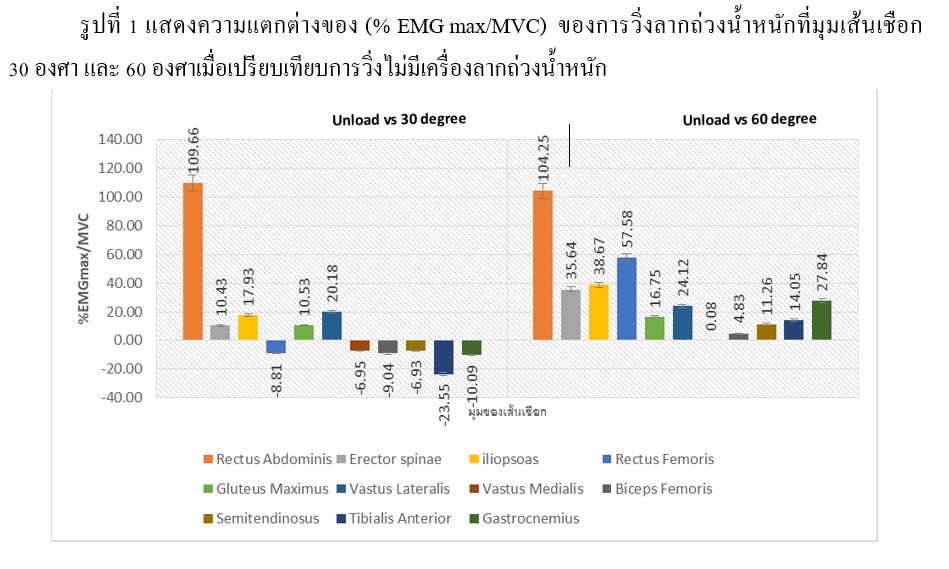
ค่าเฉลี่ยความเร็วในการวิ่งขณะวิ่งโดยไม่มีเครื่องลากถ่วงน้ำหนัก และการวิ่งลากถ่วงน้ำหนักทั้งที่มุมเส้นเชือก 30 และ 60 องศา มีความแตกต่างกันอย่างมีนัยสาคัญทางสถิติที่ระดับ 0.05 อย่างไรก็ตาม การวิ่งลากถ่วงที่มุม 60 องศา มีแนวโน้มว่า มีแรงปฏิกิริยาจากพื้นต่ำกว่า ขณะที่มีคลื่นไฟฟ้าสูงกว่าการวิ่งลากถ่วงที่มุม 30 องศา และไม่มีน้ำหนักถ่วง แรงปฏิกิริยาจากพื้นในแนวดิ่งและคลื่นไฟฟ้ากล้ามเนื้อระหว่างการวิ่งทั้ง 3 รูปแบบ
สรุปผลการวิจัย
การฝึกวิ่งลากถ่วงน้ำหนักที่มุมเส้นเชือก 60 องศา มีความเหมาะสมในการพัฒนากล้ามเนื้อที่ใช้ในการวิ่งออกตัวของนักกีฬารักบี้ฟุตบอลหญิง เนื่องจากมีคลื่นไฟฟ้ากล้ามเนื้อมากที่สุด และแรงปฏิกิริยาจากพื้นในแนวดิ่งน้อยที่สุด
Article Details

อนุญาตภายใต้เงื่อนไข Creative Commons Attribution-NonCommercial-NoDerivatives 4.0 International License.
เอกสารอ้างอิง
Alcaraz PE, Palao JM, Elvira JL, Linthorne NP. (2008). Effects of three types of resisted sprint training devices on the kinematics of sprinting at maximum velocity. The Journal of Strength & Conditioning Research, 22(3), 890-897. doi: 10.1519/JSC.0b013e31816611ea.
Bachero-Mena, B and Gonza´ lez-Badillo, JJ. (2014). Effects of resisted sprint training on acceleration with three different loads accounting for 5, 12.5, and 20% of body mass. The Journal of Strength & Conditioning Research, 28(10), 2954–2960.
Biscombe, T. and Drewett, P. (2010). Rugby: Steps to success. Leeds: Human Kinetics. Charoen krabuanrat (1995). Technical training speed. Bangkok: Department of Sports Science, Kasetsart University.
Coh M.; Peharec S.; Bacic P.; Kampmiller T., (2009). Dynamic factors and electromyoelectromyographic activity in a sprint start. Biology of Sport, Vol. 26 No 2
Cottle C, Carlson LA, Lawrence MA. (2014). Effects of sled towing on sprint starts. The Journal of Strength & Conditioning Research, 28, 1241-1245.
Cronin, J., Hansen, K., Kawamori, N., & McNair, P. (2008). Effects of weighted vests and sled towing on sprint kinematics. Sports Biomechanics / International Society of Biomechanics in Sports, 7(2), 160-172. doi:10.1080/14763140701841381.
Cronin, J.B., and Hansen, K.T. (2005). Strength and power predictors of sports speed. The Journal of Strength & Conditioning Research, 19(2), 349-357.
Dorn TW., Schache AG, Pandy MG. (2012). Muscular strategy shift in human running: dependence of running speed on hip and ankle muscle performance, Journal of Experimental Biology, 215, 1944-1956.
Harrison, AJ, and Bourke, G. (2009). The effect of resisted sprint training on speed and strength performance in male rugby players. The Journal of Strength & Conditioning Research, 23(1), 275-283.
Kawamori, N, Newton, RU, Hori, N, and Nosaka, K. (2014). Effects of weighted sled towing with heavy versus light load on sprint acceleration ability. The Journal of Strength & Conditioning Research, 28(10), 2738-2745.
Kratky, S, Buchecker, M, Pfusterschmied, J, Szekely, C, and Muller, E. (2016). Effects of a body-weight supporting kite on sprint running kinematics in well-trained sprinters. The Journal of Strength & Conditioning Research, 30(1), 102–108.
Lockie, R.G., Murphy A.J. and Spinks C.D. (2003). Effects of resisted sled towing on sprint kinematics in field-sport athletes. The Journal of Strength & Conditioning Research, 17(4), 760-767.
Milanese C., Bertucco M., Zancanaro C. (2014). The effects of three different rear knee angles on kinematics in the sprint start. Biology of Sport, 31, 209-215.
Paulson, S and Braun, WA. (2011). The influence of parachute-resisted sprinting on running mechanics in collegiate track athletes. The Journal of Strength & Conditioning Research, 25(6), 1680-1685.
Seeley, R.R., T.D. Stephens and P. Taste. (1992). Anatomy & Physiology. 2nd Edition. Missouri: A Mosby imprint of Mosby-Year Book, Inc.
Spinks, C.D., Murphy, A.J., Spinks, W.L. and Lockie, R.G. (2007). The effects of resisted sprint training on acceleration performance and kinematics in soccer, rugby union, and Australian football players. The Journal of Strength & Conditioning Research, 21(1), 77-85.
Wellman, AD, Coad, SC, Goulet, GC, and McLellan, CP. (2016). Quantification of competitive game demands of NCAA Division I college football players using global positioning systems. The Journal of Strength & Conditioning Research, 30(1), 11–19.
West, DJ, Cunningham, DJ, Bracken, RM, Bevan, HR, Crewther, BT, Cook, CJ, and Kilduff, LP. (2013). Effects of resisted sprint training on acceleration in professional rugby union players. The Journal of Strength & Conditioning Research, 27(4), 1014–1018.
