ผลของการฝึกพิลาทิสต่อความสามารถการทำงานสองอย่างในเวลาเดียวกันในนักกีฬาฟุตซอลชายระดับมหาวิทยาลัย
Article Sidebar
Main Article Content
บทคัดย่อ
วัตถุประสงค์: การวิจัยครั้งนี้มีวัตถุประสงค์เพื่อศึกษาผลของการฝึกพิลาทิสที่มีต่อความสามารถในการทำงานสองอย่างในเวลาเดียวกันของนักกีฬาฟุตซอลชายระดับมหาวิทยาลัย
วิธีดำเนินการวิจัย: กลุ่มตัวอย่างเป็นนักกีฬาฟุตซอลชาย ระดับมหาวิทยาลัย อายุ 18 -25 ปี จำนวน 26 คน โดยการสุ่มแบ่งเป็น 2 กลุ่มได้แก่ กลุ่มควบคุม (Control group, n= 13) ทำการฝึกฟุตซอลตามโปรแกรมปกติ และกลุ่มทดลอง (Pilates group, n=13) ทำการฝึกเสริมด้วยท่าพิลาทิส สัปดาห์ละ 2 วันๆละ 1 ชั่วโมง ร่วมกับฝึกฟุตซอลตามโปรแกรมปกติ เป็นเวลา 6 สัปดาห์ ทำการทดสอบ ตัวแปรทางสรีรวิทยาพื้นฐาน และความสามารถในการทำงานสองอย่างในเวลาเดียวกัน เปรียบเทียบก่อนและหลังการฝึก วิเคราะห์ข้อมูลทางสถิติโดยใช้ Paired-Samples T Test และ Independent-Samples T Test กำหนดระดับความมีนัยสำคัญที่ 0.05
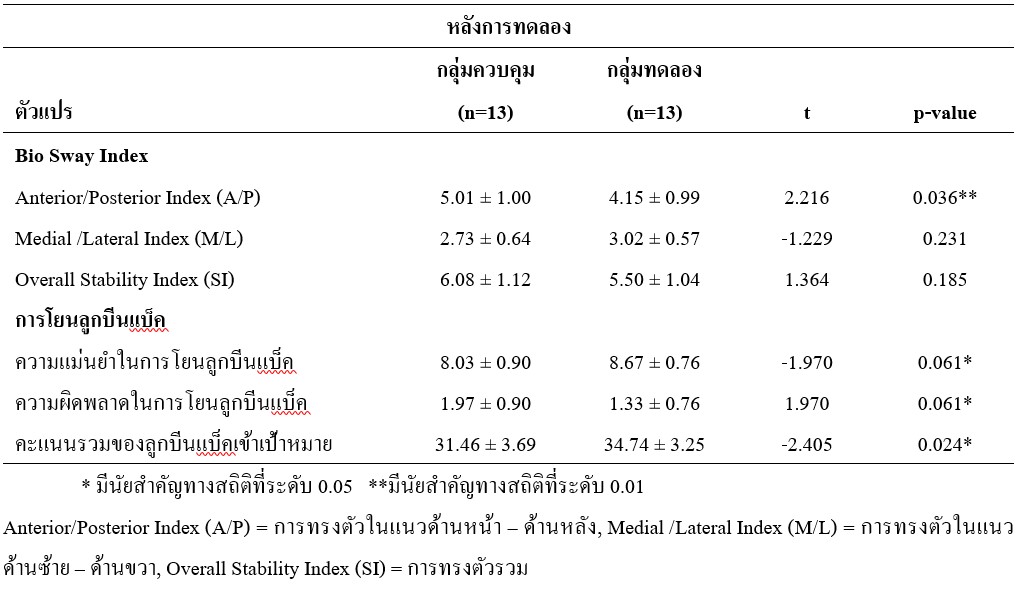
ผลการวิจัย: ผลการทดสอบค่าการทรงตัวดัชนีการเซ การโยนลูกบีนแบ็ค ภายใต้เงื่อนไขการยืนขาเดียวบนเครื่อง Bio Sway ร่วมกับการโยนลูกบีนแบ็ค พบว่ากลุ่มควบคุม มีดัชนีการแซของลำตัว มากกว่า และความสามารถโยนลูกบีนแบ็คเข้าเป้าหมายน้อยกว่า กลุ่มทดลอง และภายใต้เงื่อนไขการยืนขาเดียวบนเครื่อง Bio Sway ร่วมกับการลบเลขถอยหลัง พบว่า กลุ่มควบคุม มีค่าความถูกต้องในการลบเลข น้อยกว่ากลุ่มทดลอง ภายหลังการฝึก 6 สัปดาห์ อย่างมีนัยสำคัญทางสถิติที่ P< 0.05
สรุปผลการวิจัย: ผลการศึกษานี้สนับสนุนว่าการฝึกพิลาทิสเสริม สามารถช่วยเพิ่มประสิทธิภาพการทรงตัว การโยนลูกบีนแบ็ค และความสามารถในการลบเลขถอยหลัง ภายใต้เงื่อนไขการทำงานสองอย่างในเวลาเดียวกัน (dual task) เมื่อเทียบกับกลุ่มควบคุม จึงเป็นอีกเทคนิคทางเลือกในการฝึกเสริมเพื่อพัฒนาสมรรถภาพของการทำงานสองอย่างในเวลาเดียวกันในนักกีฬาฟุตซอลชายระดับมหาวิทยาลัย และขยายผลไปสู่นักกีฬาอื่นๆ ได้
Article Details

อนุญาตภายใต้เงื่อนไข Creative Commons Attribution-NonCommercial-NoDerivatives 4.0 International License.
เอกสารอ้างอิง
Alexis Lion, Rosario S. Spada, Gilles Bosser, Gerome C. Gauchard, Guido Anello, Paolo Bosco, Santa Calabrese, Antonella Iero, Giuseppe Stella, Maurizio Elia, and Philippe P. Perrin (2014). “Postural first” principle when balance is challenged in elderly people. International Journal of Neuroscience, 124(8), 558-566.
Bloem, B. R., Grimbergen, Y. A. M., Dijk, J. G. v., & Munneke, M. (2006). The ‘‘posture second’’ strategy- A review of wrong priorities in Parkinson’s disease. Journal of the Neurological Sciences, 248(1-2), 196-204.
Chong, R. K. Y., Mills, B., Dailey, L., Lane, E., Smith, S., & Lee, K.-H. (2010). Specific interference between a cognitive task and sensory organization for stance balance control in healthy young adults: Visuospatial effects. Neuropsychologia, 48(9), 2709-2718.
Eur-aree, V. (2015). Effects of Pilates Exercise on the Core Muscle Control and the Shotting Performance Among Rifle Shooters. (Master), Chiangmai University, Chiangmai.
Franchignoni, F., Martignoni, E., Ferrieroa, G., & Pasetti, C. (2005). Balance and fear of falling in Parkinson’s disease. Parkinsonism & Related Disorders, 11(7), 427–433.
Gillain, S., Warzee, E., Lekeu, F., Wojtasik, V., Maquet, D., Croisier, J.-L., Petermans, J. (2009). The value of instrumental gait analysis in elderly healthy, MCI or Alzheimer’s disease subjects and a comparison with other clinical tests used in single and dual-task conditions. Annals of Physical and Rehabilitation Medicine, 52(6), 453–474.
Javad, S., Aliasghar. N. (2018). The effect of integrative neuromuscular training on postural control of children with autism spectrum. Neuro Neurosurg, 1(2), 1-2.
Montero-Odasso, M., Muir, S. W., & Speechley, M. (2012). Dual-Task Complexity Affects Gait in People With Mild Cognitive Impairment: The Interplay Between Gait Variability, Dual Tasking, and Risk of Falls. Archives of Physical Medicine and Rehabilitation, 93(2), 293–299.
Moore, R., Bullough, S., Goldsmith, S., & Edmondson, L. (2014). A Systematic Review of Futsal Literature. American Journal of Sports Science and Medicine, 2(3), 108-116.
Pashler, H. (1994). Dual-task interference in simple tasks: Data and theory. Psychological Bulletin, 116(2), 220–244.
Preeti, Kalra, s., Yadav, J., & Pawaria, S. (2019). Effect of Pilates on Lower Limb Strength, Dynamic Balance, Agility and Coordination Skills in Aspiring State Level Badminton Players. Journal of Clinical and Diagnostic Research, 13(7), YC01-YC06.
Spildooren, J., Vercruysse, S., Desloovere, K., Vandenberghe, W., Kerckhofs, E., & Nieuwboer, A. (2010). Freezing of gait in Parkinson’s disease: The impact of dual-tasking and turning. Movement Disorders, 25(15), 2563–2570.
Strouwen, C., Molenaar, E. A. L. M., Muenks, L., Broeder, S., Ginis, P., Bloem, B. R., Heremans, E. (2019). Determinants of Dual-Task Training Effect Size in Parkinson Disease. Journal of Neurologic Physical Therapy, 43(1), 3–11.
Tania Patricia A., Filipa Manuel S. (2011). Influence of pilates training on muscular strength and flexibility in dancers. Motriz, Rio Claro, 17(4), 660-666
Taylor, M. E., Delbaere, K., Mikolaizak, A. S., Lord, S. R., & Close, J. C. T. (2013). Gait parameter risk factors for falls under simple and dual task conditions in cognitively impaired older people. Gait & Posture, 37(1), 126–130.
Wang, C., Kennedy, D. M., J. B. B., & Shea, C. H. (2013). A guide to performing difficult bimanual coordination tasks: just follow the yellow brick road. Experimental Brain Research, 230(1), 31–40.
