ผลของการฝึกกล้ามเนื้อรอบสะบักที่มีต่อความเร็วของไม้แบดมินตันขณะตบในนักกีฬาแบดมินตัน
Article Sidebar
Main Article Content
บทคัดย่อ
วัตถุประสงค์: เพื่อทราบผลของการฝึกกล้ามเนื้อรอบสะบักที่มีต่อความสามารถในการตบในนักกีฬาแบดมินตัน
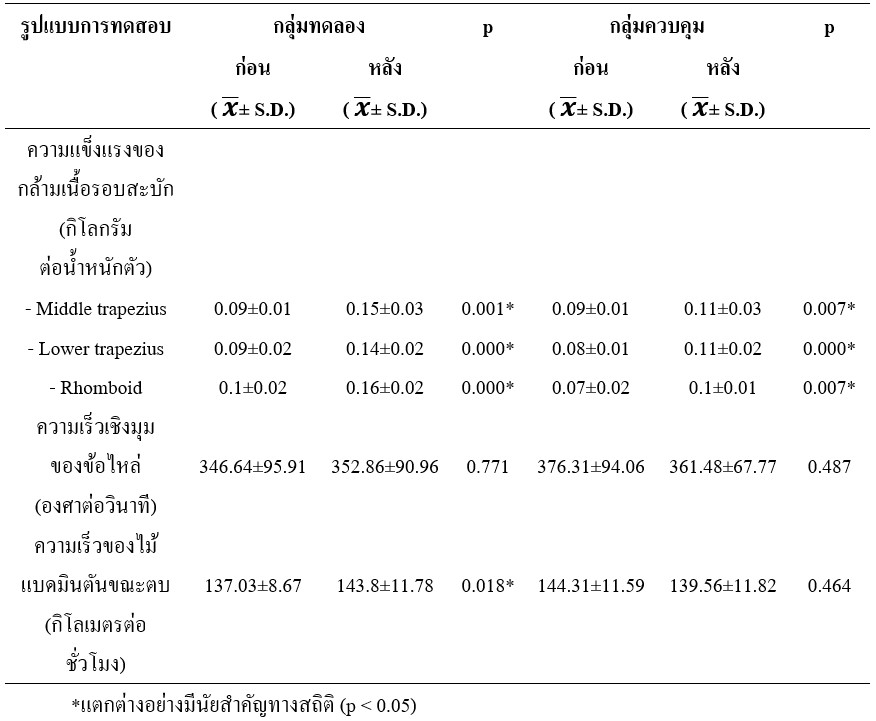
วิธีการดำเนินวิจัย: กลุ่มตัวอย่างเป็นนักกีฬาแบดมินตัน อายุระหว่าง 14–18 ปี ทั้งเพศชายและหญิง จำนวน 16 คน แบ่งออกเป็น 2 กลุ่ม ๆ ละ 8 คน ได้แก่ กลุ่มควบคุม ทำการฝึกซ้อมกีฬาแบดมินตันปกติ และกลุ่มทดลอง ทำการฝึกกีฬาแบดมินตันปกติร่วมกับเสริมโปรแกรมการฝึกกล้ามเนื้อรอบสะบัก จำนวน 3 วันต่อสัปดาห์ เป็นเวลา 6 สัปดาห์ ทำการทดสอบความแข็งแรงของกล้ามเนื้อรอบสะบัก ความเร็วเชิงมุมของข้อไหล่ และความเร็วของไม้แบดมินตันขณะตบ ก่อนและหลังการได้รับการฝึก เปรียบเทียบค่าเฉลี่ยและส่วนเบี่ยงเบนมาตรฐานก่อนและหลังการฝึก และระหว่างกลุ่มโดยการทดสอบค่าทีที่ p<0.05
ผลการวิจัย: (1) ทั้งกลุ่มทดลองและกลุ่มควบคุม พบการเพิ่มขึ้นอย่างมีนัยสำคัญของความแข็งแรงของกล้ามเนื้อรอบสะบัก แต่เฉพาะกลุ่มทดลองที่พบการเพิ่มขึ้นของความเร็วของไม้แบดมินตันขณะตบเพิ่มขึ้นอย่างมีนัยสำคัญ (2) กลุ่มทดลองแสดงการเพิ่มขึ้นของแรงของกล้ามเนื้อรอบสะบักสูงกว่าของกลุ่มควบคุมอย่างมีนัยสำคัญ ทั้งกล้ามเนื้อ Middle trapezius, Lower trapezius และ Rhomboid (p=0.01, 0.01 และ 0.02 ตามลำดับ)
สรุปผลการวิจัย: โปรแกรมการฝึกความแข็งแรงกล้ามเนื้อรอบสะบักเสริมการฝึกปกติสามารถเพิ่มความแข็งแรงของกล้ามเนื้อรอบสะบัก โดยพบว่า กลุ่มทดลองมีการเพิ่มขึ้นของกล้ามเนื้อรอบสะบักมากกว่ากลุ่มควบคุม และมีการเพิ่มของความเร็วของไม้แบดมินตันขณะตบได้อย่างมีนัยสำคัญ
Article Details

อนุญาตภายใต้เงื่อนไข Creative Commons Attribution-NonCommercial-NoDerivatives 4.0 International License.
เอกสารอ้างอิง
Awatani, T., Morikita, I., Urata, T., Shinohara, J., & Tatsumi, Y. (2018). Correlation between isometric shoulder strength and racket velocity during badminton forehand smash movements: study of valid clinical assessment methods. Journal of physical therapy science, 30(6), 850-854.
Brahms, B.-V. (2014). Badminton Handbook: Training, Tactics, Competition: Meyer & Meyer Verlag.
Cohen, D. B., Mont, M. A., Campbell, K. R., Vogelstein, B. N., & Loewy, J. W. (1994). Upper extremity physical factors affecting tennis serve velocity. The American journal of sports medicine, 22(6), 746-750.
Dai, J., Zhong, J. P., & Wu, X. Q. (2009). The training of badminton smash techniques (Vol. 6): China School Physical Education.
Fennell, J., Phadke, C. P., Mochizuki, G., Ismail, F., & Boulias, C. (2016). Shoulder retractor strengthening exercise to minimize rhomboid muscle activity and subacromial impingement. Physiotherapy Canada, 68(1), 24-28.
Fernandez-Fernandez, J., & Ellenbecker, T. (2013). Effects of a 6-week junior tennis conditioning program on service velocity. Journal of sports science medicine, 12(2), 232.
Fleisig GS, D. C., Andrews JR. (1994). Biomechanics of the shoulder during throwing. New York: Churchill Livingstone.
Grezios, A. K., Gissis, I. T., Sotiropoulos, A. A., Nikolaidis, D. V., & Souglis, A. G. (2006). Muscle-contraction properties in overarm throwing movements. The Journal of Strength Conditioning Research, 20(1), 117-123.
Kennedy, K. (1993). Rehabilitation of the unstable shoulder. Oper Techniq Sports Med, 1, 311-324.
Kibler, B. (1998). The role of the scapula in athletic shoulder function. The American journal of sports medicine, 26(2), 325-337.
Kibler, W. B., Ludewig, P. M., McClure, P. W., Michener, L. A., Bak, K., & Sciascia, A. D. (2013). Clinical implications of scapular dyskinesis in shoulder injury: the 2013 consensus statement from the ‘Scapular Summit’. Br J Sports Med, 47(14), 877-885.
Lo, D., & Stark, K. (1991). Sports performance series: The badminton overhead shot. Strength Conditioning Journal, 13(4), 6-15.
Moore, K. L., Dalley, A. F., & Agur, A. M. (2013). Clinically oriented anatomy: Lippincott Williams & Wilkins.
Mueller, K. (1987). Statische und dynamische Muskelkraft. Frankfurt, Germany: Harri Deutsch.
Phomsoupha, M., & Laffaye, G. (2015). The science of badminton: game characteristics, anthropometry, physiology, visual fitness and biomechanics. Sports medicine, 45(4), 473-495.
Pink, M., & Perry, J. (1996). Biomechanics of the shoulder. Operative techniques in upper extremity sports injuries. St. Louis: Mosby.
Sakurai, S., & Ohtsuki, T. (2000). Muscle activity and accuracy of performance of the smash stroke in badminton with reference to skill and practice. Journal of sports sciences, 18(11), 901-914.
Seki, K. (1983). Movement analysis of badminton. Bull Waseda Univ, 15, 103-106.
Suttirak Nasome, A. S., Suebsai Boonveerabut (2013). The effect of Imagery and Modeling on Accuracy In Badminton Drop Shot. Faculty of Physical Education, 1, 35-43.
Tong, Y.-M., & Hong, Y. (2000). The playing pattern of world’s top single badminton players. Paper presented at the ISBS-Conference Proceedings Archive.
Treiber, F. A., Lott, J., Duncan, J., Slavens, G., & Davis, H. (1998). Effects of Theraband and lightweight dumbbell training on shoulder rotation torque and serve performance in college tennis players. The American journal of sports medicine, 26(4), 510-515.
Tsai, C.-L., Huang, K.-S., & Chang, S.-S. (2005). Biomechanical analysis of emg activity between badminton smash and drop shot. Paper presented at the The XXth Congress of the International Society of Biome-chanics Proceeding.
Tsuruike, M., & Ellenbecker, T. S. (2015). Serratus anterior and lower trapezius muscle activities during multi-joint isotonic scapular exercises and isometric contractions. Journal of athletic training, 50(2), 199-210.
Wooden, M. J., Greenfield, B., Johanson, M., Litzelman, L., Mundrane, M., & Donatelli, R. A. (1992). Effects of strength training on throwing velocity and shoulder muscle performance in teenage baseball players. Journal of Orthopaedic Sports Physical Therapy, 15(5), 223-228.
Zhao, X. (2007). Badmintonn: A course book in English-Chinese. Xiangtan, China.
