ผลของการฝึกฟังก์ชั่นนอลด้วยแรงดันอากาศที่มีต่อความเร็วในการเตะเฉียงระดับศีรษะของนักกีฬาเทควันโดชาย
Article Sidebar
Main Article Content
บทคัดย่อ
วัตถุประสงค์: การวิจัยครั้งนี้มีวัตถุประสงค์เพื่อศึกษาผลของการฝึกฟังก์ชั่นนอลด้วยแรงดันอากาศที่มีต่อความเร็วในการเตะเฉียงระดับศีรษะ และเปรียบเทียบการฝึกฟังก์ชั่นนอลด้วยน้ำหนักที่มีต่อความเร็วในการเตะเฉียงระดับศีรษะของนักกีฬาเทควันโดชาย
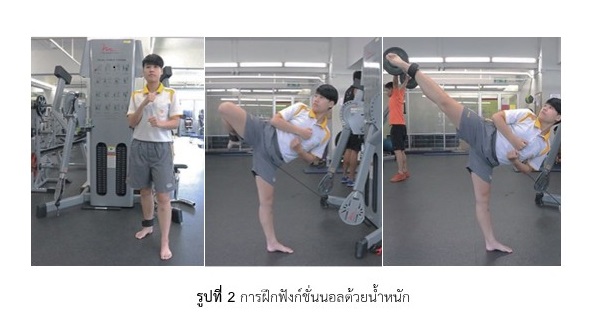
วิธีดำเนินการวิจัย: นักกีฬาเทควันโด เพศชาย ระดับมหาวิทยาลัย อายุระหว่าง 18-22 ปี จำนวน 20 คน แบ่งออกเป็น 2 กลุ่ม ได้แก่ กลุ่มที่ 1 ได้รับการฝึกฟังก์ชั่นนอลด้วยแรงดันอากาศ จำนวน 10 คน และกลุ่มที่ 2 ได้รับการฝึกฟังก์ชั่นนอลด้วยน้ำหนัก จำนวน 10 คน ทำการฝึกที่ความหนัก 40% 1RM ฝึก 3 วันต่อสัปดาห์ ระยะเวลา 6 สัปดาห์ ทำการทดสอบความเร็วในการเตะ (ความเร็วช่วงการยกเข่า ได้แก่ ความเร็วเชิงมุมสูงสุดของข้อสะโพก ความเร็วเชิงมุมสูงสุดของข้อเข่า และความเร็วช่วงการสะบัดปลายเท้า ได้แก่ ความเร็วเชิงเส้นสูงสุดของข้อเข่า และความเร็วเชิงเส้นสูงสุดของเท้า) ก่อนการฝึกและหลังการฝึก จากนั้น นำมาวิเคราะห์ผลทางสถิติโดยหาค่าเฉลี่ย ส่วนเบี่ยงเบนมาตรฐาน ทดสอบค่าทีแบบรายคู่ (Pair samples t-test) ก่อนการฝึกและหลังการฝึกภายในกลุ่ม และทดสอบค่าทีอิสระ (Independent samples t-test) ระหว่างกลุ่ม ที่ระดับความมีนัยสำคัญทางสถิติที่ .05
ผลการวิจัย: กลุ่มฝึกฟังก์ชั่นนอลด้วยแรงดันอากาศ มีค่าเฉลี่ยความเร็วในการเตะ (ความเร็วช่วงการยกเข่า ได้แก่ ความเร็วเชิงมุมสูงสุดของข้อสะโพก ความเร็วเชิงมุมสูงสุดของข้อเข่า และความเร็วช่วงการสะบัดปลายเท้า ได้แก่ ความเร็วเชิงเส้นสูงสุดของข้อเข่า และความเร็วเชิงเส้นสูงสุดของเท้า) เพิ่มขึ้นมากกว่าก่อนการฝึก อย่างมีนัยสำคัญทางสถิติที่ระดับ .05 และไม่พบความแตกต่างของค่าเฉลี่ยความเร็วในการเตะในกลุ่มฝึกฟังก์ชั่นนอลด้วยน้ำหนักภายหลังการฝึก
สรุปผลการวิจัย: โปรแกรมการฝึกฟังก์ชั่นนอลด้วยแรงดันอากาศ สามารถพัฒนาความเร็วในการเตะเฉียงระดับศีรษะของนักกีฬาเทควันโดได้เป็นอย่างดี
Article Details

อนุญาตภายใต้เงื่อนไข Creative Commons Attribution-NonCommercial-NoDerivatives 4.0 International License.
เอกสารอ้างอิง
Abernethy, B., Kippers, V., Hanrahan, S. J., Pandy, M. G., McManus, A. M., and Mackinnon, L. (2013). Biophysical Foundations of Human Movement (Third edition.) Champaign, IL.: Human Kinetics.
Bompa, T. O. (1999a). Periodization training for sport: Agility and strength training. Toronto, Canada: Veritas.
Bompa, T. O., and Carrera, M (2005). Periodization training for sport (second edition.) Champaign, IL: Human kinetics.
Bloomfield, j., Ackland, T. R., and Elliott, B. C. (1994). Applied anatomy and biomechanics in sport. Melbourne: Blackwell Scientific Publications.
Department of Physical Education. (2016). Taekwondo sports trainer training manual according to the professional standard course, Taekwondo sports trainer. (Online). Retrieved June 16,2018, from Department of Physical Education Website: https://www.dpe.go.th/manual-files-392891791927
Dokchan, V. (2012). A Comparison of two different resistance training on velocity and force of axe kick in female taekwondo athletes. Master’s Thesis, Faculty of Sport Science, Chulalongkorn University.Bangkok.
Estevan, I., Alvarez, O., Falco, C., Garcia, M. J., and Castillo, I. (2011). Impact force and time analysis in fluenced by execution distance in a roundhouse kick to the head in Taekwondo. Journal of Strength and Conditioning Research, 25(10), 2851-2856.
Estevan, I., Falco, C., Alvarez, O., and Garcia, M. J. (2012). Effect of Olympic Weight Category on Performance in the Roundhouse Kick to the Head in Taekwondo. Journal of Human Kinetics, 31, 37-43.
Estevan, I., Jandacka, D., and Falco, C. (2013). Effect of stance position on kick performance in Taekwondo. Journal of Sports Sciences, 31(16), 1815–1822.
Estevan, I., Falco, C., Silvernail, F. J., and Jandacka, D. (2015). Comparison of Lower Limb Segments Kinematics in a Taekwondo Kick. An Approach to the Proximal to Distal Motion. Journal of Human Kinetics volume, 47, 41-49.
Fong, S.S.M. and Tsang, W.W.N. (2012) Relationship between the duration of Taekwondo training and lower limb muscle strength in adolescents. Hong Kong Physiotherapy Journal, 30, 25-28.
Frost, D. M., Cronin, J. B., & Newton, R. U. (2008). A comparison of the kinematics, kinetics and muscle activity between pneumatic and free weight resistance. European journal of applied physiology, 104(6), 937–956.
Frost, D. M., Cronin, J., and Newton, R. U. (2010). A biomechanical evaluation of resistance: fundamental concepts for training and sports performance. Sports Medicine, 40(4), 303-326.
Ha, C. S., Choi, M. H., and Kim, B. Y. (2009). The kinematical analysis of the Taekwondo sparring players Bandal Chagi in kinematics. International Journal of Applied Sports Sciences, 21(1), 115-131.
Kazemi, M., Waalen, J., Morgan, C., & White, A. R. (2006). A profile of olympic taekwondo competitors. Journal of sports science & medicine, 5(CSSI), 114–121.
Keiser Corporation. (2011). When is a pound not a pond? Keiser compares iron and air. (Online).Retrieved September 11,2018, from Keiser Corporation [US] Website: http://www.keiser.com/media/pound.pdf
Kim, Y. K., Kim, Y. H., & Im, S. J. (2011). Inter-joint coordination in producing kicking velocity of taekwondo kicks. Journal of sports science & medicine, 10(1), 31–38.
Kukkiwon. (2013). Foreigner Instructors course text book. Seoul.
La-Bantao, K. (2011). A comparison of training effects between different proportion of combined of pneumatic and free weight resistance on muscular strength and power. Master’s Thesis, Faculty of Sport Science, Chulalongkorn University. Bangkok.
Lawton, T. W., Cronin, J. B., & Lindsell, R. P. (2006). Effect of interrepetition rest intervals on weight training repetition power output. Journal of strength and conditioning research, 20(1), 172-176.
Makaya, I. (2007). Martial arts conditioning: Elastic resistance band training. Martial arts Illustrated magazine. [Online]. Available from: http://www.martialartsunltd.co.uk.
Patterson, R. M., Stegink Jansen, C. W., Hogan, H. A., & Nassif, M. D. (2001). Material properties of Thera-Band Tubing. Physical therapy, 81(8), 1437-1445.
Peltonen, H., Häkkinen, K., & Avela, J. (2013). Neuromuscular responses to different resistance loading protocols using pneumatic and weight stack devices. Journal of electromyography and kinesiology, 23(1), 118-124.
Pantong, S. (2017). Effects of attack lunge training with pneumatic resistance on lunge performance in fencers. Master’s Thesis, Faculty of Sport Science, Chulalongkorn University. Bangkok.
