ศึกษาผลของการยืดกล้ามเนื้อต้นขาด้านหลังด้วยเทคนิคการหดตัว คลายตัว กล้ามเนื้อตัวต้านหดตัวกับเทคนิคแอคทีฟรีลีส ในผู้ที่ออกกำลังกายต่ำ
Article Sidebar
Main Article Content
บทคัดย่อ
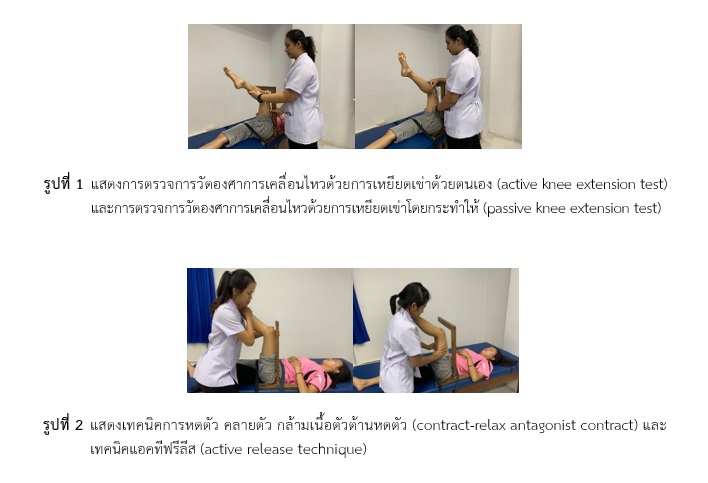
วัตถุประสงค์: การวิจัยครั้งนี้มีวัตถุประสงค์เพื่อศึกษาผลของการยืดกล้ามเนื้อต้นขาด้านหลังด้วยเทคนิคการหดตัว คลายตัว กล้ามเนื้อตัวต้านหดตัว กับเทคนิคแอคทีฟรีลีส ในผู้ที่มีการออกกำลังกายต่ำที่มีกล้ามเนื้อต้นขาด้านหลังหดสั้น
วิธีดำเนินการวิจัย: กลุ่มตัวอย่างเป็นผู้ที่มีการออกกำลังกายต่ำที่มีกล้ามเนื้อต้นขาด้านหลังหดสั้น อายุ 18-25 ปี ในจังหวัดนครปฐม จำนวน 54 คน โดยแบ่งออกเป็น 2 กลุ่ม คือ กลุ่มเทคนิคการหดตัว คลายตัว กล้ามเนื้อตัวต้านหดตัว จำนวน 27 คน และกลุ่มเทคนิคแอคทีฟรีลีส จำนวน 27 คน ทำการวัดผลองศาการเคลื่อนไหวด้วยการเหยียดเข่าด้วยตนเอง การวัดองศาการเคลื่อนไหวด้วยการเหยียดเข่าโดยกระทำให้ และการทดสอบการนั่งงอตัวไปทางข้างหน้า โดยวัดผลก่อนและหลังการยืดกล้ามเนื้อทันที 3 วันต่อสัปดาห์ เป็นระยะเวลา 3 สัปดาห์ จากนั้นนำมาวิเคราะห์สถิติ โดยใช้สถิติ Wilcoxon sign rank test เปรียบเทียบก่อนและหลัง ภายในกลุ่ม และสถิติ Mann Whitney U test เปรียบเทียบระหว่างกลุ่ม
ผลการวิจัย: หลังจากการทดลอง ไม่พบความแตกต่างของค่าเฉลี่ยของข้อมูลพื้นฐาน ได้แก่ อายุ น้ำหนัก ส่วนสูงและค่าดัชนีมวลกาย เมื่อเปรียบเทียบการทดลองภายในกลุ่มเทคนิคการหดตัว คลายตัว กล้ามเนื้อตัวต้านหดตัว และกลุ่มเทคนิคแอคทีฟรีลีส พบว่า การวัดองศาการเคลื่อนไหวด้วยการเหยียดเข่าด้วยตนเอง การวัดองศาการเคลื่อนไหวของการเหยียดเข่าโดยกระทำให้ และการวัดความอ่อนตัว มีความแตกต่างกันอย่างมีนัยสำคัญทางสถิติ (p<0.001) และเปรียบเทียบระหว่างกลุ่มเทคนิคการหดตัว คลายตัว กล้ามเนื้อตัวต้านหดตัว และกลุ่มเทคนิคแอคทีฟรีลีส หลังจากการทดลอง พบว่าไม่มีความแตกต่างกันอย่างมีนัยสำคัญทางสถิติ
สรุปผลการวิจัย: กลุ่มเทคนิคการหดตัว คลายตัว กล้ามเนื้อตัวต้านหดตัว และกลุ่มเทคนิคแอคทีฟรีลีส สามารถเพิ่มความยาวของกล้ามเนื้อต้นขาด้านหลัง ความยืดหยุ่นของกล้ามเนื้อต้นขาด้านหลังและองศาการเคลื่อนไหวของการเหยียดเข่าด้วยตนเองได้ทันที
Article Details

อนุญาตภายใต้เงื่อนไข Creative Commons Attribution-NonCommercial-NoDerivatives 4.0 International License.
เอกสารอ้างอิง
Attrey P., Yadav M., and Singh S. (2017). Relationship between passive straight legs raising test and v-sit and reach test in measuring the hamstring flexibility. Indian Journal of Physical Education, Sport and Applied Sciences, 7(2), 23-30.
Boonsom, N. (2017). Flexibility Development by Stretching. Veridian E-Journal, 10(2), 2173-2184.
Braman, M.S. (2016). The Effect of Hamstring Lengthening on Pelvic Tilt and Lumbar Lordosis. Master of Science in Biomedical Engineering, Biomedical engineering, College of graduate health sciences, The University of Tennessee. Tennessee.
Bunyaratavej, N. (1986). Back pain. Bangkok: Phaisansin.
Burgess, T., Vadachalam, T., Buchholtz, K., & Jelsma, J. (2019). The effect of the contract-relax-agonist-contract (CRAC) stretch of hamstrings on range of motion, sprint and agility performance in moderately active males: A randomised control trial. South African journal of sports medicine, 31(1), v31i1a6091. https://doi.org/10.17159/2078-516X/2019/v31i1a6091
Contractor G. (2017). Effects of Active Release Technique on Hamstrings Flexibility in Patients having Chronic Low Back Pain. International Journal of Science and Research, 6(3), 967-971.
Damsen, P. (2009). Effects of Proprioceptive Neuromuscular Facilitation Stretching and Passive Stretching on Flexibility. Master’s Thesis, Physical Education, Srinakharinwirot University. Bangkok.
Department of physical education. (2018). Stretching exercises based on sports science in athletes, (Online). Retrieved July 28, 2019, from Ministry of Tourism and Sports. Website: https://www.dpe.go.th/dwl-preview-401891791937
Department of physical education. (2019). Physical fitness test and guideline for 19-59 years old, (Online). Retrieved June 28, 2019, from Ministry of Tourism and Sports. Website: https://www.dpe.go.th/manual-files-411291791796
Dungkong, S. (2018). Physical Therapy Management of Myofascial Pain Syndrome of Upper Trapezius Muscle. Siriraj Medical Bulletin, 11(1), 27-33.
Fatima, G., Qamar, M. M., Hassan, J. U., and Basharat, A. (2017). Extended sitting can cause hamstring tightness. Saudi Journal of Sports Medicine, 17(2), 111-114.
Hindle, K.B., Whitcomb, T.J., Briggs, W.O., and Hong J. (2012). Proprioceptive Neuromuscular Facilitation (PNF): Its Mechanisms and Effects on Range of Motion and Muscular Function. Journal of Human Kinetics, 31, 105-113.
Kage, V., and Ratnam, R. (2014). Immediate effect of active release technique versus mulligan bent leg raise in subjects with hamstring tightness: a randomized clinical trial. International Journal of Physiotherapy and Research, 2(1), 301-304.
Kim, J.H., Lee, H.S., and Park, S.W. (2015). Effects of the active release technique on pain and range of motion of patients with chronic neck pain. Journal of Physical Therapy Science, 27(8), 2461–2464.
Koli, B.K., and Anap, D.B. (2018). Prevalence and severity of hamstring tightness among college student: a cross sectional study. International Journal of Clinical and Biomedical Research, 4(2), 65-68.
Mitchell, U.H., Myrer, J.W., Hopkins, J.T., Hunter, I., Feland, J.B., and Hilton, S.C. (2009). Neurophysiological reflex mechanisms' lack of contribution to the success of PNF stretches. Journal of Sport Rehabilitation, 18(3), 343-357.
Nagarwal, A.K., Zutshi, K., Ram, C.S., and Zafar, R. (2010). Improvement of Hamstring Flexibility: A Comparison between Two PNF Stretching Techniques. International Journal of Sports Science and Engineering, 4(1), 25-33.
Rafaqat, A., Usman M., Shahzad, M.F., and Sattar, M.I. (2018). Effects of active release technique in males as compared to females with postural and psychological cervical muscle spasm: A Quasi experimental study. Italian Journal of Sports Rehabilitation and Posturology, 5(1), 870-887.
Reis, F.J.J. and Macedo, A.R. (2015). Influence of hamstring tightness in pelvic, lumbar and trunk range of motion in low back pain and asymptomatic volunteers during forward bending. Asian Spine Journal. 9(4), 535-540.
Robb, A., & Pajaczkowski, J. (2011). Immediate effect on pain thresholds using active release technique on adductor strains: Pilot study. Journal of bodywork and movement therapies, 15(1), 57-62.
Shakya, N.R., and Manandhar, S. (2018). Prevalence of hamstring muscle tightness among undergraduate physiotherapy students of Nepal using passive knee extension angle test. International Journal of Scientific and Research Publications, 8(1), 182-187.
Singh, S.K., Grover, V., & Singh, S.K. (2015). Effect of Neural Mobilization and PNF Stretching on Hamstring Flexibility in Working Women. International Journal of Health Sciences and Research, 5(8), 361-368.
Tak, S., Lee, Y., Choi, W., and Lee G. (2013). The effects of active release technique on the gluteus medius for pain relief in persons with chronic low back pain. Physical Therapy Rehabilitation Science, 2(1), 27-30.
Tola, J. (2007). Essential atlas of physiology. Bangkok: Suweerivasarn company.
Topothai, T., Liangruenrom, N., Topothai, C., Suriyawongpaisan, W., Limwattananon, S., and Limwattananon, C. (2018). How Much of Energy Expenditure from Physical Activity and Sedentary Behavior of Thai Adults: The 2015 National Health and Welfare Survey. Journal of Health Systems Research, 11(3), 327-344.
Victoria, G.D., Carmen, E.V., Alexandru, S., Antoanela, O., Florin, C., and Daniel D. (2013). The PNF (proprioceptive neuromuscular facilitation) stretching technique-a brief review. Ovidius University Annals, Series Physical Education and Sport, 13(2), 623-628.
