ผลฉับพลันของการผสมผสานการฝึกด้วยน้ำหนักและยางยืดในท่าย่อกระโดดที่มีต่อพลังสูงสุดและคลื่นไฟฟ้ากล้ามเนื้อ
Article Sidebar
Main Article Content
บทคัดย่อ
วัตถุประสงค์: การวิจัยนี้มีวัตถุประสงค์เพื่อศึกษาและเปรียบเทียบผลฉับพลันของการผสมผสานการฝึกด้วยน้ำหนักและยางยืดในท่าย่อกระโดดที่มีต่อพลังสูงสุดและคลื่นไฟฟ้ากล้ามเนื้อ
วิธีดำเนินการ: การวิจัยครั้งนี้ศึกษาในนิสิตชาย คณะวิทยาศาสตร์การกีฬา จุฬาลงกรณ์มหาวิทยาลัย เลือกแบบเฉพาะเจาะจง อายุเฉลี่ย 18-25 ปี จำนวน 13 คน ทำการทดสอบการผสมผสานการฝึกด้วยน้ำหนักและยางยืดในท่าย่อกระโดดที่สัดส่วน 90:10, 80:20, 70:30, 60:40 และ 50:50 โดยทำการแบกน้ำหนักย่อกระโดด 6 ครั้ง
ไม่ต่อเนื่องกัน จำนวน 1 เซท ที่ความหนัก 30% ของความแข็งแรงสูงสุด การทดสอบแต่ละรูปแบบจะห่างกันไม่น้อยกว่า 48 ชม. และนำข้อมูลที่ได้มาวิเคราะห์ทางสถิติ เพื่อหาค่าเฉลี่ยและส่วนเบี่ยงมาตรฐาน และเปรียบเทียบความแตกต่างโดยใช้สถิติวิเคราะห์ความแปรปรวนทางเดียวชนิดวัดซ้ำ (One-way analysis of variance with repeated measure) กำหนดความมีนัยสำคัญทางสถิติที่ระดับ .05
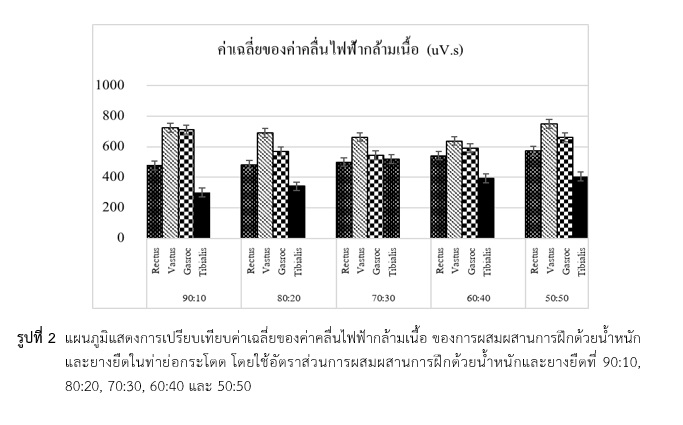
ผลการวิจัย: (1) ค่าเฉลี่ยของค่าพลังสูงสุดของสัดส่วนการผสมผสานการฝึกด้วยน้ำหนักและยางยืด 50:50 แตกต่างกับสัดส่วนของการผสมผสานการฝึกด้วยน้ำหนักและยางยืด 90:10 และ 80:20 อย่างมีนัยสำคัญทางสถิติที่ระดับ .05 และค่าเฉลี่ยของค่าพลังสูงสุดของสัดส่วนการผสมผสานการฝึกด้วยน้ำหนักและยางยืด 90:10, 80:20, 70:30 และ 60:40 ไม่แตกต่างกันอย่างมีนัยสำคัญทางสถิติที่ระดับ .05 (2) ค่าเฉลี่ยของค่าของค่าคลื่นไฟฟ้ากล้ามเนื้อ ของสัดส่วนการผสมผสานการฝึกด้วยน้ำหนักและยางยืด 90:10, 80:20, 70:30, 60:40 และ 50:50 ไม่แตกต่างกันอย่างมีนัยสำคัญทางสถิติที่ระดับ .05
สรุปผลการวิจัย: การผสมผสานการฝึกด้วยน้ำหนักและยางยืด ที่ความหนัก 30% ของ 1RM ในสัดส่วนการผสมผสานการฝึกด้วยน้ำหนักและยางยืด 50:50 ในท่าย่อกระโดด สามารถพัฒนาพลังสูงสุดได้ดีกว่าสัดส่วนการผสมผสานการฝึกด้วยน้ำหนักและยางยืด 90:10, 80:20, 70:30 และ 60:40
Article Details

อนุญาตภายใต้เงื่อนไข Creative Commons Attribution-NonCommercial-NoDerivatives 4.0 International License.
เอกสารอ้างอิง
Albernethy, B., Kippers, V., Hanrahan, S., Pandey, M., McManus, A., & Mackinnon, L. (2005). The Biophysical Foundations of Human Movement. Champaign, IL: Human Kinetics.
Anderson, C. E., Sforzo, G. A., & Sigg, J. A. (2008). The effects of combining elastic resistance and free weight resistance on strength and power in athletes. Journal of Strength and Conditioning Research, 22(2), 567-574.
Argus, C. K., Gill, N. D., Keogh, J. W., Blazevich, A. J., & Hopkins, W. G. (2011). Kinetic and training comparisons between assisted, resisted, and free countermovement jumps. Journal of strength and conditioning research, 25(8), 2219-2227.
Baker, D., & Newton, R. D. (2005). Methods to Increase the Effectiveness of Maximal Power Training for the Upper Body. Strength and Conditioning Journal, 27(6), 24-32.
Benjaponsit, K. & Intiraporn, C. (2015). Acute Effects of Different Resistance Elastic Band on Vertical Jump Peak Power in Young Female Volleyball Players. Journal of Sports Science and Health, 16(3), 28-36.
Bellar, D. M., Muller, M. D., Barkley, J. E., Kim, C. H., Ida, K., Ryan, E. J., Glickman, E. L. (2011). The effects of combined elastic resistance- and free-weight tension vs. free-weight tension on one-repetition maximum strength in the bench press. Journal of Strength and Conditioning Research, 25(2), 459-463.
Corbin, C. B., Welk, G. J., Corbin, W. R., & Welk, K. A. (2008). Concepts of fitness and wellness. Americans, New York: The McGraw-Hill companies.
Everett, G. (2011). Olympic weightlifting: a complete guide for athletes and coaches. The United States of American: Catalyst Athletics.
Fleck, S. J., & Kraemer, W. J. (2004). Designing resistance training programs Champaign, Illinois: Human Kinetics.
Harman, E., Baechle, T. R., & Earle, R. W. (2000). The biomechanics of resistance exercise (Eds). In Essentials of Strength and Conditioning Champaign, IL: Human Kinetics.
Hori, N., Newton, R. U., Andrews, W. A., Kawamori, N., McGuigan, M. R., & Nosaka, K. (2008). Does performance of hang power clean differentiate performance of jumping, sprinting, and changing of direction?. Journal of strength and conditioning research, 22(2), 412-418.
Israetel, M. A., McBride, J. M., Nuzzo, J. L., Skinner, J. W., & Dayne, A. M. (2010). Kinetic and kinematic differences between squats performed with and without elastic resistance bands. Journal of Strength and Conditioning Research, 24(1), 190-194.
McBride, J. M., Triplett-McBride, T., Davie, A., & Newton, R. U. (2002). The effect of heavy- vs. light-load jump squats on the development of strength, power, and speed. Journal of strength and conditioning research, 16(1), 75–82.
Paditsaeree, K., Intiraporn, C., & Lawsirirat, C. (2016). Comparison Between the Effects of Combining Elastic and Free-Weight Resistance and Free-Weight Resistance on Force and Power Production. Journal of strength and conditioning research, 30(10), 2713-2722.
Rhea, M. R., Kenn, J. G., & Dermody, B. M. (2009). Alterations in speed of squat movement and the use of accommodated resistance among college athletes training for power. Journal of Strength and Conditioning Research, 23(9), 2645-2650.
Saeterbakken, A. H., Andersen, V., & Tillaar, R. (2016). Comparison of Kinematics and Muscle Activation in Free-Weight Back Squat with and Without Elastic Resistance Bands. Journal of Strength and Conditioning Research, 30(4), 945–952.
Simmons, L. P. (1999). Bands and chains. Power lifting USA, 22, 26-27.
Stevenson, M. W., Warpeha, J. M., Dietz, C. C., Giveanz, R. M., & Erdman, A. G. (2010). Acute effects of elastic resistance bands during the free-weight barbell back squat exercise on velocity, power and force production. Journal of Strength and Conditioning Research, 24(11), 2944-2954.
Thomas, G. A., Kraemer, W. J., Spiering, B. A., Volek, J. S., Anderson, J. M., & Maresh, C. M. (2007). Maximal power at different percentages of one repetition maximum: influence of resistance and gender. Journal of strength and conditioning research, 21(2), 336-342.
Umberger, R. (1998). Mechanics of the vertical jump and two joint muscles: implication for training. National Strength and Conditioning Association Journal, 20(5), 70-74.
Wallace, B. J., Winchester, J. B., & McGuigan, M. R. (2006). Effects of elastic resistance bands on force and power characteristics during the back-squat exercise. Journal of Strength and Conditioning Research, 20(2), 268–272.
Wilson, G. J., Newton, R. U., Murphy, A. J., & Humphries, B. J. (1993). The optimal training load for the development of dynamic athletic performance. Medicine and science in sports and exercise, 25(11), 1279-1286.
Yessis, M. (2000). Explosive Golf: Using the Science of Kinesiology to Improve Your Swing [Press release]
