ความแตกต่างของความแข็งแรงสูงสุดและสัดส่วนความแข็งแรงของกล้ามเนื้อต้นขาด้านหน้าและหลังระหว่างนักวิ่งเพื่อสุขภาพที่ไม่มีการบาดเจ็บอายุมากกว่าและน้อยกว่า 40 ปี
Article Sidebar
Main Article Content
บทคัดย่อ
วัตถุประสงค์การวิจัย: เพื่อศึกษาเปรียบเทียบหาความแตกต่างของความแข็งแรงสูงสุดกล้ามเนื้อต้นขา (Peak torque/body weight) และสัดส่วนความแข็งแรงของกล้ามเนื้อต้นขาด้านหน้าและหลัง (Hamstrings to quadriceps ratio) ในกลุ่มนักวิ่งเพื่อสุขภาพที่มีช่วงอายุที่แตกต่างกัน
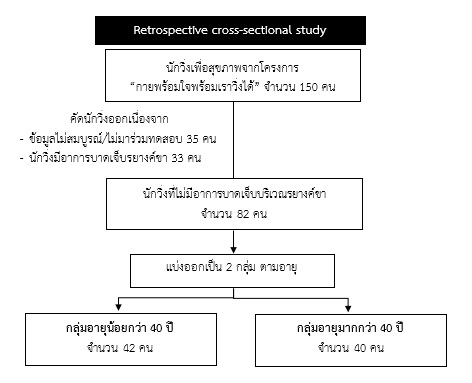
วิธีการดําเนินการวิจัย: กลุ่มผู้เข้าร่วมการวิจัยเป็นนักวิ่งเพื่อสุขภาพที่ไม่มีอาการบาดเจ็บของรยางค์ขาจำนวน 82 คน (ชายจำนวน 42 คนและหญิงจำนวน 40 คน) อายุเฉลี่ย 39.85±9.23 ปี (Mean±SD) จากโครงการการทดสอบสมรรถนะนักวิ่งจากโครงการ “กายพร้อม ใจ พร้อม เราวิ่งได้” ในช่วงระหว่างปี พ.ศ. 2559-2562 โดยแบ่งผู้เข้าร่วมการวิจัยออกเป็น 2 กลุ่มตามอายุ ได้แก่ กลุ่มอายุน้อยกว่า 40 ปี จำนวน 42 คน และกลุ่มอายุมากกว่า 40 ปี จำนวน 40 คน นำมาทดสอบกำลังกล้ามเนื้อเข่าด้วย Isokinetic dynamometer ที่อัตราเร็วเชิงมุม 60, 120 และ 180 °/วินาที แล้วนำค่า Peak torque/body weight และHamstrings to quadriceps ratio มาวิเคราะห์ข้อมูลทางสถิติ โดยใช้ Unpaired t-test ตั้งค่า p-value น้อยกว่า 0.05 สำหรับตัวแปรที่มีการกระจายของข้อมูลไม่ปกติใช้ Mann–Whitney U test
ผลการวิจัย: กลุ่มนักวิ่งอายุน้อยกว่า 40 ปี มีค่า Peak torque/body weight ของ Knee extensor ที่อัตราเร็วเชิงมุม 60 และ 120 ต่อวินาที มีค่ามากกว่าอย่างมีนัยสำคัญกลุ่มนักวิ่งช่วงอายุมากกว่า 40 ปี (p=0.038, p=0.042) ในส่วนของตัวแปร Flexor peak torque และ H:Q ratio ไม่พบความแตกต่างกันระหว่างกลุ่ม
สรุปผลการวิจัย: แรงเหยียดเข่าสูงสุด (Extensor peak torque)ในกลุ่มนักวิ่งอายุมากกว่า 40 ปี มีค่าเฉลี่ยน้อยกว่ากลุ่มนักวิ่งอายุน้อยกว่า 40 ปี อย่างมีนัยสำคัญที่ความเร็วเชิงมุม 60 และ 120 °/วินาที จากผลการวิจัยนี้ สนับสนุนการศึกษาก่อนหน้าเรื่องของการบาดเจ็บทางกระดูกและกล้ามเนื้อที่มีโอกาสเกิดได้สูงในกลุ่มนักวิ่งที่มีอายุมากกว่า 40 ปี อาจมาจากปัจจัยเรื่องของแรงเหยียดเข่าสูงสุดที่ลดลง
Article Details

อนุญาตภายใต้เงื่อนไข Creative Commons Attribution-NonCommercial-NoDerivatives 4.0 International License.
เอกสารอ้างอิง
Aagaard, P., Simonsen, E. B., Magnusson, S. P., Larsson, B., & Dyhre-Poulsen, P. (1998). A new concept for isokinetic hamstring: quadriceps muscle strength ratio. The American journal of sports medicine, 26(2), 231-237.
Conoboy, P., & Dyson, R. (2006). Effect of aging on the stride pattern of veteran marathon runners. British journal of sports medicine, 40(7), 601-604.
Coombs, R., & Garbutt, G. (2002). Developments in the use of the hamstring/quadriceps ratio for the assessment of muscle balance. Journal of sports science & medicine, 1(3), 56.
Dellagrana, R. A., Diefenthaeler, F., Carpes, F. P., Hernandez, S. G., & de Campos, W. (2015). Evidence for isokinetic knee torque asymmetries in male long distance-trained runners. International journal of sports physical therapy, 10(4), 514.
DeVita, P., Fellin, R. E., Seay, J. F., Ip, E., Stavro, N., & Messier, S. P. (2016). The relationships between age and running biomechanics. Medicine and science in sports and exercise, 48(1), 98-106.
Drouin, J. M., Valovich-mcLeod, T. C., Shultz, S. J., Gansneder, B. M., & Perrin, D. H. (2004). Reliability and validity of the Biodex system 3 pro isokinetic dynamometer velocity, torque, and position measurements. European journal of applied physiology, 91(1), 22-29.
Duarte, J. P., Valente-Dos-Santos, J., Coelho-E-Silva, M. J., Couto, P., Costa, D., Martinho, D., Seabra, A., Cyrino, E. S., Conde, J., Rosado, J., & Gonçalves, R. S. (2018). Reproducibility of isokinetic strength assessment of knee muscle actions in adult athletes: Torques and antagonist-agonist ratios derived at the same angle position. PloS one, 13(8), e0202261. https://doi.org/10.1371/journal.pone.0202261
Fukuchi, R. K., & Duarte, M. (2008). Comparison of three-dimensional lower extremity running kinematics of young adult and elderly runners. Journal of sports sciences, 26(13), 1447-1454.
Hsu, C.-L., Yang, C.-H., Wang, J.-H., & Liang, C.-C. (2020). Common running musculoskeletal injuries and associated factors among recreational gorge marathon runners: An investigation from 2013 to 2018 Taroko gorge marathons. International journal of environmental research and public health, 17(21), 8101.
Huang, H., Guo, J., Yang, J., Jiang, Y., Yu, Y., Müller, S., Ren, G., & Ao, Y. (2017). Isokinetic angle-specific moments and ratios characterizing hamstring and quadriceps strength in anterior cruciate ligament deficient knees. Scientific reports, 7(1), 7269. https://doi.org/10.1038/s41598-017-06601-5
Imtanabut, W., Sathianpantarit, P., Sungnak, P., Laisirirungrai, D., Kingcha, P., Sinsurin, K. (2021). The difference of HQ ratio and knee peak torque between the lower and higher mileage runners. Journal of Sports Science and Technology, 21(1), 68-78.
Kannus, P., & Beynnon, B. (1993). Peak torque occurrence in the range of motion during isokinetic extension and flexion of the knee. International journal of sports medicine, 14(08), 422-426.
Karamanidis, K., & Arampatzis, A. (2005). Mechanical and morphological properties of different muscle-tendon units in the lower extremity and running mechanics: effect of aging and physical activity. Journal of Experimental Biology, 208(20), 3907-3923.
Larsson, L., Grimby, G., & Karlsson, J. (1979). Muscle strength and speed of movement in relation to age and muscle morphology. Journal of Applied Physiology, 46(3), 451-456.
Lee, D.-c., Pate, R. R., Lavie, C. J., Sui, X., Church, T. S., & Blair, S. N. (2014). Leisure-time running reduces all-cause and cardiovascular mortality risk. Journal of the American College of Cardiology, 64(5), 472-481.
Manou, V., Arseniou, P., Gerodimos, V., & Kellis, S. (2002). Test-retest reliability of an isokinetic muscle endurance test. Isokinetics and Exercise Science, 10(4), 177-181.
Marti, B., Vader, J. P., Minder, C. E., & Abelin, T. (1988). On the epidemiology of running injuries: the 1984 Bern Grand-Prix study. The American journal of sports medicine, 16(3), 285-294.
McKean, K. A., Manson, N. A., & Stanish, W. D. (2006). Musculoskeletal injury in the master’s runners. Clinical Journal of Sports Medicine, 16(2), 149-154.
NCD Countdown 2030 collaborators (2018). NCD Countdown 2030: worldwide trends in non-communicable disease mortality and progress towards Sustainable Development Goal target 3.4. Lancet (London, England), 392(10152), 1072–1088.
Nugent, E. P., Snodgrass, S. J., & Callister, R. (2015). The effect of velocity and familiarisation on the reproducibility of isokinetic dynamometry. Isokinetics and Exercise Science, 23(3), 205-214.
Organization, W. H. (2018). World health statistics 2018: monitoring health for the SDGs, sustainable development goals: World Health Organization.
Sapega A. A. (1990). Muscle performance evaluation in orthopaedic practice. The Journal of bone and joint surgery. American volume, 72(10), 1562-1574.
Thorstensson, A., & Karlsson, J. (1976). Fatiguability and fibre composition of human skeletal muscle. Acta Physiologica Scandinavica, 98(3), 318-322.
Tredinnick, T. J., & Duncan, P. W. (1988). Reliability of measurements of concentric and eccentric isokinetic loading. Physical Therapy, 68(5), 656-659.
Upiriyasakul, R., Bovonsunthonchai, S., Sakunkaruna, Y., Sakunkaruna, S., Thong-on, S., & Laisirirungrai, D. (2015). Incidence of injury in marathon runners; Bangkok marathon. Journal of Sports Science and Technology, 15(1), 171-178.
