
การเปลี่ยนแปลงของตัวแปรทางชีวกลศาสตร์ของการว่ายน้ำ 200 เมตร ท่าฟรอนท์ ครอลในรยางค์ส่วนล่างของนักกีฬาว่ายน้ำทีมชาติไทย
Article Sidebar
Main Article Content
บทคัดย่อ
วัตถุประสงค์: การวิจัยครั้งนี้มีวัตถุประสงค์เพื่อศึกษาการเปลี่ยนแปลงของตัวแปรทางชีวกลศาสตร์ของการว่ายน้ำ 200 เมตร ท่าฟรอนท์ ครอลในรยางค์ส่วนล่างของนักกีฬาว่ายน้ำทีมชาติไทย
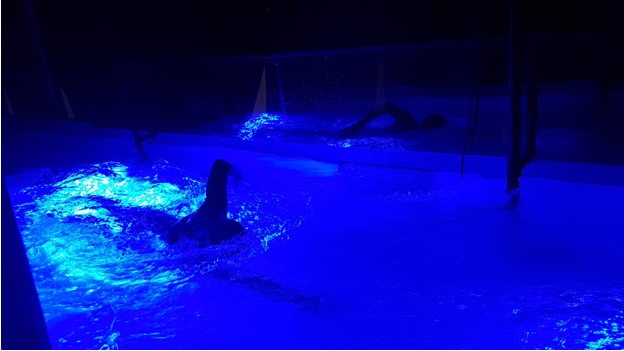
วิธีดำเนินการวิจัย: กลุ่มตัวอย่างที่ใช้ในการวิจัยครั้งนี้คือนักกีฬาว่ายน้ำทีมชาติที่แข่งขันท่าฟรอนท์ ครอล (front crawl) ในการแข่งขันซีเกมส์ครั้งที่ 29 ณ ประเทศมาเลเซีย ปี 2560 เพศชาย จำนวน 7 คน คัดเลือกกลุ่มตัวอย่างด้วยวิธีการเลือกแบบเจาะจง (Purposive Sampling) ทำการทดสอบการเปลี่ยนแปลงของตัวแปรทางชีวกลศาสตร์ของการว่ายน้ำ 200 เมตรท่าฟรอนท์ครอว์ลในรยางค์ส่วนล่างของนักกีฬาว่ายน้ำทีมชาติไทย ในอุโมงค์น้ำ (Water flume) โดยการว่ายน้ำด้วยความเร็ว 75% ของความเร็วเฉลี่ยสูงสุดที่ได้จากการว่ายท่าฟรอนท์ ครอล ระยะ 200 เมตรในสระว่ายน้ำ 50 เมตร นำผลที่ได้มาวิเคราะห์ทางสถิติโดยหาค่าเฉลี่ย ส่วนเบี่ยงเบนมาตรฐานของตัวแปรทางชีวกลศาสตร์ และทดสอบความแตกต่างของตัวแปรทางชีวกลศาสตร์ 4 ช่วง ได้แก่ ช่วง 1 (20-40 เมตร) ช่วง 2 (70-90 เมตร) ช่วง 3 (120-140 เมตร) และช่วง 4 (170-190 เมตร) โดยใช้วิธีทดสอบทางสถิติแบบความแปรปรวนทางเดียวชนิดวัดซ้ำ (One-way repeated measure ANOVA with post-hoc LSD) กำหนดระดับมีนัยสำคัญทางสถิติที่ระดับ 0.05
ผลการวิจัย: พบว่า มุมที่ลำตัวกระทำต่อผิวน้ำ(Body’s angle of attack) มุมของข้อเท้า (Angle of the ankle) มุมของหัวเข่า (Angle of the knee) มุมของสะโพก (Angle of the hip) ความเร็วของข้อเท้า (Velocity of the ankle) ความเร็วของหัวเข่า (Velocity of the knee) และความเร็วของสะโพก (Velocity of the hip) ในขณะว่ายน้ำ 200 เมตร ท่าฟรอนท์ ครอล ทั้ง 4 ช่วง แตกต่างกันอย่างมีนัยสำคัญทางสถิติที่ระดับ 0.05 โดยพบว่า เมื่อระยะทางในการว่ายน้ำเพิ่มขึ้น มุมที่ลำตัวกระทำต่อผิวน้ำลดลง ขณะที่มุมของข้อเท้า หัวเข่าและสะโพกเพิ่มขึ้น
สรุปผลการวิจัย: ตัวแปรทางชีวกลศาสตร์ของรยางค์ส่วนล่างในขณะว่ายน้ำ 200 เมตร ท่าฟรอนท์ ครอล มีการเปลี่ยนแปลงตามระยะทางในการว่ายน้ำที่เพิ่มขึ้น
Article Details

อนุญาตภายใต้เงื่อนไข Creative Commons Attribution-NonCommercial-NoDerivatives 4.0 International License.
เอกสารอ้างอิง
Callaway, A.J. (2015). Measuring Kinematic Variables in Front Crawl Swimming Using Accelerometers: A Validation Study. Sensors, 15(5), 11363-11386.
Chainok, P., Nakkanueng, H., Sowhasun, I., and Matjiur, R. (2020). Analysis of Specific Pacing Strategy of the 200M and Individual Medley Swimmers in the 45th Thailand National Game. Journal of Sports Science and Health, 21(2), 207-221.
Chengalur, S. N., & Brown, P. L. (1992). An analysis of male and female Olympic swimmers in the 200-meter events. Canadian journal of sport sciences, 17(2), 104-109.
Chollet, D., Chalies, S., & Chatard, J. C. (2000). A new index of coordination for the crawl: description and usefulness. International journal of sports medicine, 21(1), 54-59.
de Jesus, K., de Jesus, K., Figueiredo, P., Gonçalves, P., Vilas-Boas, J.P., and Fernandes, R.J. (2011). LOWER LIMBS JOINTS MOTION DURING SUBMAXIMAL 100-M BUTTERFLY. Paper presented at the ISBS-Conference Proceedings Archive.
Deschodt, V., Arsac, L., and Rouard, A. (1999). Relative contribution of arms and legs in humans to propulsion in 25-m sprint front-crawl swimming. European Journal of Applied Physiology and Occupational Physiology, 80(3), 192-199.
Deschodt, V.J., and Arsac, L.M. (2004). Morning vs. evening maximal cycle power and technical swimming ability. The Journal of Strength & Conditioning Research, 18(1), 149-154.
Figueiredo, P., Rouard, A., Vilas-Boas, J.P., and Fernandes, R.J. (2013). Upper-and lower-limb muscular fatigue during the 200-m front crawl. Applied Physiology, Nutrition, and Metabolism, 38(7), 716-724.
Gatta, G., Cortesi, M., and Di Michele, R. (2012). Power production of the lower limbs in flutter-kick swimming. Sports Biomechanics, 11(4), 480-491.
Maglischo, C., Maglischo, E., Higgins, J., Hinricks, R., Luedtke, D., Schleihauf, R., and Thayer, A. (1986). A biomechanical analysis of the 1984 US Olympic swimming team: The distance freestylers. Journal of Swimming Research, 2(3), 12-16.
McLeod, I. (2010). Swimming anatomy. Human Kinetics Champaign, IL.
Strzała, M., Krężałek, P., Kaca, M., Głąb, G., Ostrowski, A., Stanula, A., and Tyka, A. (2012). Swimming speed of the breaststroke kick. Journal of human kinetics, 35(1), 133-139.
