ปัจจัยทำนายพฤติกรรมเนือยนิ่งในเด็กวัยเรียน
คำสำคัญ:
ปัจจัยทำนาย, พฤติกรรมเนือยนิ่ง, เด็กวัยเรียนบทคัดย่อ
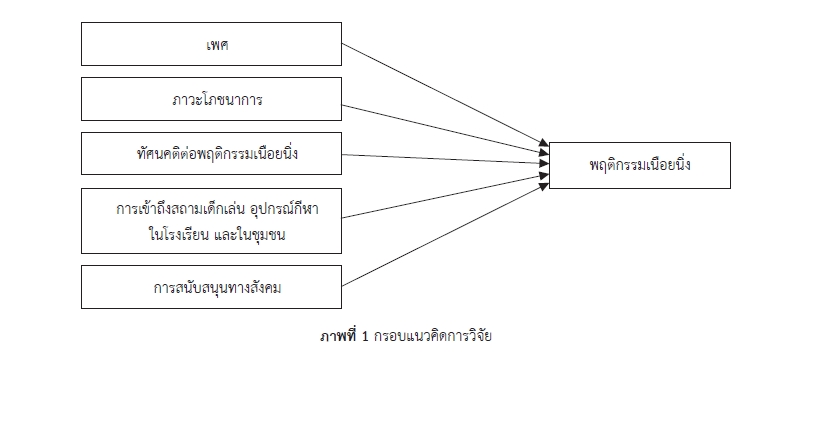
การศึกษาครั้งนี้มีวัตถุประสงค์เพื่อศึกษาปัจจัยทำนายพฤติกรรมเนือยนิ่งในเด็กวัยเรียน กลุ่มตัวอย่างคือ นักเรียนชั้นประถมศึกษาปีที่ 4-6 ในเขตอำเภอบ้านบึง จังหวัดชลบุรี จำนวน 183 คน ซึ่งได้มาจากการสุ่มแบบหลายขั้นตอน เครื่องมือที่ใช้ในการเก็บรวบรวมข้อมูลประกอบด้วย แบบสอบถามข้อมูลส่วนบุคคล ทัศนคติต่อพฤติกรรมเนือยนิ่ง การเข้าถึงสนามเด็กเล่นและอุปกรณ์กีฬาในโรงเรียนและชุมชน การสนับสนุนทางสังคม และพฤติกรรมเนือยนิ่ง เก็บรวบรวมข้อมูลระหว่างเดือนมิถุนายน ถึง กรกฎาคม พ.ศ. 2566 วิเคราะห์ข้อมูลโดยใช้สถิติพรรณนาและสถิติถดถอยพหุคูณแบบขั้นตอน
ผลการวิจัยพบว่า พฤติกรรมเนือยนิ่งของกลุ่มตัวอย่างในวันธรรมดา (จันทร์-ศุกร์) อยู่ในระดับน้อย (M = 3.57, SD = 1.242) และในวันหยุดอยู่ในระดับปานกลาง (M = 3.70, SD = 1.362) ปัจจัยที่สามารถทำนายพฤติกรรมเนือยนิ่งได้ คือ ทัศนคติต่อพฤติกรรมเนือยนิ่ง (b = .179) ซึ่งสามารถทำนายได้ร้อยละ 3.2 (R² = .032, p < .05)
จากผลการวิจัยครั้งนี้มีข้อเสนอแนะว่า พยาบาลเวชปฏิบัติชุมชนและบุคลากรด้านสุขภาพควรนำผลการวิจัยไปพัฒนารูปแบบกิจกรรมเพื่อลดพฤติกรรมเนือยนิ่งในเด็กวัยเรียน โดยเน้นการปรับทัศนคติต่อพฤติกรรมเนือยนิ่ง
เอกสารอ้างอิง
Bashatah, A., Ali, W. S., & Al-Rawi, M. B. A. (2023). Attitudes towards exercise, leisure activities, and sedentary behavior among adults: A cross-sectional, community-based study in Saudi Arabia. Medicina (Kaunas, Lithuania), 59(9), 1524. https://doi.org/10.3390/medicina59091524
Carson, V., Hunter, S., Kuzik, N., Gray, C. E., et al. (2016). Systematic review of sedentary behaviour and health indicators in school-aged children and youth: An update. Applied Physiology, Nutrition, and Metabolism, 41(6), S240–S265.
Carson, V., Hunter, S., Kuzik, N., Gray, C. E., Poitras, V. J., Chaput, J. P., Saunders, T. J., Katzmarzyk, P. T., Okely, A. D., Connor Gorber, S., Kho, M. E., Sampson, M., Lee, H., & Tremblay, M. S. (2016). Systematic review of sedentary behaviour and health indicators in school-aged children and youth: An update. Applied Physiology, Nutrition, and Metabolism, 41(6), 240-265.
Cronbach, L. J. (1951). Coefficient alpha and the internal structure of tests. Psychometrika, 16(3), 297–334.
Davis, L. L. (1992). Instrument review: Getting the most from a panel of experts. Applied Nursing Research, 5(4), 194-197.
Department of Health. (2022). Report on the physical activity situation of Thai children and youth in 2022. Nonthaburi: Ministry of Public Health. [In Thai]
Ekpalakarn, W. (2014). The 5th Thai national health examination survey report: Child health edition 2014. Nonthaburi: Health Systems Research Institute (HSRI). [In Thai]
Green, L. W, & Kreuter, M. W. (2005). Health promotion planning: An educational and ecological approach (4th ed.). London: Mayfield Publishing.
Hemathulin, N., & Saengsawang, I. (2023). The future of Thai children addicted to screens. Retrieved from https://www.theprachakorn.com/newsDetail.php?id=744 [In Thai]
Howarth, J. (2024). Alarming average screen time statistics 2024. Retrieved from https://explodingtopics.com/blog/screen-time-stats
Janssen, I., & LeBlanc, A. (2010) Systematic review of the health benefits of physical activity and fitness in school aged children and youth. International Journal of Behavioral Nutrition and Physical Activity, 7(40), 1-16.
Liangruenrom, N., Craike, M., Biddle, S. J. H., Kanyapat, S., & Pedisic, Z. (2019). Correlates of physical activity and sedentary behaviour in the Thai population: A systematic review. BMC Public Health, 19(414), 1-26.
Little, R. J. A., & Rubin, D. B. (2020). Statistical analysis with missing data (3rd ed.). New York: John Wiley & Sons.
National Statistical Office, Ministry of Digital Economy and Society. (2021). Key findings: The 2020 household survey on the use of information and communication technology. Bangkok: Economic Statistics Division, National Statistical Office. [In Thai]
Nutrition Division, Department of Health, Ministry of Public Health. (2021). Manual for using growth reference standards for children aged 6–19 years. Bangkok: Tumduayjai. [In Thai]
Mekwimon, W., Ploykamonchun, S., & Sribenjamart, N. (2022). Attitudes, perceptions, and sedentary behavior among school-age children: A survey study in primary schools. Journal of Public Health Academic, 31(4), 679-694. [In Thai]
Office of Chonburi Primary Educational Service Area 1. (2021). Educational information, Chonburi Primary Educational Service Area 1. Retrieved from https://www.chon1.go.th/web/ [In Thai]
Polit, D. F., & Beck, C. T. (2017). Nursing research: Generating and assessing evidence for nursing practice (10th ed.). Philadelphia: Lippincott Williams & Wilkins.
Research Group on Behavior and Social Phenomena. (2023). Analysis: The physical activity situation of the Thai population in 2022 and recommendations for promoting physical activity in 2023. Retrieved from https://tpak.or.th/th/article/647 [In Thai]
Rosenberg, D. E., Norman, G. J., Wagner, N., Patrick, K., Calfas, K. J., & Sallis, J. F. (2010). Reliability and validity of the sedentary behavior questionnaire (SBQ) for adults. Journal of Physical Activity and Health, 7(6), 697-705.
Thongthanas, J., & Khawsanit, P. (2020). Health literacy, health behavior, and physical activity among undergraduate students at North Bangkok University. Journal of Health Education, Physical Education and Recreation, 46(2), 56–67. [In Thai]
Tremblay, M. S., LeBlanc, A. G., Kho, M. E., Saunders, T. J., Larouche, R., Colley, R. C., Goldfield, G., & Gorber, S. C. (2011). Systematic review of sedentary behavior and health indicators in school-aged children and youth. International Journal of Behavioral Nutrition and Physical Activity, 98(8), 1-22.
World Health Organization [WHO]. (2020). WHO guidelines on physical activity and sedentary behavior. Geneva, Switzerland: World Health Organization.
World Health Organization [WHO]. (2021). Physical activity. Retrieved from https://www.who.int/health-topics/physical-activity#tab=tab_1
ดาวน์โหลด
เผยแพร่แล้ว
รูปแบบการอ้างอิง
ฉบับ
ประเภทบทความ
สัญญาอนุญาต

อนุญาตภายใต้เงื่อนไข Creative Commons Attribution-NonCommercial-NoDerivatives 4.0 International License.