The Limited Health Literacy and Associated Factors Among Construction Workers in Bangkok, Thailand
คำสำคัญ:
Factors, Limited health literacy, Construction workersบทคัดย่อ
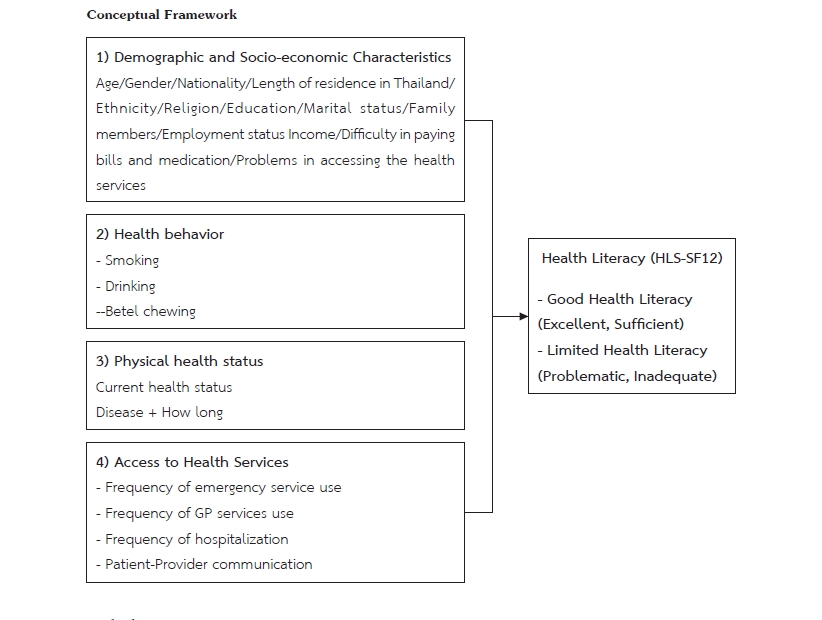
This cross-sectional study aimed to study the level of limited health literacy and its associated factors among construction workers in Bangkok, Thailand. Multistage random sampling was used to select the sample of 225 Thai and 183 Myanmar construction workers in Bangkok. . Research instruments were questionnaires to gather data for socioeconomic factors, health behavior, physical health status, access to health services and health literacy. Descriptive statistics and multiple logistic regression were used to analyze the data.
The results revealed that the sample had limited health literacy in 36.27%. Limited health literacy was significantly correlated with nationality (AOR=2.32, 95%CI: 1.72-3.12, p <0.001), eucational level (AOR= 2.86, 95%CI: 1.64-4.97, p <0.001), difficulty in accessing health services (AOR= 5.49, 95%CI: 2.92-10.34, p <0.001), taking medical treatment at the clinic, (AOR= 3.79, 95%CI: 11.78-8.06, p <0.001) and patient-provider communication (AOR= 2.54, 95%CI: 1.44-4.46, p <0.001).
The findings suggest that health care providers could apply these results to develop activities/ programs to enhance health literacy for construction workers by focusing on accessing health services, taking medical treatment at the clinic, and patient-provider communication.
เอกสารอ้างอิง
Alam, M. K., Rao, M. B., & Cheng, F.-C. (2010). Sample size determination in logistic regression. The Indian Journal of Statistics, 72-B(1), 58-75.
Aung, T. N. N., Shirayama, Y., Moolphate, S., Lorga, T., Jamnongprasatporn, W., Yuasa, M., & Aung, M. N. (2022). Prevalence and risk factors for hypertension among Myanmar migrant Workers in Thailand. International Journal of Environmental Research and Public Health, 19(6), 3511.
Barber, S., & Sciortino, R. (2024). Thailand Migration Report 2024, Bangkok: United Nations Network on Migration in Thailand,.
Berens, E. M., Vogt, D., Messer, M., Hurrelmann, K., & Schaeffer, D. (2016). Health literacy among different age groups in Germany: Results of a cross-sectional survey. BMC Public Health, 16(1), 1151. https://doi.org/10.1186/s12889-016-3810-6
Denuwara, H. M. B. H., & Gunawardena, N. S. (2017). Level of health literacy and factors associated with it among school teachers in an education zone in Colombo, Sri Lanka. BMC Public Health, 17(1), 631. https://doi.org/10.1186/s12889-017-4543-x
Finbråten, H. S., Guttersrud, Ø., Nordström, G., Pettersen, K. S., Trollvik, A., & Wilde-Larsson, B. (2020). Explaining variance in health literacy among people with type 2 diabetes: The association between health literacy and health behaviour and empowerment. BMC Public Health, 20(1). https://doi.org/10.1186/s12889-020-8274-z
Flores, D., House, M., Pearson, J., & Stuart, D. (2023). Health literacy and social determinants of health. The Southwest Respiratory and Critical Care Chronicles, 11(47), 26–32. https://doi.org/10.12746/swrccc.v11i47.1169
Intarakamhang, U., Khammungkul, J., & Boocha, P. (2022). General health literacy scale for Thais and comparison between age groups. Heliyon, 8(5), e09462. https://doi.org/10.1016/j.heliyon.2022.e09462
International Organization for Migration. (2018). Non-communicable diseases and migration. Grand-Saconnex, Switzerland: International Organization for Migration.
Jaafar, N., Perialathan, K., Krishnan, M., Juatan, N., Ahmad, M., Mien, T. Y. S., Salleh, K. Z., Isa, A., Mohamed, S. S., Hanit, N. H. A., Hasani, W. S. R., Mohamad, E. M. W., & Johari, M. Z. (2021). Malaysian Health Literacy: Scorecard Performance from a National
Survey. International Journal of Environmental Research and Public Health, 18(11), 5813. https://doi.org/10.3390/ijerph18115813
Jasiyajirawattana, S., Burtdee, P., & Napasai, P. (2022). Health literacy and its related factors among Thai population in Eastern (Health Region 6) Thailand. Chonburi: Health Region 6.
Kamimura, A., Higham, R., Rathi, N., Panahi, S., Lee, E., & Ashby, J. (2020). Patient–provider relationships among vulnerable patients: The association with health literacy, continuity of care, and self-rated health. Journal of Patient Experience, 7(6), 1450–1457. https://doi.org/10.1177/2374373519895680
Kayalkar, V. D., & Dmello, M. K. (2024). Health literacy among rural adolescents in Amravati, Maharashtra: A community based cross-sectional study. Clinical Epidemiology and Global Health, 26. 1-6. https://doi.org/10.1016/j.cegh.2024.101532
Kinoshita, S., Hirooka, N., Kusano, T., Saito, K., & Aoyagi, R. (2024). Does health literacy influence health-related lifestyle behaviors among specialists of health management? A cross-sectional study. BMC Primary Care, 25(1). https://doi.org/10.1186/s12875-024-02263-1
Kosiyaporn, H., Julchoo, S., Sinam, P., Phaiyarom, M., Kunpeuk, W., Pudpong, N., & Suphanchaimat, R. (2020). Health literacy and its related determinants in migrant health workers and migrant health volunteers: A case study of Thailand, 2019. International
Journal of Environmental Research and Public Health, 17(6). 2105. https://doi.org/10.3390/ijerph17062105
Kumar Singh, A., Aljohani, A., Shakor, P., Awuzie, B. O., Uddin, S. M. J., & Shivendra, B. T. (2024). Study on safety health of construction workers at workplace: a sustainable perspective approach. Frontiers in Built Environment, 10, 1451727. https://doi.org/10.3389/fbuil.2024.1451727
Liu, R., Zhao, Q., Yu, M., Chen, H., Yang, X., Liu, S., Okan, O., Chen, X., Xing, Y., & Guo, S. (2024). Measuring General Health Literacy in Chinese adults: validation of the HLS19-Q12 instrument. BMC Public Health, 24(1), 1036. https://doi.org/10.1186/s12889-024-17977-1
McCaskill, A., Gasch-Gallen, A., & Montero-Marco, J. (2024). Validation of the Spanish version of the Health Literacy Survey (HLS19-Q12) in secondary care specialty consultations. Public Health, 237, 116–121. https://doi.org/10.1016/j.puhe.2024.09.022
Pelikan, J. M., Link, T., Straßmayr, C., Waldherr, K., Alfers, T., Bøggild, H., Griebler, R., Lopatina, M., Mikšová, D., Nielsen, M. G., Peer, S., Vrdelja, M., & HLS19 Consortium of the WHO Action Network M-POHL (2022). Measuring comprehensive, general health literacy in the general adult population: The development and validation of the HLS19-Q12 Instrument in seventeen countries. International Journal of Environmental Research and Public Health, 19(21), 14129. https://doi.org/10.3390/ijerph192114129
Poza-Méndez, M., Bas-Sarmiento, P., Erahmouni, I., & Fernández-Gutiérrez, M. (2023a). Assessment of health literacy among migrant populations in Southern Spain: A cross-sectional study. Nursing Open, 10(4), 2600–2610. https://doi.org/10.1002/nop2.1520
Sukys, S., Kuzmarskiene, G., & Motiejunaite, K. (2024). Exploring the association between adolescents’ health literacy and health behavior by using the short health literacy (HLS19-Q12) questionnaire. Healthcare (Switzerland), 12(24), 1-16. https://doi.org/10.3390/healthcare12242585
Vongpisal, C., & Yodpijit, N. (2017). Construction accidents in Thailand: Statistical data analysis. The Journal of King Mongkut’s University of Technology North Bangkok, 10(1), 7-21. https://doi.org/10.14416/j.ijast.2017.02.005
ดาวน์โหลด
เผยแพร่แล้ว
รูปแบบการอ้างอิง
ฉบับ
ประเภทบทความ
สัญญาอนุญาต

อนุญาตภายใต้เงื่อนไข Creative Commons Attribution-NonCommercial-NoDerivatives 4.0 International License.