Factors Predicting Family Caregiver Burden in Older Adults with Stroke Patients in Wenzhou, China
คำสำคัญ:
Family Caregivers Burden, Older Adults with stroke, Activities of Daily Living, Social Support, Post-Stroke Depression, Caregiver-patient Relationshipบทคัดย่อ
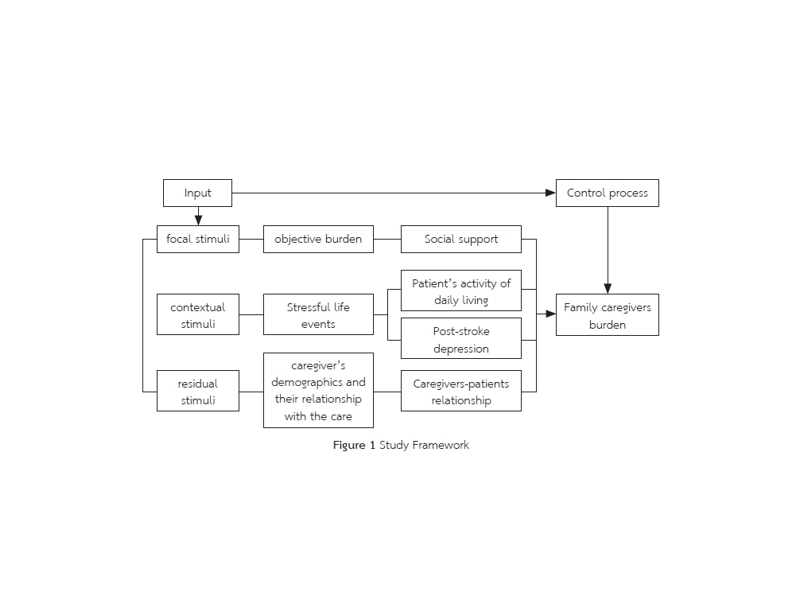
This study aimed to characterize the burden level experienced by family caregiver and to investigate the factors predicting family caregiver burden in older adults with stroke in Wenzhou, China. A simple random sampling method was used to recruit the sample of 101 patient-caregiver dyads in the Second Affiliated Hospital of Wenzhou Medical University. Research instruments included the Demographic questionnaire, the Zarit Burden Interview Scale, the Modified Barthel Index scale, A New Post-Stroke Depression Scale, Chinese version of the Social Support Rating Scale. Descriptive statistics and stepwise multiple regression analysis were used to analyze the data.
The results revealed that the sample had mean score of the family caregiver's burden at a moderate level (M=44.97, SD=18.43). The significant predictors of burden for family caregivers of older adults with stroke were activities of daily living (β= -0.400, P<0.001), social support (β= -0.353, P<0.001), and post-stroke depression (β= 0.188, P=0.039). The caregiver-patient relationship: cousin (β= -0.177, P=0.017) was a significant predictor, as opposed to being a spouse or child. These predictors could together explain 49.7% of the variance in burden for family caregivers of older adults with stroke. (R2= 0.497, p < 0.001)
Activities of daily living, post-stroke depression, social support, and caregiver-patient relationship are the significant predictors of burden for family caregivers of older adults with stroke. The results of this study serve as a reference for healthcare personnel should be developing the intervention based on the activities of daily, strengthening social suport systems, enhancing stroke outcomes, and improving the caregiver-patient relationship, thereby effectively reducing the burden of family caregivers.
เอกสารอ้างอิง
Achilike, S., Beauchamp, J. E., Cron, S. G., Okpala, M., Payen, S. S., Baldridge, L., Okpala, N., Montiel, T. C., Varughese, T., & Love, M. (2020). Caregiver burden and associated factors among informal caregivers of stroke survivors. Journal of Neuroscience Nursing, 52(6), 277-283. https://doi.org/10.1097/JNN.0000000000000552
Bachner, Y., & O’rourke, N. (2007). Reliability generalization of responses by care providers to the Zarit Burden Interview. Aging & Mental Health, 11(6), 678-685. https://doi.org/10.1080/13607860701529965
Cao, L.-L., Tang, Y.-F., Xia, Y.-Q., Wei, J.-H., Li, G.-R., Mu, X.-M., Jiang, C. -Z., He, M., & Cui, L.-J. (2022). A survey of caregiver burden for stroke survivors in non-teaching hospitals in Western China. Medicine, 101(50), e31153. https://doi.org/10.1097/MD.0000000000031153
Dou, D.-M., Huang, L.-L., Dou, J., Wang, X.-X., & Wang, P.-X. (2018). Post-stroke depression as a predictor of caregivers burden of acute ischemic stroke patients in China. Psychology, Health & Medicine, 23(5), 541-547. https://doi.org/10.1080/13548506.2017.1371778
Fadilah, N., & Rahariyani, L. D. (2019). The impact of independent of activity daily living among stroke patients on caregivers burden. Jurnal Ners, 14(3), 188-194. https://doi.org/10.20473/jn.v14i3.17047
Fang, L., Dong, M., Fang, W., & Zheng, J. (2022). Relationships between care burden, resilience, and depressive symptoms among the main family caregivers of stroke patients: A cross-sectional study. Frontiers in Psychiatry, 13, 960830. https://doi.org/10.3389/fpsy.2022.960830
Fauziah, W., Mayumi, K., Shogenji, M., Tsujiguchi, H., & Taniguchi, Y. (2022). Factors associated with depression among family caregivers of patients with stroke in Indonesia: A cross-sectional study. Journal of Nursing Research, 30(5), e231. https://doi.org/10.1097/jnr.000000000000000515
He, L., Wang, J., Wang, F., Wang, L., Liu, Y., Zhou, F., & Xu, F. (2023). Depression status and functional outcome of patients with ischemic stroke and the impact on caregivers living in Chengdu: A cross-sectional study. Frontiers in Psychiatry, 14, 1166273. https://doi.org/10.3389/fpsyt.2023.1166273
Kavga, A., Kalemikerakis, I., Faros, A., Milaka, M., Tsekoura, D., Skoulatou, M., Tsatsou, L., & Govina, O. (2021). The effects of patients’ and caregivers’ characteristics on the burden of families caring for stroke survivors. International Journal of Environmental Research and Public Health, 18(14), 7298. https://doi.org/10.3390/ijerph18147298
Leung, S. O., Chan, C. C., & Shah, S. (2007). Development of a Chinese version of the Modified Barthel Index—Validity and reliability. Clinical Rehabilitation, 21(10), 912-922.
Liu, Z., Sun, W., Chen, H., Zhuang, J., Wu, B., Xu, H., Li, P., Chen, X., li, J., & Yin, Y. (2022). Caregiver burden and its associated factors among family caregivers of persons with dementia in Shanghai, China: A cross-sectional study. BMJ open, 12(5), e057817.
Lorito, C. D., Pollock, K., Booth, V., Howe, L., Goldberg, S., Godfrey, M., Dunllop, M., Harwood, R. H., & Wardt, V. v. d. (2024). Social participation in the promoting activity, independence and stability in early dementia (PrAISED), a home-based therapy intervention for people living with dementia: A realist evaluation. BMC geriatrics, 24(1), 615.
Martini, S., Ningrum, D. A. S., Abdul-Mumin, K. H., & Yi-Li, C. (2022). Assessing quality of life and associated factors in post-stroke patients using the world health organization abbreviated generic quality of life questionnaire (WHOQOL-BREF). Clinical Epidemiology and Global Health, 13, 100941. https://doi.org/10.1016/j.cegh.2021.100941
Olver, J., Yang, S., Fedele, B., Ni, J., Frayne, J., Shen, G., & McKenzie, D. (2021). Post Stroke Outcome: global insight into persisting sequelae using the Post Stroke Checklist. Journal of Stroke and Cerebrovascular Diseases, 30(4), 105612. https://doi.org/10.1016/j.jstrokecerebrovasdis.2021.105612
Oven Ustaalioglu, B., Acar, E., & Caliskan, M. (2018). The predictive factors for perceived social support among cancer patients and caregiver burden of their family caregivers in Turkish population. International Journal of Psychiatry in Clinical Practice, 22(1), 63-69. https://doi.org/10.1018/13651501.2017.1358370
Razali, N. S. N. M., Talib, S. S., Roslan, N. F. A., & Daud, A. Z. C. (2020). Caregivers’ burdens and its’ association with activities of daily living performance of individuals with stroke: A cross-sectional study. Healthscope: The Official Research Book of Faculty of Health Sciences, UiTM, 3(3), 44-48.
Sun, W.-J., Song, Y.-Y., Wang, C., Jiang, Y., Cui, W.-Y., Liu, W.-J., & Liu, Y. (2023). Telerehabilitation for family caregivers of stroke survivors: A systematic review and meta‐analysis. Journal of Nursing Management, 2023(1), 3450312. https://doi.org/10.1155/2023/3450312
Tsai, P.-F. (2003). A middle-range theory of caregiver stress. Nursing Science Quarterly, 16(2), 137-145. https://doi.org/10.1177/0894318403251789
Wang, G., Cheng, Q., Wang, Y., Deng, Y.-l., Ren, R.-j., Xu, W., Zhen, J., Bai, L., & Chen, S.-d. (2008). The metric properties of Zarit caregiver burden scale: validation study of a Chinese version. Alzheimer Disease & Associated Disorders, 22(4), 321-326. https://doi.org/10.1097/WAD.0b013e3181902334
Wang, Y.-J., Li, Z.-X., Gu, H.-Q., Zhai, Y., Jiang, Y., Zhao, X.-Q., Wang, Y.-L., Yang, X., Wang, C.-J., & Meng, X. (2020). China stroke statistics 2019: a report from the National center for healthcare quality management in neurological diseases, China national clinical research center for neurological diseases, the Chinese stroke association, National center for chronic and non-communicable disease control and prevention, Chinese center for disease control and prevention and Institute for global neuroscience and stroke collaborations. Stroke and Vascular Neurology, 5(3). https://doi.org/10.1136/svn-2020-000457
Xiao, S. (1994). Theoretical basis and research application of social support rating scale. The Journal of Clinical Psychiatry, 4(2), 98-100.
Xu, Q., Ma, J., Zhang, Y., & Gan, J. (2024). Family resilience and social support as mediators of caregiver burden and capacity in stroke caregivers: A cross-sectional study. Frontiers in Psychology, 15, 1435867. https://doi.org/10.3389/fpsyg.2024.1435867
Xu, Q., Ma, J., Zhang, Y., & Gan, J. (2024). Family resilience and social support as mediators of caregiver burden and capacity in stroke caregivers: A cross-sectional study. Frontiers in Psychology, 15, 1435867. https://doi.org/10.3389/fpsyg.2024.1435867
Yue, Y., Liu, R., Lu, J., Wang, X., Zhang, S., Wu, A., . . . Yuan, Y. (2015). Reliability and validity of a new post-stroke depression scale in Chinese population. Journal of Affective Disorders, 174, 317-323. https://doi.org/10.1016/j.jad.2014.11.031
Yuliana, S., Yu, E., Rias, Y. A., Atikah, N., Chang, H. J., & Tsai, H. T. (2023). Associations among disability, depression, anxiety, stress, and quality of life between stroke survivors and their family caregivers: An Actor‐Partner Interdependence Model. Journal of Advanced Nursing, 79(1), 135-148. https://doi.org/10.1111/jan.15465
ดาวน์โหลด
เผยแพร่แล้ว
รูปแบบการอ้างอิง
ฉบับ
ประเภทบทความ
สัญญาอนุญาต

อนุญาตภายใต้เงื่อนไข Creative Commons Attribution-NonCommercial-NoDerivatives 4.0 International License.