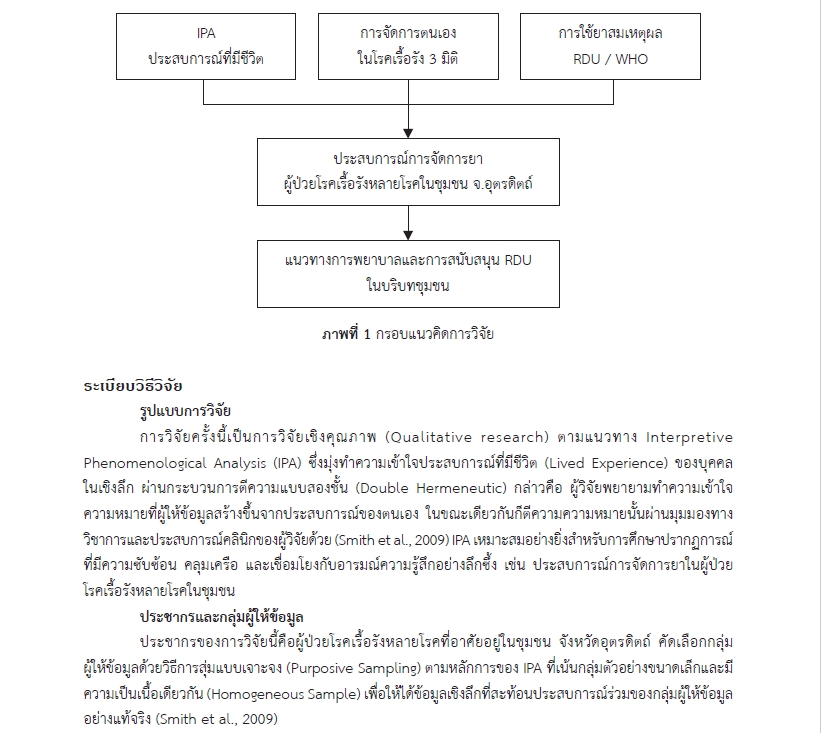
ประสบการณ์การจัดการยาของผู้ป่วยโรคเรื้อรังหลายโรคในชุมชน จังหวัดอุตรดิตถ์
คำสำคัญ:
การจัดการยา, การใช้ยาหลายขนาน, โรคเรื้อรังหลายโรค, ประสบการณ์ที่มีชีวิต, ชุมชนบทคัดย่อ
การวิจัยเชิงคุณภาพครั้งนี้มีวัตถุประสงค์เพื่อศึกษาประสบการณ์การจัดการยาของผู้ป่วยโรคเรื้อรังหลายโรคในชุมชน จังหวัดอุตรดิตถ์ โดยใช้แนวทาง Interpretive Phenomenological Analysis (IPA) คัดเลือกผู้ให้ข้อมูลด้วยวิธีการสุ่มแบบเจาะจง จำนวน 14 คน ซึ่งได้รับการวินิจฉัยโรคเรื้อรัง 2 โรคขึ้นไปและได้รับยาอย่างน้อย 5 รายการต่อวัน เก็บข้อมูลด้วยการสัมภาษณ์เชิงลึกกึ่งโครงสร้างและวิเคราะห์ข้อมูลตามแนวทาง IPA 6 ขั้นตอน ตรวจสอบความน่าเชื่อถือตามเกณฑ์ของ Lincoln และ Guba
ผลการวิจัยพบประเด็นหลัก 4 ประเด็น ได้แก่ 1) ภาระและความท้าทายในการจัดการยา ซึ่งครอบคลุมความซับซ้อนของสูตรยา ผลข้างเคียงที่รบกวนชีวิต และภาระทางเศรษฐกิจ 2) การรับรู้และทัศนคติต่อการใช้ยา ที่ประกอบด้วยการยอมรับที่ค่อยเป็นค่อยไป ความกังวลต่อผลระยะยาว และความเชื่อด้านการแพทย์พื้นบ้าน 3) กลยุทธ์การจัดการยาด้วยตนเอง ที่แสดงให้เห็นความคิดสร้างสรรค์และการตัดสินใจโดยอิสระของผู้ป่วย และ 4) เครือข่ายสนับสนุนและปฏิสัมพันธ์กับระบบสุขภาพ ที่เน้นบทบาทสำคัญของครอบครัว ความสัมพันธ์กับบุคลากรสุขภาพ และอุปสรรคในการเข้าถึงบริการ
จากผลการวิจัยชี้ให้เห็นว่าการจัดการยาเป็นกระบวนการเชิงรุกที่ซับซ้อน พยาบาลวิชาชีพควรบูรณาการการประเมินประสบการณ์การจัดการยาในบริบทชีวิตจริงของผู้ป่วยเข้าสู่กระบวนการพยาบาล เพื่อสนับสนุนการใช้ยาอย่างสมเหตุสมผลในระดับชุมชน
เอกสารอ้างอิง
Ahmed, S. K. (2024). The pillars of trustworthiness in qualitative research. Journal of Medicine, Surgery, and Public Health, 2, 100051. Retrieved from https://doi.org/10.1016/j.glmedi.2024.100051
Berardinelli, D., Conti, A., Hasnaoui, A., Casabona, E., Martin, B., Campagna, S., & Dimonte, V. (2024). Nurse-led interventions for improving medication adherence in chronic diseases: A systematic review. Healthcare, 12(23), 2337. Retrieved from https://doi.org/10.3390/healthcare12232337
Cheng, C., Yu, H., & Wang, Q. (2023). Nurses' experiences concerning older adults with polypharmacy: A meta-synthesis of qualitative findings. Healthcare, 11(3), 334. Retrieved from https://doi.org/10.3390/healthcare11030334
Costa-Font, J., Sato, A., & Hirsch, B. (2024). Cultural persistence and the 'herbal medicine paradox'. Journal of Health Psychology, 30(2), 171–185. Retrieved from https://doi.org/10.1177/13591053241237031
Doumat, G., Daher, D., Itani, M., Ghanem, A., Khachan, F., & Nassar, A. (2023). The effect of polypharmacy on healthcare services utilization in older adults with comorbidities: A retrospective cohort study. BMC Primary Care, 24, 120. Retrieved from https://doi.org/10.1186/s12875-023-02070-0
Hossain, M. M., Ahmed, S., & Chowdhury, R. (2024). Prevalence of multimorbidity and polypharmacy among adults and older adults: A systematic review. The Lancet Healthy Longevity, 5(3), e228–e235. Retrieved from https://doi.org/10.1016/S2666-7568(24)00007-2
Jin, C., Chen, Y., Chen, J., Bai, X., Yang, P., & Li, C. (2024). Exploring medication self-management in polypharmacy: A qualitative systematic review of patients and healthcare providers perspectives. Frontiers in Pharmacology, 15, 1426777. Retrieved from https://doi.org/10.3389/fphar.2024.1426777
Kim, S., Lee, H., Park, J., Kang, J., Rahmati, M., Rhee, S. Y., & Yon, D. K. (2024). Global and regional prevalence of polypharmacy and related factors, 1997–2022: An umbrella review. Archives of Gerontology and Geriatrics, 124, 105465. Retrieved from https://doi.org/10.1016/j.archger.2024.105465
Liu, J., Yu, Y., Yan, S., Zeng, Y., Su, S., He, T., Wang, Z., Ding, Q., Zhang, R., Li, W., Wang, X., Zhang, L., & Yue, X. (2023). Risk factors for self-reported medication adherence in community-dwelling older patients with multimorbidity and polypharmacy: A multicenter cross-sectional study. BMC Geriatrics, 23, 75. Retrieved from https://doi.org/10.1186/s12877-023-03768-7
Mannheimer, S., Bergqvist, M., Bastholm-Rahmner, P., Gustafsson, L. L., Vég, A., & Schmidt-Mende, K. (2022). Experiences of patients receiving home care and living with polypharmacy: A qualitative interview study. BJGP Open, 6(2), BJGPO.2021.0181. Retrieved from https://doi.org/10.3399/BJGPO.2021.0181
Mikkelsen, T. H., Søndergaard, J., Kjaer, N. K., Nielsen, J. B., Ryg, J., Kjeldsen, L. J., & Mogensen, C. B. (2023). Handling polypharmacy: A qualitative study using focus group interviews with older patients, their relatives, and healthcare professionals. BMC Geriatrics, 23, 477. Retrieved from https://doi.org/10.1186/s12877-023-04131-6
Peltzer, K., & Pengpid, S. (2019). Herbal or traditional medicine consumption in a Thai worker population: Pattern of use and therapeutic control in chronic diseases. BMC Complementary Medicine and Therapies, 19, 195. Retrieved from https://doi.org/10.1186/s12906-019-2652-z
Smith, J. A., Flowers, P., & Larkin, M. (2009). Interpretative phenomenological analysis: Theory, method and research. London: SAGE.
Van Wilder, L., Devleesschauwer, B., Clays, E., Pype, P., Vandepitte, S., & De Smedt, D. (2022). Polypharmacy and health-related quality of life/psychological distress among patients with chronic disease. Preventing Chronic Disease, 19, E50. Retrieved from https://doi.org/10.5888/pcd19.220062
World Health Organization. (2019). Medication safety in polypharmacy: Technical report (WHO/UHC/SDS/2019.11). WHO. Retrieved from https://www.who.int/publications/i/item/WHO-UHC-SDS-2019.11
Xin, G., Yuanxing, W., Jiaming, W., & Xue, H. (2025). Medication multiple experiences of elderly patient with multiple chronic condition: A qualitative meta-synthesis. PLOS One, 20(9), e0331753. Retrieved from https://doi.org/10.1371/journal.pone.0331753
ดาวน์โหลด
เผยแพร่แล้ว
รูปแบบการอ้างอิง
ฉบับ
ประเภทบทความ
สัญญาอนุญาต

อนุญาตภายใต้เงื่อนไข Creative Commons Attribution-NonCommercial-NoDerivatives 4.0 International License.