
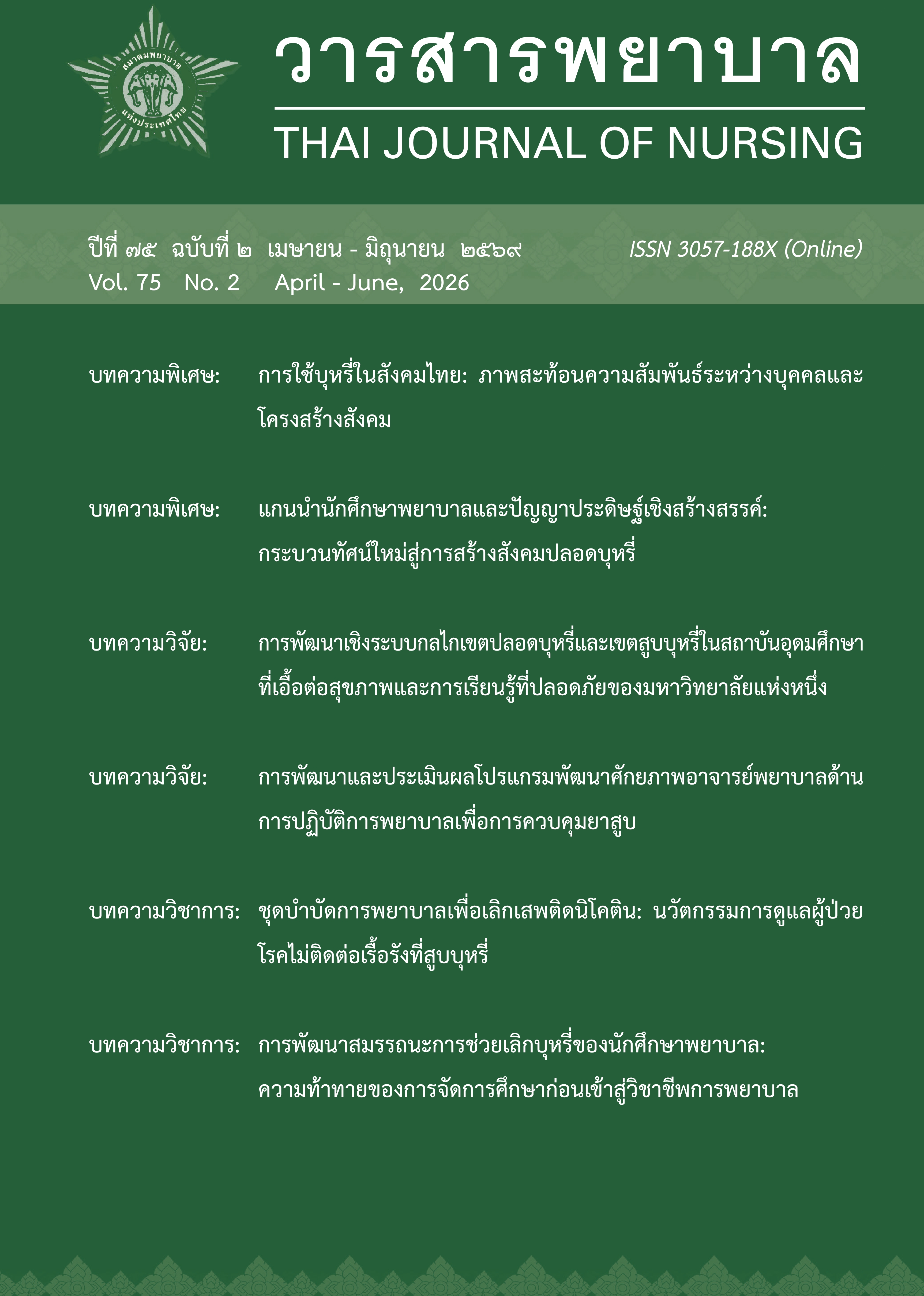
A development of smoking cessation competency among nursing students: The challenges of pre-service nursing education
Article Sidebar
Main Article Content
Abstract
Smoking cessation is a critical role of professional nurses in health promotion and the prevention of non-communicable diseases. However, evidence indicates that many nursing students remain insufficiently prepared and lack confidence in performing smoking cessation interventions upon entering professional practice. This article analyzes the current situation and structural challenges of pre-service nursing education in developing smoking cessation competency among nursing students. The analysis is based on a synthesis of theoretical concepts, established smoking cessation guidelines, relevant empirical studies, and a competency framework that has been developed and refined through expert consultation. Key challenges in developing smoking cessation competency include the unclear integration of such competencies within nursing curricula, emphasis on theoretical knowledge rather than practical skills, limitations in faculty capacity and educational resources, and assessment approaches that do not adequately reflect real-world practice. To address these challenges, nursing education should adopt a competency-based approach by explicitly defining smoking cessation competency as a core learning outcome, integrating experiential and practice-based learning strategies, and strengthening assessment methods to align with professional practice. Such reforms are essential to enhance nursing students’ readiness and confidence in delivering effective smoking cessation interventions and to ensure that pre-service nursing education responds to the evolving demands of contemporary health systems.
Article Details

This work is licensed under a Creative Commons Attribution-NonCommercial-NoDerivatives 4.0 International License.
References
กรองจิต วาทีสาธกกิจ. (2559). คู่มือการรักษาโรคเสพติดยาสูบสำหรับพยาบาล. มณปรียา กราฟฟิค.
ณิชมน หลำรอด, สุรินธร กลัมพากร, และ จุฑาธิป ศีลบุตร. (2562). ผลของโปรแกรมการพัฒนาศักยภาพอาสาสมัครสาธารณสุขประจำหมู่บ้านต่อความรอบรู้ด้านสุขภาพในการช่วยเลิกบุหรี่ จังหวัดปทุมธานี. วารสารวิจัยทางวิทยาศาสตร์สุขภาพ, 13(1), 84–94.
บุญชัย พิริยกิจกำจร และ นิรชร ชูติพัฒนะ. (2561). แนวทางการป้องกัน และลด ละ เลิกบุหรี่ของเยาวชนจังหวัดสงขลา. วารสารเครือข่ายวิทยาลัยพยาบาลและการสาธารณสุขภาคใต้, 5(1), 108-123.
ผ่องศรี ศรีมรกต, จรรยา ใจหนุน, ปุณยนุช สนามทอง, ยุพิน หงษ์ทอง, ประทีป แสวงดี, และ อรสา อัครวัชรางกูร. (2556). ประสิทธิภาพของการช่วยเลิกบุหรี่โดยพยาบาลในประเทศไทย. วารสารพยาบาล, 62(1), 32–43.
Benner, P., Sutphen, M., Leonard, V., & Day, L. (2009). Educating nurses: A call for radical transformation. John Wiley & Sons.
Cai, Y., Chen, G., & Bai, P. (2025). Global, regional, and national burden of smoking-related diseases and associations with health workforce distribution, 1990–2021: Analysis from the Global Burden of Disease Study 2021. International Journal of Public Health, 70, Article 1608217. https://doi.org/10.3389/ijph.2025.1608217
Cottafava, D., Cavaglià, G., & Corazza, L (2019). Education of sustainable development goals through students’ active engagement: A transformative learning experience. Sustainability Accounting, Management and Policy Journal, 10(3), 521–544.
Goodchild, M., Nargis, N., & Tursan d’Espaignet, E. (2018). Global economic cost of smoking-attributable diseases. Tobacco Control, 27(1), 58–64. https://doi.org/10.1136/tobaccocontrol-2016-053305
Harvey, J., Chadi, N., Canadian Paediatric Society, & Adolescent Health Committee. (2016). Preventing smoking in children and adolescents: Recommendations for practice and policy. Paediatrics & Child Health, 21(4), 209–214. https://doi.org/10.1093/pch/21.4.209
Jeffries, P. (2021). The NLN Jeffries simulation theory. Lippincott Williams & Wilkins.
Jiang, N., Zhang, Y., Qian, X., Thorpe, L., Trinh-Shevrin, C., & Shelley, D. (2020). Chinese immigrant smokers’ access barriers to tobacco cessation services and experience using social media and text messaging. Tobacco Prevention & Cessation, 6, 52. https://doi.org/10.18332/tpc/125942
Li, M., Koide, K., Tanaka, M., Kiya, M., & Okamoto, R. (2021). Factors associated with nursing interventions for smoking cessation: A narrative review. Nursing Reports, 11(1), 64–74. https://doi.org/10.3390/nursrep11010007
Ma, C., Heiland, E. G., Li, Z., Zhao, M., Liang, Y., & Xi, B. (2021). Global trends in the prevalence of secondhand smoke exposure among adolescents aged 12–16 years from 1999 to 2018. The Lancet Global Health, 9(12), e1667–e1678. https://doi.org/10.1016/S2214-109X(21)00344-0
Miller, W. R., & Rollnick, S. (2013). Motivational interviewing: Helping people change (3rd ed.). Guilford Press.
Ng’ombe, J. N., Nedson, N. R., & Tembo, N. F. P. (2020). “Look at me, I plan to quit smoking”: Bayesian hierarchical analysis of adolescent smokers’ intention to quit smoking. Healthcare, 8(2), 76. https://doi.org/10.3390/healthcare8020076
Obisesan, O. H., Mirbolouk, M., Osei, A. D., Orimoloye, O. A., Uddin, S. I., Dzaye, O., El Shahawy, O., Stokes, A., Benjamin, E. J., DeFilippis, A. P., Bhatnagar, A., & Blaha, M. J. (2019). Association between e-cigarette use and depression in the behavioral risk factor surveillance system, 2016–2017. JAMA Network Open, 2(12), Article e1916800. https://doi.org/10.1001/jamanetworkopen.2019.16800
Panda, R., Persai, D., Mahapatra, S., & Mohanty, I. (2021). Does behavioral intervention affect intention to quit? A quasi-experimental study from primary healthcare settings in India. Tobacco Prevention & Cessation, 7, 56. https://doi.org/10.18332/tpc/138951
Prochaska, J. O., & DiClemente, C. C. (1986). Toward a comprehensive model of change. In W. R. Miller & N. Heather (Eds.), Treating addictive behaviors: Processes of change (pp. 3–27). Springer. https://doi.org/10.1007/978-1-4613-2191-0_1
Taylor, G. M. J., Dalili, M. N., Semwal, M., Civljak, M., Sheikh, A., & Car, J. (2017). Internet-based interventions for smoking cessation. Cochrane Database of Systematic Reviews, (9), CD007078. https://doi.org/10.1002/14651858.CD007078.pub5
World Health Organization. (2016, 6 September). Nurse educator core competencies. WHO. https://www.who.int/publications/i/item/nurse-educator-core-competencies
World Health Organization. (2020, 23 May). Toolkit for delivering the 5A’s and 5R’s brief tobacco interventions to TB patients in primary care. WHO. https://www.who.int/publications/i/item/toolkit-for-delivering-5as-and-5rs-brief-tobacco-interventions-in-primary-care
World Health Organization. (2021, 16 December). WHO global report on trends in prevalence of tobacco use 2000–2025. WHO. https://www.who.int/publications/i/item/9789240039322
World Health Organization. (2023, 30 July). WHO report on the global tobacco epidemic 2023. WHO. https://www.who.int/publications/i/item/9789240077164
Zhang, G., Zhou, J., Luk, T. T., Lam, V. S. F., Yao, Z., Wang, M. P., & Cheung, Y. T. D. (2024). The learning outcomes of smoking cessation training in undergraduate nursing students: A systematic review. Nurse Education in Practice, 75, 103907. https://doi.org/10.1016/j.nepr.2024.103907
