
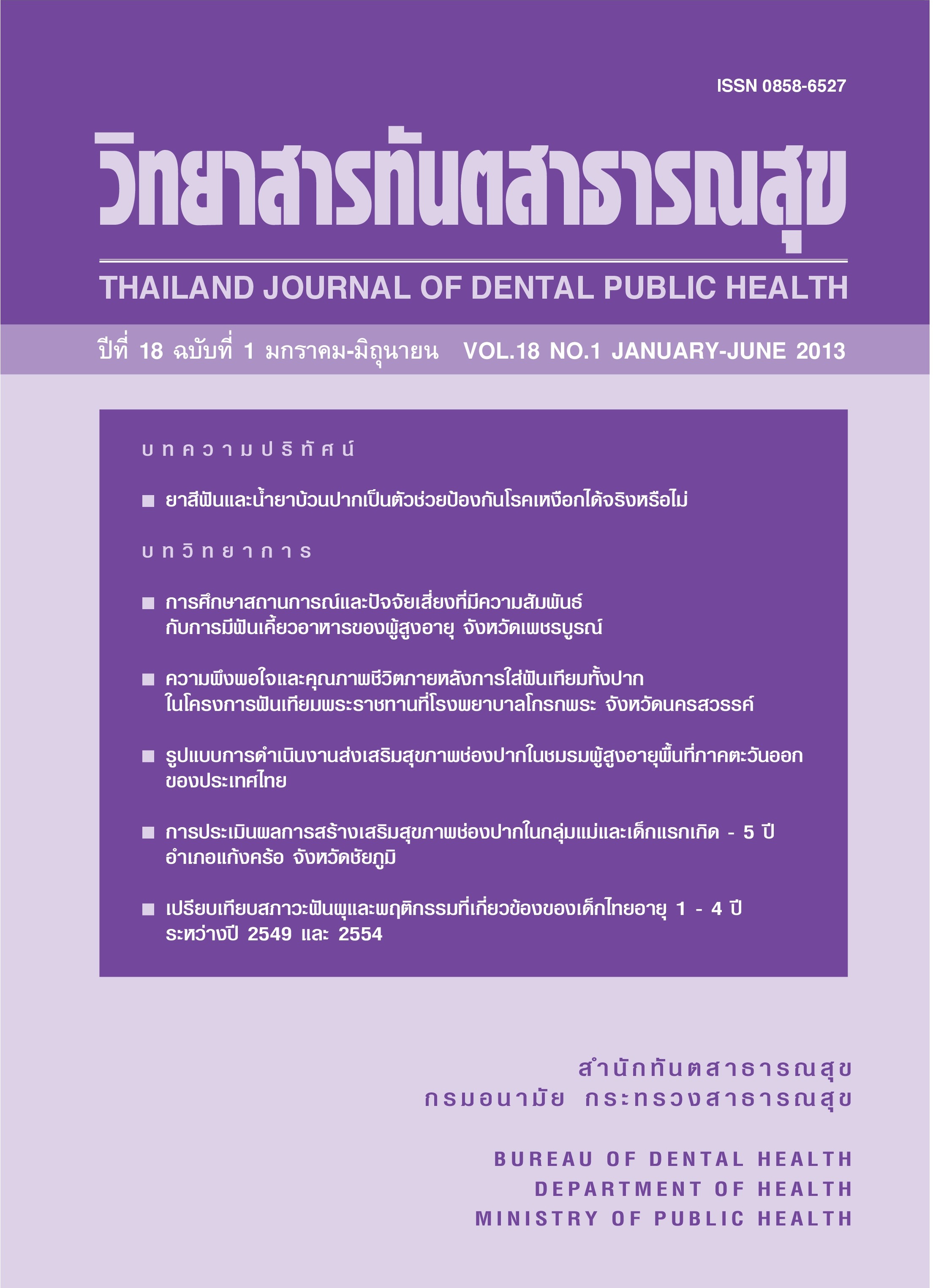
เปรียบเทียบสภาวะฟันผุและพฤติกรรมที่เกี่ยวข้องของเด็กไทยอายุ 1-4 ปี ระหว่างปี 2549 และ 2554
Article Sidebar
Main Article Content
บทคัดย่อ
การศึกษาครั้งนี้มีวัตถุประสงค์เพื่อเปรียบเทียบสภาวะฟันผุและพฤติกรรมที่เกี่ยวข้องของเด็ก 1-4 ปี ซึ่งสำรวจในปี 2549 และ 2554 โดยสุ่มจังหวัดสำรวจ 20 จังหวัด แต่ละจังหวัดดำเนินการเก็บข้อมูลในโรงพยาบาลส่วนภูมิภาคสังกัดกระทรวงกระทรวงสาธารณสุขทุกอำเภอรวม 250 โรงพยาบาล เก็บข้อมูลในกลุ่มเป้าหมาย 2 กลุ่ม คือ 1) เด็กที่มารับวัคซีนในคลินิกเด็กดี และ 2) เด็กในศูนย์เด็กเล็ก โดยการตรวจสุขภาพช่องปากเด็ก ร่วมกับ การสัมภาษณ์ผู้เลี้ยงดูเด็ก วิเคราะห์ผลโดยใช้สถิติไค-สแควร์ จำนวนเด็กในการวิเคราะห์ปี 2549 เท่ากับ 4,814 ราย และ ในปี 2554 เท่ากับ 4,206 ราย พบอัตราฟันผุร้อยละ 46.0 ปี 2549 ลดลงเป็นร้อยละ 43.6 ปี 2554 พฤติกรรมส่งเสริมสุขภาพช่องปากที่มีแนวโน้มเพิ่มขึ้นคือ สัดส่วนการแปรงฟันของเด็กที่มีความสม่ำเสมอเพิ่มสูงขึ้น สัดส่วนการบริโภคน้ำอัดลมประจำลดลง สัดส่วนการรับบริการทาฟลูออไรด์วาร์นิชเพิ่มขึ้น แต่พฤติกรรมส่งเสริมสุขภาพช่องปากที่มีแนวโน้มลดลงคือ สัดส่วนการบริโภคนมจืดลดลง ส่วนพฤติกรรมเสี่ยงที่มีแนวโน้มเพิ่มขึ้นคือ สัดส่วนการบริโภคอาหารที่มีรสหวานเป็นประจำเพิ่มขึ้นและสัดส่วนเด็กบริโภคขนมและเครื่องดื่มต่อวันมากกว่า 2 รายการเพิ่มขึ้นตามอายุ
Downloads
Article Details
เอกสารอ้างอิง
2. กองทันตสาธารณสุข กรมอนามัย. รายงานผลการสำรวจสภาวะทันตสุขภาพแห่งชาติครั้งที่ 6 พ.ศ. 2543-2550. โรงพิมพ์สามเจริญพาณิชย์ (กรุงเทพ) จำกัด, 2551.
3. Casamassimo PS. Relationships between oral and systemic health. Pediatr Clin North Am 2000;47:1149-1157.
4. Ritchie CS, Joshipura K, Hung HC, Douglass CW. Nutrition as a mediator in the relation between oral and systemic disease: associations between specific measures of adult oral health and nutrition outcomes. Crit Rev Oral Biol Med 2002;13:291-300.
5. Davies GN. Early childhood caries--asynopsis. Community Dent Oral Epidemiol 1998; 26: 106-16.
6. Van Houte J. Role of microorganisms in caries etiology. J Dent Res 1994; 73: 672-81.
7. Milgrom P, Riedy CA, Weinstein P, et al. Dental caries and its relationship to bacterial infection, hypoplasia, diet, and oral hygiene in 6- to 36-month-old children. Community Dent Oral Epidemiol 2000; 28: 295-306.
8. Ramos-Gomez FJ, Weintraub JA, Gansky SA, et al. Bacterial, behavioral and environmental factors associated with early childhood caries. J Clin Pediatr Dent 2002; 26: 165-73.
9. Köhler B, Andréen I, Jonsson B. The earlier the colonization by mutans streptococci, the higher the caries prevalence at 4 years of age. Oral Microbiol Immunol 1988; 3: 14-7.
10. Dilley GJ, Dilley DH, Machen JB. Prolonged nursing habit: A profile of patients and their families. ASDC J Dent Child 1980; 47: 102-8.
11. Wendt LK, Hallonsten AL, Koch G, et al. Oral hygiene in relation to caries development and immigrant status infants and toddlers. Scand J Dent Res 1994; 102: 269-73.
12. Kowash HB, Pinfecld A, Smith J, et al.Effectiveness on oral health of a Long-term health education programme for mothers with young children. Br Dent J 2000; 188:201-5.
13. Al-Malik MI, Holt RD, Bedi R. The relationship between erosion, caries and rampant caries and dietary habits in preschool children in Saudi Arabia. Int J Paediatr Dent 2001; 11:430-9.
14. Chan SC, Tsai JS, King NM. Feeding and oral hygiene habits of preschool children in Hong Kong and their caregivers' dental knowledge and attitudes. Int J Paediatr Dent 2002; 12: 322-31.
15. Petersen PE. Oral health behavior of 6-yearold Danish children. Acta Odontol Scand 1992; 50: 57-64.
16. Gibson S, Williams S. Dental caries in preschool children: associations with social class, tooth-brushing habit and consumption of sugars and sugar-containing foods. Further analysis of data from the National Diet and Nutrition Survey of children aged 1.5-4.5 years. Caries Res 1999; 33: 101-13.
17. Preventive Oral Health Intervention for Pediatricians. Pediatrics 2008; 122: 1387-1394. Downloaded from www.pediatrics.org by on February 8, 2011.
18. สมนึก ชาญด้วยกิจ, สุณี วงค์คงคาเทพ, ขนิษฐ์ รัตนรังสิมา, อังศณา ฤทธิ์อยู่. ปัจจัยที่มีอิทธิพลต่อการเกิดฟันผุของเด็กไทยอายุ 6 -30 เดือน ว ทันต 2547; 2: 123-137.
19. Streckson-Blicks C., Holm AK. Between-meal eating, tooth-brushing frequency and dental caries in 4-year-old children in the north of Sweden. Int J Pediatric Dent. 1995.Jun; 5(2):k67-72.
20. Tsubouchi J, Tsubouchi M, Maynard RJ, Domoto PK., Weinstein P. A study of dental caries and risk factors among Native American infants. ASDC J Dent Child.1995.Jul-Aug; 62(4):283-7.
21. Douglass JM., Tinanoff N., Tang JM., Altman DS. Dental caries patterns and oral health behavior in Arizona infants and toddler. Community Dent Oral Epidermol.2001.Feb; 29:14-22.
22. Harris R., Nicoll AD., Adair PM., Pine CM. Risk factor for dental caries in young children: a systematic review of the literature. Community Health Dent 2004 Mar; 21(Suppl):71-85.
23. สุณี วงศ์คงคาเทพ. ความสัมพันธ์ของการทำความสะอาดช่องปากกับการเกิดฟันผุของเด็กไทยอายุต่ำกว่า 5 ปี. วารสารส่งเสริมสุขภาพและอนามัยส่งแวดล้อม 2551; 31 (2):34-47.
24. บุบผา ไตรโรจน์ จันทนา อึ้งชูศักดิ์ วิไลลักษณ์ บังเกิดสิงห์ และสุรางค์ เชษฐพฤนท์. การศึกษาสถานการณ์การบริโภคนมของเด็กวัยก่อนเรียนในศูนย์เด็กเล็ก พ.ศ. 2546. ว.ทันต.สธ 2546; 8(1-2): 31-37.
25. จันทนา อึ้งชูศักดิ์, สุภาวดี พรหมมา, สุรางค์ เชษฐพฤนท์, สุพรรณี สุคันวรานิล และ วิไลลักษณ์ บังเกิดสิงห์. พฤติกรรมการแปรงฟันและการเข้าถึงบริการทันตสุขภาพตามชุดสิทธิประโยชน์ของเด็กก่อนวัยเรียน อายุ 6-36 เดือน. ว.ทันต.สธ. 2552;14(1):59.
