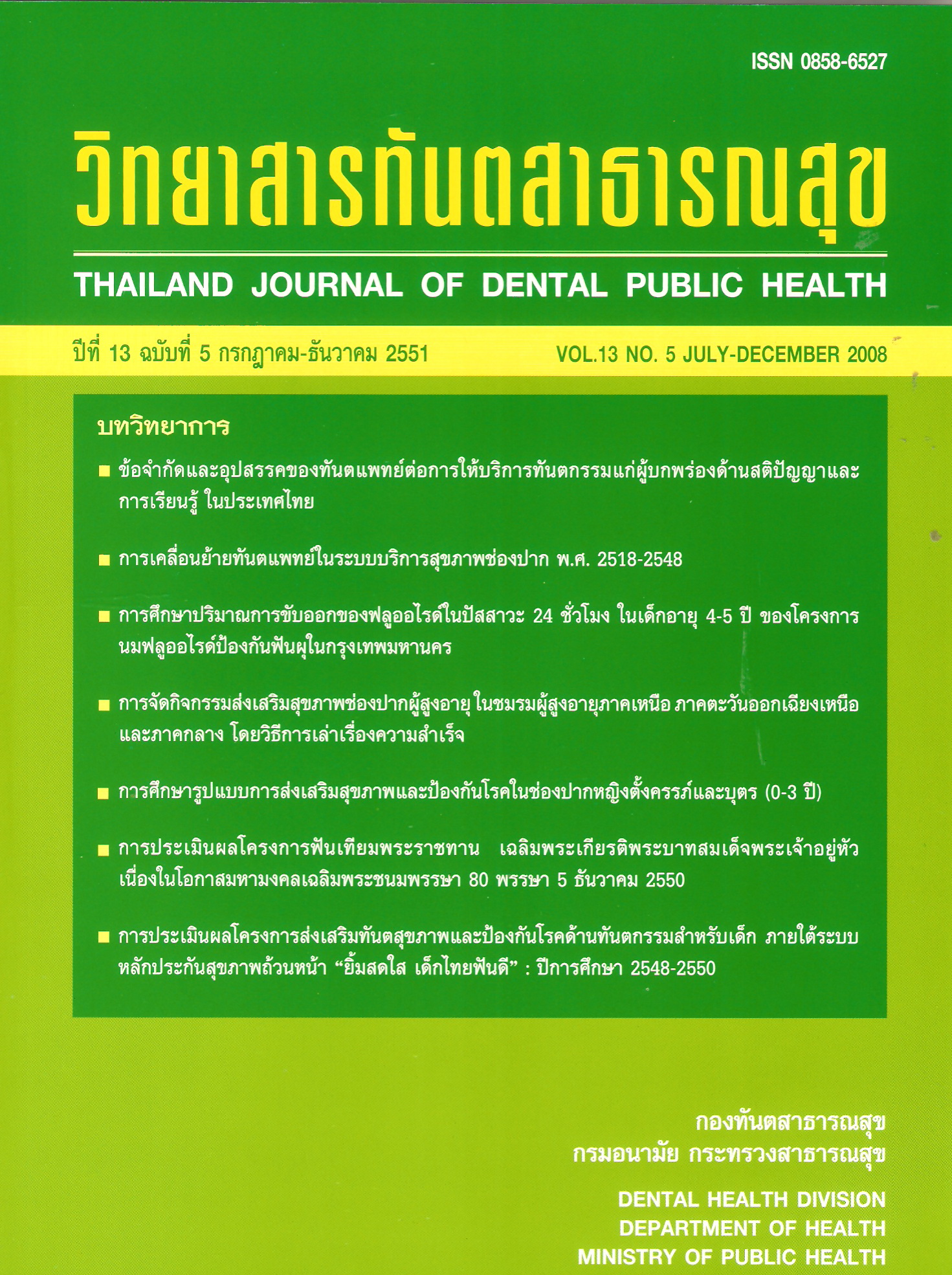
การศึกษาปริมาณการขับออกของฟลูออไรด์ในปัสสาวะ 24 ชั่วโมง ในเด็กอายุ 4-5 ปี ของโครงการนมฟลูออไรด์ป้องกันฟันผุในกรุงเทพมหานคร
Article Sidebar
Main Article Content
บทคัดย่อ
การศึกษาครั้งนี้เป็นการประเมินปริมาณการขับออกของฟลูออไรด์โดยรวมในปัสสาวะใน 24 ชั่วโมง ของตัวแทนนักเรียนอายุ 4-5 ปี ที่ดื่มนมฟลูออไรด์ในกรุงเทพมหานคร (จำนวน 30 คน) เปรียบเทียบกับ ตัวแทนนักเรียนในกลุ่มอายุเดียวกันของจังหวัดสมุทรปราการ (จำนวน 29 คน) ซึ่งไม่ได้ดื่มนมฟลูออไรด์
ทั้ง 2 พื้นที่นี้มีปริมาณฟลูออไรด์ในน้ำบริโภคใกล้เคียงกันโดยมีค่าอยู่ระหว่าง 0.1-0.2 ส่วนในล้านส่วน ตัวอย่างปัสสาวะของเด็กแต่ละคนจะถูกเก็บต่อเนื่องเป็นเวลาใกล้เคียงกับ 24 ชั่วโมง โดยผู้ทำการศึกษาได้เก็บ ตัวอย่างปัสสาวะนักเรียนตั้งแต่มาถึงตอนเช้าจนถึงเวลาโรงเรียนเลิกโดยแยกเป็นช่วงก่อนดื่มนมกับช่วงหลังดื่มนม และผู้ปกครองของนักเรียนที่ร่วมในการศึกษานี้จะเก็บตัวอย่างปัสสาวะตั้งแต่เด็กกลับถึงบ้านและช่วงเวลากลางคืนถึงเช้า มีการบันทึกเวลาที่เริ่มต้นและสิ้นสุดของการเก็บตัวอย่างปัสสาวะทั้ง 3 ช่วงเวลาดังกล่าว จาก นั้นตัวอย่างปัสสาวะทั้งหมดจะถูกนำมาวัดปริมาณและวิเคราะห์ความเข้มข้นของฟลูออไรด์มีการสังเกตและ สอบถามข้อมูลการใช้ยาสีฟันผสมฟลูออไรด์ของนักเรียนทั้ง 2 กลุ่มด้วย ผลการศึกษายืนยันว่ากลุ่มตัวอย่างทั้งสองมีการใช้ยาสีฟันผสมฟลูออไรด์ไม่แตกต่างกัน โดยพบว่า ค่าเฉลี่ยปริมาณฟลูออไรด์โดยรวมที่ถูกขับออกในปัสสาวะใน 24 ชั่วโมงของกลุ่มศึกษามีค่าสูงกว่ากลุ่มควบคุม โดยมีค่า 346.90 (+89.93) และ 207.69 (+106.08) ไมโครกรัมตามลำดับ และค่าเฉลี่ยความเข้มข้นโดยรวมใน 24 ชั่วโมงของฟลูออไรด์ในปัสสาวะในกลุ่มศึกษามีค่าสูงกว่าในกลุ่มควบคุม โดยมีค่า 0.63 (+0.23) และ 0.35 (+0.12) ส่วนในล้านส่วนตามลำดับ ซึ่งเมื่อเปรียบเทียบค่าเดียวกันนี้กับตารางมาตรฐานขององค์การอนามัย โลกพบว่าปริมาณและค่าความเข้มข้นโดยรวมของฟลูออไรด์ที่ถูกขับออกในปัสสาวะ 24 ชั่วโมงของกลุ่มที่ดื่มนม แสดงถึงการได้รับฟลูออไรด์โดยรวมอยู่ในขนาดที่ยอมรับได้ ซึ่งผลสรุปของการศึกษาครั้งนี้ยืนยันว่าเด็กที่อยู่ใน โครงการนมฟลูออไรด์ป้องกันฟันผุของกรุงเทพมหานครไม่ได้เพิ่มความเสี่ยงต่อการเกิดฟันตกกระ
Downloads
Article Details
เอกสารอ้างอิง
2. Petersen PE. The World Oral Health Report 2003: Continuous improvement of oral health in the 21st century the approach of the WHO Global Oral Health Programme. Community Dentistry and Oral Epidemiology 2003:31(Suppl.1):3-24.
3. Lennon MA et al., Legislation and community based aspects of the implementation of a milk fluoridation programme. In: Stephen K, Banoczy Jand Pakhomov GN, eds: Milk fluoridation for the prevention of dental caries. World Health Organization/Borrow Dental milk Foundation, Geneva. 1996.
4. World Health Organization Ed: Marthaler, Monitoring of renal fluoride excretion in community preventive programmes on oral health. Geneva, 1999.
5. Szekely M et al., Comparative baseline study of the urinary fluoride excretion in Romanian pre-school children. Caries Research. 2004: 38: 337, Abstract 58.
6. Villa A, Anabalon, M and Cbezas, L, The fractional urinary fluoride excretion in young children under stable fluoride intake condition. Community Dentistry and Oral Epidemiology. 2000: 28: 344-355.
7. Villa A, Critical evaluation of previously published data on the fractional urinary fluoride excretion in young children. Community Dental Health. 2004: 21: 155-169.
8. Baez R, Baez M and Marthaler TM, Urinary fluoride excretion by children 4-6 years old in a South Texas community, Pan Am J Public Health. 2000:7:242-248.
9. Rugg-Gunn AJ et al., Urinary fluoride children in 4-year-old children in Sri Lanka and England. Caries Res. 1993: 27:478-483.
10. Rugg-Gunn AJ, Al-Mohammadi SM and Butler TJ, Malnutrition and developmental defects of enamel in 2 to 6 year-old Saudi boys. Caries Res. 1998: 32:181-192.
11. Zohouri FV and Rugg-Gunn AJ, Total fluoride intake and urinary excretion in 4-year-old Iranian children residing in low fluoride areas, British journal of Nutrition 2000: 83: 15-25
12. Katley CE et al., Urinary fluoride excretion of young children exposed to different fluoride regimens. Community Dental Health. 2002: 19:12-17.
13. Marthaler TM et al., Urinary fluoride excretion in pre-school children related to the use of fluoridated milk or salt. Caries Res. 1994: 28:217.
14. Marthaler TM et al., Urinary fluoride excretion in children with low fluoride intake or consuming fluoridated salt. Caries Res. 1995: 29:26-34.
