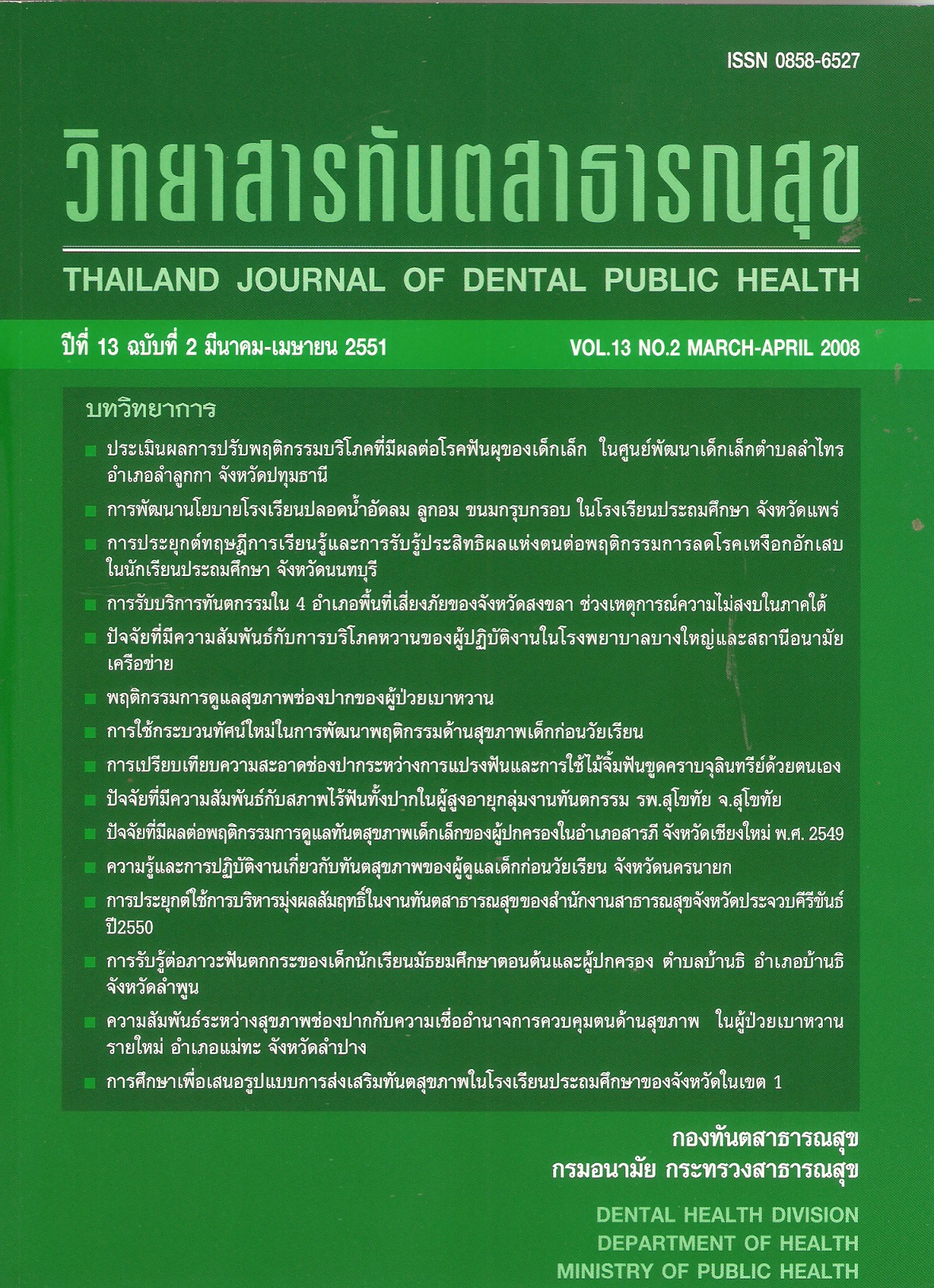
The relationship between oral health status and the multidimensional health locus of control Among new case diabetes patients located in Maetha district, Lampang Province.
Article Sidebar
Main Article Content
Abstract
Locus of control scales have long been demonstrated the relationship to the decision in preventive and curative behavior in human being, psychological factors to physical disease and the response of patients to disease. This cross - sectional study aimed to investigate the relationship between locus of control and oral health status among new case diabetes patients at Maetha district, Lampang province. This study was carried out among 20 males and 31 females with average age 50.73 + 6.85 years old. The Multidimensional Health Locus of Control (MHLC) Scale was used to measure health locus of control with three dimensions; internal, external and chance. Oral health examination was performed by trained oral health personnel using WHO criteria for dental caries status (DMFT), Periodontal status (CPITN) and Debris index. Data was analyzed by using means and medians and non - parametric statistics. The results showed mean score of internal MHLC was 30.18+ 3.56, mean score of external MHLC was 30.86+ 3.42 and mean score of chance MHLC 22.76+ 4.46.Dental caries status was varied from caries free to DMFT = 28, mean of DMFT was 2.29 + 3.02. It was found that subjects with calculus was 54.90%, with periodontal pocket dept more than 4-5 mm. was 41.17%. Debris index range from 1 to 2.67 with mean DI 1.93 + 0.43. It was found that there was significant correlation between the external MHLC dimension with debris index (p value = 0.012). This study suggests that oral health status related to external multidimensional health locus of control.
Downloads
Article Details
References
2. Rotter, Julian B. The development and applications of social learning theory. New York:Praeger;1982.
3. Wallston KA, Wallston BS, Devellis R. Development of the multidimensional health locus of control(MHLC) scale. Health Educ Monogr (serial online] 1978 [cited 2007 June 9]:6:160-70
4. พัชราวรรณ ศรีศิลปะนันทน์,การทบทวนองค์ความรู้เรื่องการสร้างเสริมสุขภาพช่องปาก ผู้สูงอายุ ข้อเสนอเชิงนโยบาย ข้อเสนอเพื่อ การศึกษา วิจัยและพัฒนาสุขภาพช่องปาก กับสุขภาพร่างกาย [cited 2007 June 9] [cited book/elderly/keld04.html.]
5. อุบล เลี้ยววาริณ, ความสําคัญของการศึกษาที่มีต่อจิตลักษณะและพฤติกรรมสุขภาพของ ผู้ปฏิบัติงานในเขตกรุงเทพมหานคร ปริญญา นิพนธ์ ดุษฎีบัณฑิต สาขาพัฒนาศึกษาศาสตร์ มหาวิทยาลัยศรีนครินทรวิโรฒ:2534
6 ดวงเดือน พันธุมนาวิน, ทฤษฎีต้นไม้จริยธรรม การวิจัยและการพัฒนาบุคลากร โครงการ ส่งเสริมเอกสารวิชาการ สถาบันบัณฑิตพัฒนบริหารศาสตร์: 2538
7. Bagley JG, Low KG. Enhancing flossing compliance in college freshmen. Clin Prev Dent (serial online] 1992[cited 2007 June 10] ; 14(6): 25-30.
8. Wolfe GR, Stewart JE, Hartz GW. Relationship of dental coping beliefs and oral hygiene. Community Dent Oral Epidemiol. (serial online] 1991[cited 2007 June 10); 19(2): 112-5.
9. Scruggs RR, Warren DP, Levine P. Juvenile diabetics' oral health and locus of control. A pilot study. J Dent Hyg (serial online] 1989[cited 2007 June 10]; 63(8): 376-81.
10. Brandao IM, et al. Early childhood caries: the influence of socio-behavioral variables and health locus of control in a group of children from Araraquara, Sao Paulo, Brazil. Cad Saude Publica (serial online] 2006 [cited 2007 June 10); 22(6): 1247-56.
11. Astrom AN, Blay D. Multidimensional health locus of control scales: applicability among Ghanaian adolescents. East Afr Med J[serial online] 2002[cited 2007 June 11];79(3): 128-33.
12. Bajwa A, Watts TL, Newton JT. Health control beliefs and quality of life considerations before and during periodontal treatment. Oral Health Prev Dent (serial online] 2007[cited 2007 June 11); 5(2): 101-4.
13. Chase I, et al. Clinical outcomes for Early Childhood Caries (ECC): the influence of health locus of control. Eur J Paediatr Dent (serial online] 2004[cited 2007 June 10]; 5(2): 76-80.
14. Hollister MC, Anema MG. Health behavior models and oral health: a review. J Dent Hyg (serial online] 2004 [cited 2007 June 10]; 78(3): 6.
15. Galgut PN, et al. The relationship between the multidimensional health locus of control and the performance of subjects on a preventive periodontal programme. J Clin Periodontol (serial online] 1987[cited 2007 June 14); 14(3): 171-5.
16. Kneckt MC, AM Syrjala, ML Knuuttila. Locus of control beliefs predicting oral and diabetes health behavior and health status. Acta Odontol Scand. [serial online] 1999[cited 2007 June 9); 57(3): 127-31.
17. aún siunaustuvaiWbPPDP, buanne เวชปฏิบัติ เพื่อการบริหารจัดการภาระโรค เขต ภาคเหนือตอนบน 8 จังหวัด ปอดอุดกั้นเรื้อรัง maquartaanau lu78274. 2549. 27-31
18. World Health Organization. Oral Health Surveys-Basic methods.4 th ed.:Dentition status and treatment need., Geneva 1997, 39-44
19. World Health Organization. Oral Health Surveys-Basic methods.4 rd ed.: Community Periodontal Index, Geneva 1997, 36-38
20. Greene JC,Vermillion JR. The Simplified Oral Hygiene Index. J Am Dent Assoc 1964;68:8-13
21. Wallston KA, Wallston BS.Health locus of control scales.In : Herbert ML, ed. Research with the locus of control construction. New York :Academic Press; 1981:189-239
22. Petersen PE. The World Oral Health Report 2003: continuous improvement of oral health in the 21st Centurythe approach of the WHO Global Oral Health Programme. Community Dent Oral Epidemiol (serial online] 2003[cited 2007 May 5]; 31(1) : 3-24.
23. กองทันตสาธารณสุข กรมอนามัย กระทรวงสาธารณสุข.รายงานผลการสํารวจสภาวะ ทันตสุขภาพแห่งชาติครั้งที่ 5. 2543-2544 กรุงเทพฯ:บริษัทสมเจริญพานิชย์ (กรุงเทพ) จํากัด;2545.
24. Macgregor IDM, Regis D, Balding J.Self concept and dental health behaviours in adolescents. J Clin Periodontal (serial online] 1997[cited 2007 June 10]; 24(5): 335-9.
25. Borkowska ED, Watts TLP, Weinman J. The relationship of health beliefs and psychological mood to patient adherence to oral hygiene behaviour. J Clin Periodontol [serial online] 1998 [cited 2007 June 10]; 25(3): 187-93.
26. รัตนา อัมไพรวรรณ และคณะ, การสร้างเกณฑ์คัดกรอง กลุ่มเสี่ยงโรคโรคปริทันต์, [cited 2007 June 10]; Availablefrom:http:// dental.anamai.moph.go.th/oralhealth/PR/E-book /risk/r02.htm]
27. ศูนย์พัฒนาทรัพยากรการศึกษา มหาวิทยาลัยมหาสารคาม, เอกสารประกอบการเรียน พฤติกรรม สุขภาพ [cited 2007 May 10]; vailable from :http://cyberclass.msu.ac.th/cyberclass/ library/library.php]
