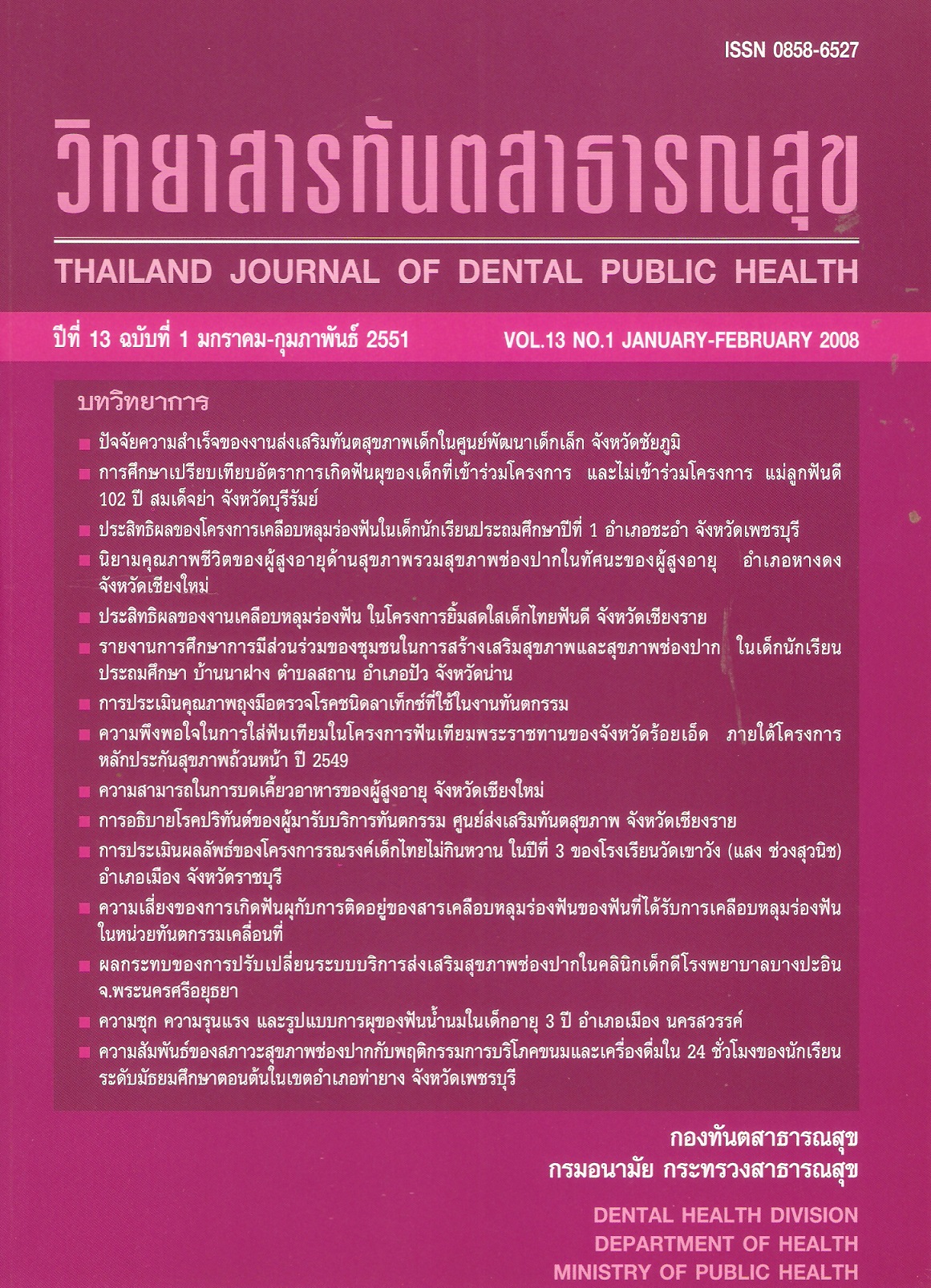
ความเสี่ยงของการเกิดฟันผุกับการติดอยู่ของสารเคลือบหลุมร่องฟันของฟันที่ได้รับการเคลือบหลุมร่องฟันในหน่วยบริการทันตกรรมเคลื่อนที่
Article Sidebar
Main Article Content
บทคัดย่อ
การศึกษานี้มีวัตถุประสงค์เพื่อศึกษาความสัมพันธ์ระหว่างความเสี่ยงของการเกิดฟันผุกับการติดอยู่ ของสารเคลือบหลุมร่องฟันในฟันกรามแท้ซี่แรกที่ได้รับการเคลือบหลุมร่องฟันในหน่วยทันตกรรมเคลื่อนที่ทําการ ศึกษาในช่วงปี พ.ศ.2546 - 2548 ผู้ศึกษาติดตามตรวจฟันกรามแท้ซี่แรกที่ได้รับการทําเคลือบหลุมร่องฟันโดย เจ้าพนักงานทันตสาธารณสุขที่ทําในหน่วยทันตกรรมเคลื่อนที่ที่โรงเรียน โดยติดตามตรวจฟันกรามแท้ของ นักเรียนประถมศึกษาปีที่1ที่ได้รับการเคลือบแล้วจํานวน 206 คน จาก 11 โรงเรียน ใน 6 CUP ของจังหวัด สงขลาทุก 6 เดือน เป็นระยะเวลา 30 เดือน รวม 5 ครั้ง โดยแบ่งการติดอยู่ของสารเคลือบหลุมร่องฟันเป็น 3 แบบ คือ ฟันที่สารเคลือบหลุมร่องฟันติดอยู่สมบูรณ์ ฟันที่มีสารเคลือบหลุมร่องฟันติดอยู่บางส่วน และฟันที่ สารเคลือบหลุมร่องฟันหลุดหมด ผลการศึกษาพบการหลุดของสารเคลือบหลุมร่องฟันสูงสุด ในช่วง 6 เดือน แรก โดยมีการหลุดของสารเคลือบหลุมร่องฟันแบบหลุดบางส่วนและหลุดหมด รวมกันในช่วง 6 เดือนแรกถึง ร้อยละ 32.8 และมีแนวโน้มการหลุดลดลง โดยมีการหลุดร้อยละ 12.4, 13.8, 6.3 และ 3.9 ในช่วง 6-12 เดือน, 12-18 เดือน, 18 - 24 เดือน และ ช่วง 24 - 30 เดือน ตามลําดับ ความเสี่ยงของการเกิดฟันผุของฟันที่มีสาร เคลือบหลุมร่องฟันติดอยู่บางส่วนเป็น 2.8 เท่าของฟันที่สารเคลือบหลุมร่องฟันหลุดหมด ฟันที่มีสารเคลือบ หลุมร่องฟันติดอยู่สมบูรณ์มีความเสี่ยงต่อการเกิดฟันผุเป็น 0.4 เท่า หรือสามารถป้องกันฟันผุได้เป็น 2.5 เท่า ของฟันที่สารเคลือบหลุมร่องฟันหลุดหมด การศึกษานี้ชี้ให้เห็นถึงความสําคัญของการเคลือบหลุมร่องฟันที่ดี ซึ่งหมายถึง ฟันที่มีสารเคลือบหลุมร่องฟันติดอยู่สมบูรณ์และนาน จะสามารถป้องกันฟันผุได้ดี ดังนั้นจึงต้อง คํานึงถึงการปรับปรุงประสิทธิภาพของการทําเคลือบหลุมร่องฟัน และผู้ทําควรมีการติดตามตรวจการยึดอยู่ ของสารเคลือบหลุมร่องฟันเป็นระยะๆ อย่างสม่ําเสมอ เพื่อทําการซ่อมแซมได้ทันท่วงที
Downloads
Article Details
เอกสารอ้างอิง
2. Cohen L.A. and Horowizt A.M. : Community-based sealant programs in the United States : results of a survey. Journal of Public Health Dentristry 1993; 53,241-245.
3. บานเย็น ศิริสกุลเวโรจน์ : การยึดติดของสารเคลือบหลุมร่องฟันที่ให้บริการในหน่วยทันตกรรมเคลื่อนที่และผลต่อการลดอัตรา การเกิดโรคฟันผุ เอกสารรายงานการวิจัย หน้า 13, 2541
4. Tianviwat S., Chukadee W., Sirisakulveroj B., Leewanant R. and Larsen M.J. : Retention of pit and fissure sealants under field conditions after nearly 2-3 years. Journal of the Dental Association of Thailand 2001;51, 115-120.
5. Going A.W. : Sealant effect on incipient caries, enamel maturation and future caries susceptibility. Journal of Dental Education 1984; 48, 35-41.
6. National Institutes of Health. : Dental sealants in the prevention of tooth decay. Journal of Education 1984 ; 48, 126-131.
7. Chestnutt I.G., Schafer F., Jacobson P.M. and Stephen K.W. : The Prevalence and effectiveness of fissure sealants in Scottish adolescents. British Dental Journal 1994; 20,125-129.
8. Poulsen S., Thylstrup A., Christensen P.F. and Ishoy U. : Evaluation of a pit and fissure- sealing program in a public dental health service after 2 years. Community Dental and Oral Epidemiology 1979 ; 7, 154-157.
9. Thipsoonthornchai J. : The comparative study on retention rate and caries prevention between Glass ionomer and Resin using as pit and fissure sealant in mobile dental service, Buriram province. Journal of Dental Public Health 2003; 15, 62-67.
10. Simonsen R.J.: Retention and effectiveness of dental sealant after 15 years. Journal of American Dental Association 1991; 122, 34-42.
11. Moller I.J. and Poulsen S.: A standardized system for diagnosting, recording and analyzing dental caries data. Scandinavia Journal of Dental Research 1973; 81, 1-13.
12. Scorino avaa Jouría gÁ (2550) : 057967979 และสมการสําหรับการวิจัยทางสุขภาพ. พิมพ์ ครั้งที่ 1 ที่กรุงเทพฯ : จุฬาลงกรณ์มหาวิทยาลัย
13. http://en.wikipedia.org/wiki/Markov_ chain (Access on 5 December 2007)
14. Gwinnette A.J.: The bonding of sealants to enamel. America Society of Preventive Dental Journal 1973, 21-2.9.
15. Feigal R.J., Hitt J. and Splieth C. : Retaining sealant on salivary contaminated enamel. Journal of American Dental Association 1993; 124,88-97.
16. Bravo M.,Osorio E., Garcia-Anllo I., Llodra J.C. and Baca P. : The influence of dft index on sealant success : a 48- month survival analysis. Journal of Dental Research 1996; 75, 768-774.
17. Holst A., Braune K. and Sullivan A. : A five - year evaluation of fissure sealants applied by dental assistants. Sweden Dental Journal 1998 ; 22, 195-201.
18. Wendt L.K., Koch G. and Birkhed D. : On the retention and effectiveness of fissure sealant in permanent molars after 15-20 years : a cohort study. Community Dental and Oral Epidemiology 2001; 29, 302-307.
19. Llodra J.C., Bravo M., Delgado-Rodriguez M., Baca P. and Galvez R. : Factors influencing the effectiveness of sealantsa meta - analysis. Community Dental and Oral Epidemiology 1993; 21, 261- 268.
20. Lussi A.: Validity of diagnostic and treatment decisions of fissure caries. Caries Research 1991 ; 25, 296-303.
21. Mertz-Fairhurst E.J., Schuster G.S. and Fairhurst C.W.: Arresting caries by sealant: results of a clinical study. Journal of American Dental Association 1986; 112,194-197.
22. Handelman S.L., Leverett D.H., Espeland M.A. and Curzon J.A.: Clinical radiographic evaluation of sealed carious and sound tooth surfaces. Journal of American Dental Association 1986 ; 113,751-754.
23. Duangthip D.,Lussi A.: Effects of application techniques and fissure types on the in vitro performance of two fissure sealants. Journal of American Dental Association 2004;17(2) , 134-142.
24. ฝ่ายทันตสาธารณสุข สํานักงานสาธารณสุข จังหวัดสงขลา : รายงานผลการสํารวจสภาวะ ทันตสุขภาพจังหวัดสงขลา ครั้งที่ 3 พ.ศ. 2544
