
Reduction Mammoplasty: The Factors that Influence Outcomes and Patients' Satisfaction in Calabar, Nigeria
DOI:
https://doi.org/10.64387/tjs.2026.276251Keywords:
Reduction mammaplasty, Breast reduction, Patients’ satisfaction, Breast surgery complications, Mammaplasty outcomeAbstract
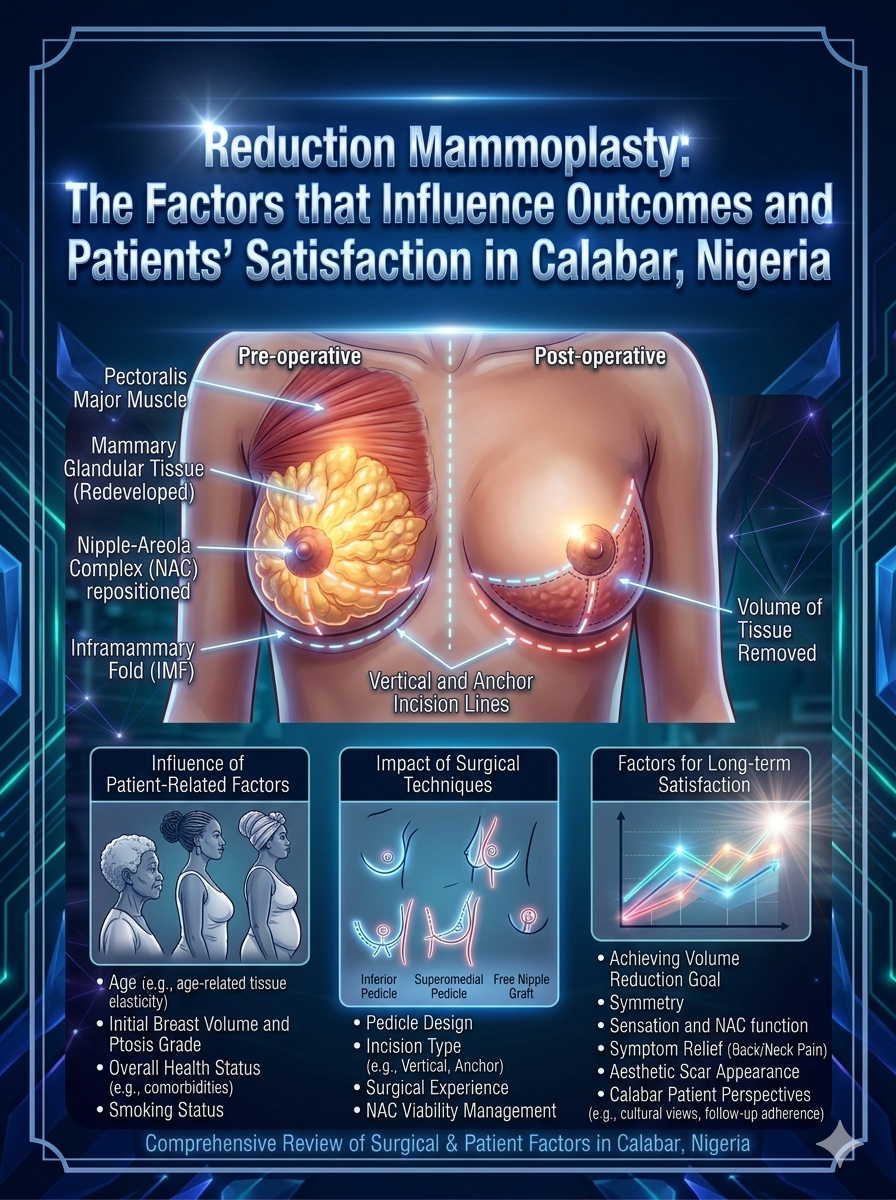
Background: Breast reduction surgery, also called reduction mammoplasty, is a common breast aesthetic surgery.
Objective: We aim to investigate factors that influence reduction mammoplasty outcomes and patient satisfaction at our institution.
Patients and Methods: This 10-year retrospective study included 39 patients who underwent reduction mammoplasty from January 2014 to December 2023. We reviewed patients’ records, including sociodemographic parameters, complication types, and patient satisfaction levels. Exclusion criteria included incomplete records and other breast surgeries performed for reasons unrelated to the study's purpose. We analyzed the results using the Statistical Package for the Social Sciences (SPSS) version 20.0, along with questionnaires (5-point Likert scale) and postoperative BREAST-Q outcomes to assess patient satisfaction.
Results: Table 1 shows the socio-demographic parameters, including age range, educational level, and surgeon cadre; all patients were female. The Table showed an age range of 25-50 years, with a mean value of 38 ± 5 years. The 41-50 age group had the most patients. All surgeons were plastic surgeons. Table 2 shows the various complications and their corresponding frequencies. Predictors such as obesity and surgical technique constituted major outcome parameters. Patient satisfaction with the decision, assessed using a 5-point Likert scale, was high (90-98%), and the BREAST-Q outcome was also high (p = 0.03).
Conclusion: Reduction mammoplasty is a common breast aesthetic surgery. The factors that influence outcomes were age, educational level, breast asymmetry, obesity, surgical technique, and impact on sexuality. We identified factors that influence patient outcomes. Overall patient outcomes showed a high level of patient satisfaction.
References
Spaniol JR, Buchanan PJ, Greco RJ. Secondary reduction mammaplasty: does initial pedicle design matter? J Plast Surg Hand Surg. 2019;53(2):105-10. doi: 10.1080/2000656X.2018.1556670.
Sears ED, Lu YT, Chung TT, et al. Pathology evaluation of reduction mammaplasty specimens and subsequent diagnosis of malignant breast disease: a claims-based analysis. World J Surg. 2019;43(6):1546-53. doi: 10.1007/s00268-019-04931-1.
Tapp M, Singh R, Ulm JP, et al. Association of increased body mass index and resection weights on the safety of reduction mammaplasty in the adolescent population. J Plast Reconstr Aesthet Surg. 2019;72(7):1219-43. doi: 10.1016/j.bjps.2019.03.006.
Lee HJ, Ock JJ. How to improve projection in nipple reconstruction: a modified method using acellular dermal matrix disk and fragments. Plast Reconstr Surg. 2019;143(4):698e-706e. doi: 10.1097/PRS.0000000000005454.
William JC, Patricia AC, Christin AH, Olive SLH, Erwin AK, Martinaor- Jorge j, Paget JT. Breast Reduction Surgery, Breast Reduction Surgery Care at Mayo Clinic.
Spear SL, Howard MA. Evolution of the vertical reduction mammaplasty. Plast Reconstr Surg. 2003;112(3):855-68. doi: 10.1097/01.PRS.0000072251.85687.1B.
Hall-Findlay EJ. A simplified vertical reduction mammaplasty: shortening the learning curve. Plast Reconstr Surg. 1999;104(3):748-59.
Spear SL, Howard MA. Evolution of the vertical reduction mammaplasty. Plast Reconstr Surg. 2003 Sep;112(3):855-68; quiz 869. doi: 10.1097/01.PRS.0000072251.85687.1B.
Momeni A, Sorice SC, Li AY, et al. Breast reconstruction with free abdominal flaps is associated with persistent lower extremity venous stasis. Plast Reconstr Surg. 2019;143(6):1144e-1150e. doi: 10.1097/PRS.0000000000005613.
Ercan A. Feasibility and safety of superomedial pedicle for breast reduction in geriatric patients. Aesthetic Plast Surg. 2024;48(19):3847-54. doi: 10.1007/s00266-024-03859-9.
Nelson JA, Fischer JP, Wink JD, et al. A population-level analysis of bilateral breast reduction: does age affect early complications? Aesthet Surg J. 2014;34(3):409-16. doi: 10.1177/1090820X14525393.
Daley J, Khuri SF, Henderson W, et al. Risk adjustment of the postoperative morbidity rate for the comparative assessment of the quality of surgical care: results of the National Veterans Affairs Surgical Risk Study. J Am Coll Surg. 1997;185(4):328-40.
Malyar M, Peymani A, Johnson AR, et al. The impact of resident postgraduate year involvement in body-contouring and breast reduction procedures: a comprehensive analysis of 9638 patients. Ann Plast Surg. 2019;82(3):310-5. doi: 10.1097/SAP.0000000000001714.
Hashem AM, Waltzman JT, D'Souza GF, et al. Resident and program director perceptions of aesthetic training in plastic surgery residency: an update. Aesthet Surg J. 2017;37(7):837-46. doi: 10.1093/asj/sjw275.
Atterhem H, Holmner S, Janson PE. Reduction mammaplasty: symptoms, complications, and late results. A retrospective study on 242 patients. Scand J Plast Reconstr Surg Hand Surg. 1998;32(3):281-6. doi: 10.1080/02844319850158615.
Letterman G, Schurter M. The effects of mammary hypertrophy on the skeletal system. Ann Plast Surg. 1980;5(6):425-31. doi: 10.1097/00000637-198012000-00003.
Saariniemi K, Luukkala T, Kuokkanen H. The outcome of reduction mammaplasty is affected more by psychosocial factors than by changes in breast dimensions. Scand J Surg. 2011;100(2):105-9. doi: 10.1177/145749691110000207.
de Sá JZ, Braga ACCR, Barreto RHC, et al. Sensitivity of the Nipple-Areola Complex in Reduction Mammaplasty Following Periareolar Dermis Section. Aesthet Surg J. 2020 Aug 14;40(9): NP491-8. doi: 10.1093/asj/sjaa011.
Radosa JC, Radosa MP, Baum S, et al. Reduction mammaplasty for symptomatic macromastia: which factors influence the post-operative outcome? Arch Gynecol Obstet. 2013;287(4):715-22. doi: 10.1007/s00404-012-2620-z.
Nuzzi LC, Firriolo JM, Pike CM, et al. The effect of reduction mammaplasty on quality of life in adolescents with macromastia. Pediatrics. 2017;140(5):e20171103. doi: 10.1542/peds.2017-1103.
Cunning JR, Mookerjee VG, Alper DP, et al. How does reduction mammaplasty surgical technique impact clinical, aesthetic, and patient-reported outcomes?: a comparison of the superomedial and inferior pedicle techniques. Ann Plast Surg. 2023;91(1):28-35. doi: 10.1097/SAP.0000000000003610.
Carpelan A, Kauhanen S, Mattila K, et al. Reduction mammaplasty as an outpatient procedure: a retrospective analysis of outcome and success rate. Scand J Surg. 2015;104(2):96-102. doi: 10.1177/1457496914526872.
Janik PE, Charytonowicz D, Miszczyk J, et al. Female sexual function and sexual well-being before and after breast reduction: a pilot cross-sectional study and review of literature. Ann Plast Surg. 2019;82(6):609-13. doi: 10.1097/SAP.0000000000001742.
Emami SA, Sobhani R. Impact of reduction mammaplasty on sexuality in patients with macromastia and their partners. J Plast Reconstr Aesthet Surg. 2016;69(10):1335-9. doi: 10.1016/j.bjps.2016.07.018.
Fischer JP, Cleveland EC, Shang EK, et al. Complications following reduction mammaplasty: a review of 3538 cases from the 2005-2010 NSQIP data sets. Aesthet Surg J. 2014;34(1):66-73. doi: 10.1177/1090820X13515676.
Gonzalez MA, Glickman LT, Aladegbami B, et al. Quality of life after breast reduction surgery: a 10-year retrospective analysis using the Breast Q questionnaire: does breast size matter? Ann Plast Surg. 2012 Oct;69(4):361-3. doi: 10.1097/SAP.0b013e31824a218a.
Corrêa MPD, Dornelas MT, de Carvalho EN, et al. Assessment of quality of life in patients who underwent breast reduction using BREAST-Q. J Plast Reconstr Aesthet Surg. 2018;71(6):929-31. doi: 10.1016/j.bjps.2018.02.010.
Derby BM, Grotting JC, Redden DT. Vertical Sculpted Pillar Reduction Mammaplasty in 317 Patients: Technique, Complications, and BREAST-Q Outcomes. Aesthet Surg J. 2016;36(4):417-30. doi: 10.1093/asj/sjv217.
Downloads
Published
How to Cite
Issue
Section
License
Copyright (c) 2026 The Royal College of Surgeons of Thailand

This work is licensed under a Creative Commons Attribution-NonCommercial-NoDerivatives 4.0 International License.
Articles must be contributed solely to The Thai Journal of Surgery and when published become the property of the Royal College of Surgeons of Thailand. The Royal College of Surgeons of Thailand reserves copyright on all published materials and such materials may not be reproduced in any form without the written permission.


