
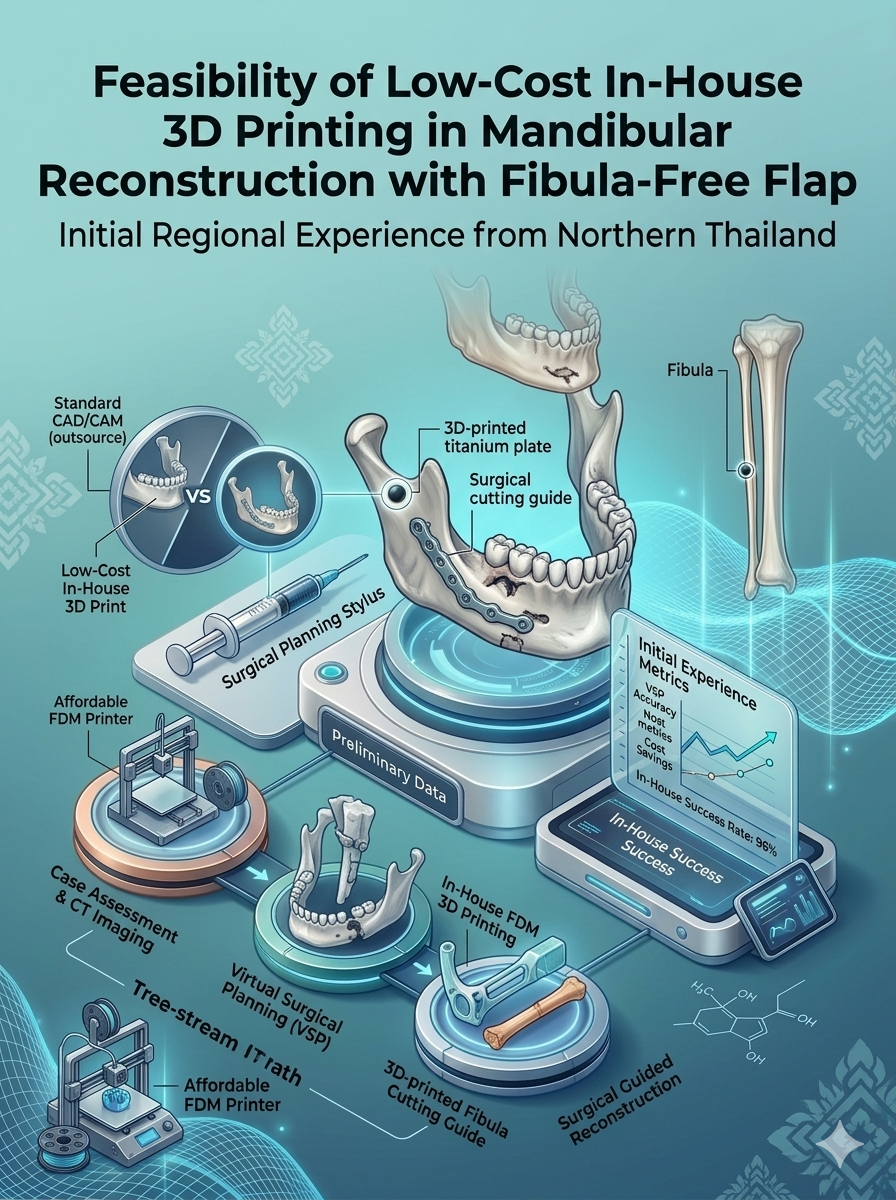
Feasibility of Low-Cost In-House 3D Printing in Mandibular Reconstruction with Fibula Free Flap: Initial Regional Experience from Northern Thailand
DOI:
https://doi.org/10.64387/tjs.2026.278453Keywords:
Mandibular reconstruction, Fibula free flap, 3D printing, Open-source software, Virtual surgical planning, In-house workflowAbstract
Background: Computer-assisted mandibular reconstruction with fibula free flap (FFF) improves accuracy but is often limited by high cost and dependency on external engineering support. This study evaluated the feasibility, workflow, and outcomes of a low-cost, in-house 3D printing protocol for mandibular reconstruction in a regional hospital.
Materials and Methods: Eighteen patients who underwent in-house, open-source–based 3D–planned FFF reconstruction between 2020 and 2025 were retrospectively reviewed. We analyzed demographic, operative, and reconstructive parameters, including ischemia time, operative duration, flap survival, and postoperative outcomes.
Results: The mean age was 60.9 years, with an equal sex distribution. Squamous cell carcinoma was the most common diagnosis (61%), and lateral-type defects predominated (78%). All reconstructions used osteocutaneous FFF with a single skin paddle. The mean defect length was 83.8 mm, ischemia time was 101 ± 32 minutes, and total operative time was 613 ± 110 minutes. No patient required routine ICU admission. All 18 flaps survived (100%). Minor complications included two fistulae (11%) and one plate exposure (5.6%). The average 3D printing cost was approximately 100 THB (USD 2.7) per model.
Conclusion: An in-house, surgeon-driven 3D printing workflow using open-source software is feasible, accurate, and cost-effective for mandibular reconstruction. A regional hospital setting can achieve outcomes comparable to high-cost commercial systems, supporting broader access to digital reconstructive technology.
References
Chim H, Salgado CJ, Mardini S, et al. Reconstruction of mandibular defects. Semin Plast Surg. 2010 May;24(2):188-97. doi: 10.1055/s-0030-1255336.
Kumar BP, Venkatesh V, Kumar KA, et al. Mandibular Reconstruction: Overview. J Maxillofac Oral Surg. 2016 Dec;15(4):425-441. doi: 10.1007/s12663-015-0766-5.
Hidalgo DA. Fibula free flap: a new method of mandible reconstruction. Plast Reconstr Surg. 1989 Jul;84(1):71-9. PMID: 2734406.
Dell'Aversana Orabona G, Abbate V, Maglitto F, et al. Low-cost, self-made CAD/CAM-guiding system for mandibular reconstruction. Surg Oncol. 2018 Jun;27(2):200-7. doi: 10.1016/j.suronc.2018.03.007.
Tarsitano A, Mazzoni S, Cipriani R, et al. The CAD-CAM technique for mandibular reconstruction: an 18 patients oncological case-series. J Craniomaxillofac Surg. 2014 Oct;42(7):1460-4. doi: 10.1016/j.jcms.2014.04.011.
Dowgierd K, Pokrowiecki R, Wolanski W, et al. Analysis of the effects of mandibular reconstruction based on microvascular free flaps after oncological resections in 21 patients, using 3D planning, surgical templates and individual implants. Oral Oncol. 2022 Apr; 127:105800. doi: 10.1016/j.oraloncology.2022.105800.
Bosc R, Hersant B, Carloni R, et al. Mandibular reconstruction after cancer: an in-house approach to manufacturing cutting guides. Int J Oral Maxillofac Surg. 2017 Jan;46(1):24-31. doi: 10.1016/j.ijom.2016.10.004.
Culié D, Dassonville O, Poissonnet G, et al. Virtual planning and guided surgery in fibular free-flap mandibular reconstruction: A 29-case series. Eur Ann Otorhinolaryngol Head Neck Dis. 2016 Jun;133(3):175-8. doi: 10.1016/j.anorl.2016.01.009.
Damecourt A, Nieto N, Galmiche S, et al. de Boutray M. In-house 3D treatment planning for mandibular reconstruction by free fibula flap in cancer: Our technique. Eur Ann Otorhinolaryngol Head Neck Dis. 2020 Dec;137(6):501-5. doi: 10.1016/j.anorl.2020.02.002.
Ganry L, Hersant B, Quilichini J, et al. Use of the 3D surgical modelling technique with open-source software for mandibular fibula free flap reconstruction and its surgical guides. J Stomatol Oral Maxillofac Surg. 2017 Jun;118(3):197-202. doi: 10.1016/j.jormas.2017.03.002.
Ganry L, Quilichini J, Bandini CM, et al. Three-dimensional surgical modelling with an open-source software protocol: study of precision and reproducibility in mandibular reconstruction with the fibula free flap. Int J Oral Maxillofac Surg. 2017 Aug;46(8):946-57. doi: 10.1016/j.ijom.2017.02.1276.
Mottini M, Seyed Jafari SM, Shafighi M, Schaller B. New approach for virtual surgical planning and mandibular reconstruction using a fibula free flap. Oral Oncol. 2016 Aug;59:e6-e9. doi: 10.1016/j.oraloncology.2016.06.001.
Wang L, Ma W, Zhang C, et al. Optimized design for using of double-barrel vascularized fibular flap in various types of mandibular defects. J Dent Sci. 2025 Jan;20(1):578-85. doi: 10.1016/j.jds.2024.04.022.
Downloads
Published
How to Cite
Issue
Section
License
Copyright (c) 2026 The Royal College of Surgeons of Thailand

This work is licensed under a Creative Commons Attribution-NonCommercial-NoDerivatives 4.0 International License.
Articles must be contributed solely to The Thai Journal of Surgery and when published become the property of the Royal College of Surgeons of Thailand. The Royal College of Surgeons of Thailand reserves copyright on all published materials and such materials may not be reproduced in any form without the written permission.


