
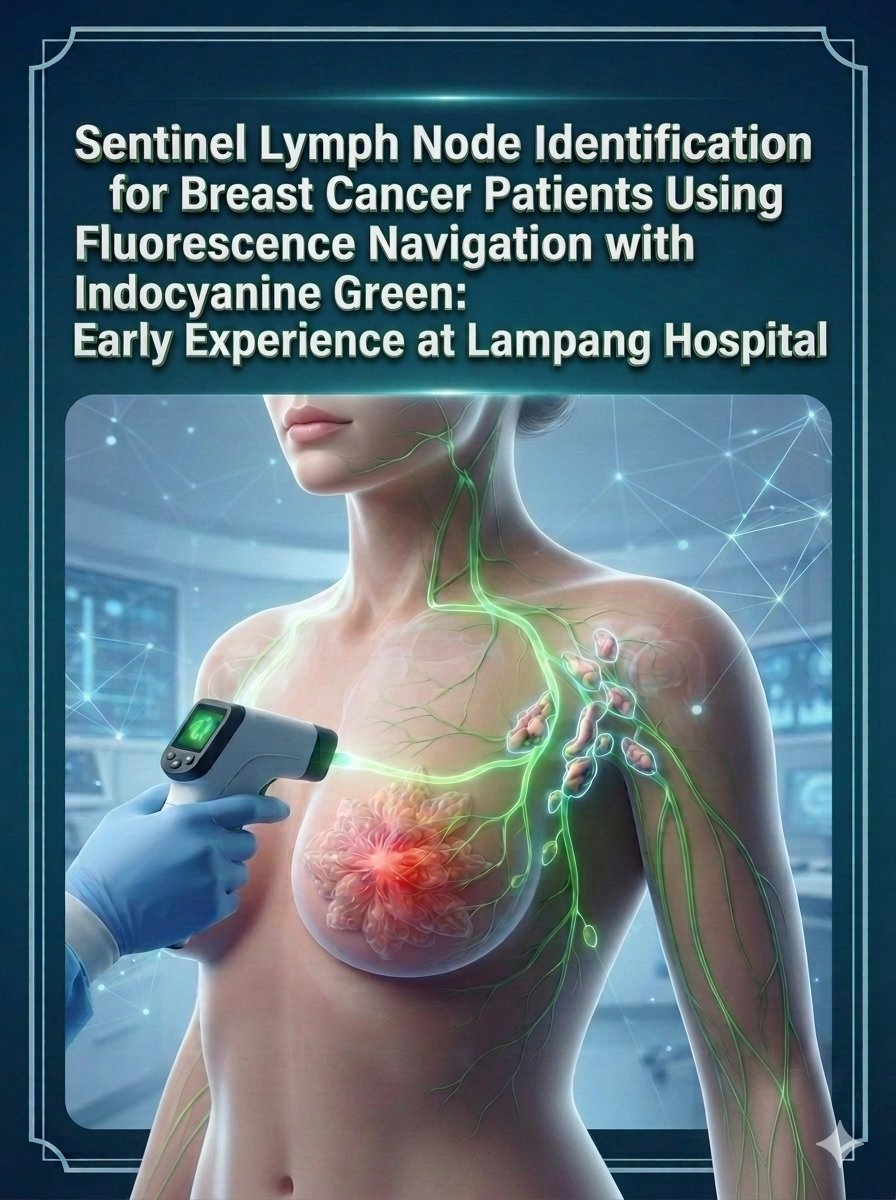
Sentinel Lymph Node Identification for Breast Cancer Patients Using Fluorescence Navigation with Indocyanine Green: Early Experience at Lampang Hospital
DOI:
https://doi.org/10.64387/tjs.2026.278495Keywords:
Breast cancer, Indocyanine green, Blue dye, Sentinel lymph node biopsyAbstract
Background: Breast cancer is the most common malignancy among women. Axillary lymph node status is a key determinant of prognosis and treatment decisions. Although axillary lymph node dissection (ALND) provides accurate staging and regional control, it is associated with higher morbidity. Sentinel lymph node biopsy (SLNB) has therefore become the standard approach for axillary staging and avoiding unnecessary dissection. Indocyanine green (ICG) has recently been used as an alternative technique for sentinel lymph node localization via fluorescence imaging. This study presents a case series using ICG fluorescence navigation in breast cancer surgery.
Materials and Methods: From June 2022 to June 2024, 18 breast cancer patients underwent SLNB with ICG fluorescence navigation at Lampang Hospital. All patients had been diagnosed with breast cancer. These 18 patients included clinically node-negative cases and node-negative-to-positive patients (N1 to N0) who received neoadjuvant systemic treatment and underwent SLNB (dual mapping: standard isosulfan blue dye with ICG).
Results: Eighteen cases underwent sentinel lymph node biopsy (SLNB) using dual mapping with standard isosulfan blue dye and ICG for localization. No adverse events occurred from intraoperative use of ICG or blue dye. All lymph nodes visualized with either fluorescence or dye were excised. In total, we removed 75 lymph nodes across 18 procedures. ICG identified seventy nodes, while only 29 were detected with blue dye. On average, the ICG method detected 3.88 sentinel lymph nodes (SLNs) (range: 2-8), resulting in a detection rate of 100%. In comparison, only 1.61 SLNs (range: 0-4) were identified, with an identification rate of 88.88%.
Conclusion: Fluorescence-guided SLNB with ICG is safe and highly effective, improving detection rates compared to dye alone. This method enhances lymphatic mapping and supports surgical training for both surgeons and residents.
References
Giuliano AE, Haigh PI, Brennan MB, et al. Prospective observational study of sentinel lymphadenectomy without further axillary dissection in patients with sentinel node-negative breast cancer. J Clin Oncol. 2000 Jul;18(13):2553-9. doi: 10.1200/JCO.2000.18.13.2553.
Purushotham AD, Upponi S, Klevesath MB, et al. Morbidity after sentinel lymph node biopsy in primary breast cancer: results from a randomized controlled trial. J Clin Oncol. 2005 Jul 1;23(19):4312-21. doi: 10.1200/JCO.2005.03.228.
Lyman GH, Somerfield MR, Bosserman LD, et al. Sentinel Lymph Node Biopsy for Patients With Early-Stage Breast Cancer: American Society of Clinical Oncology Clinical Practice Guideline Update. J Clin Oncol. 2017 Feb 10;35(5):561-4. doi: 10.1200/JCO.2016.71.0947. Epub 2016 Dec 12.
Kühn T, Classe JM, Gentilini OD, et al. Current Status and Future Perspectives of Axillary Management in the Neoadjuvant Setting. Breast Care (Basel). 2018 Oct;13(5):337-41. doi: 10.1159/000492437.
Kuehn T, Bauerfeind I, Fehm T, et al. Sentinel-lymph-node biopsy in patients with breast cancer before and after neoadjuvant chemotherapy (SENTINA): a prospective, multicentre cohort study. Lancet Oncol. 2013 Jun;14(7):609-18. doi: 10.1016/S1470-2045(13)70166-9.
Boughey JC, Suman VJ, Mittendorf EA, et al. Alliance for Clinical Trials in Oncology. Sentinel lymph node surgery after neoadjuvant chemotherapy in patients with node-positive breast cancer: the ACOSOG Z1071 (Alliance) clinical trial. JAMA. 2013 Oct 9;310(14):1455-61. doi: 10.1001/jama.2013.278932.
Chirappapha P, Chatmongkonwat T, Lertsithichai P, et al. Sentinel lymph node biopsy after neoadjuvant treatment of breast cancer using blue dye, radioisotope, and indocyanine green: Prospective cohort study. Ann Med Surg (Lond). 2020 Sep 22;59:156-60. doi: 10.1016/j.amsu.2020.09.030.
Kitai T, Inomoto T, Miwa M, Shikayama T. Fluorescence navigation with indocyanine green for detecting sentinel lymph nodes in breast cancer. Breast Cancer. 2005;12(3):211-5. doi: 10.2325/jbcs.12.211.
Wilke LG, McCall LM, Posther KE, et al. Surgical complications associated with sentinel lymph node biopsy: results from a prospective international cooperative group trial. Ann Surg Oncol. 2006 Apr;13(4):491-500. doi: 10.1245/ASO.2006.05.013.
Raut CP, Hunt KK, Akins JS, et al. Incidence of anaphylactoid reactions to isosulfan blue dye during breast carcinoma lymphatic mapping in patients treated with preoperative prophylaxis: results of a surgical prospective clinical practice protocol. Cancer. 2005 Aug 15;104(4):692-9. doi: 10.1002/cncr.21226.
Bleicher RJ, Kloth DD, Robinson D, et al. Inflammatory cutaneous adverse effects of methylene blue dye injection for lymphatic mapping/sentinel lymphadenectomy. J Surg Oncol. 2009 May 1;99(6):356-60. doi: 10.1002/jso.21240.
Takemoto N, Koyanagi A, Yasuda M, et al. Comparison of the indocyanine green dye method versus the combined method of indigo carmine blue dye with indocyanine green fluorescence imaging for sentinel lymph node biopsy in breast conservative therapy for stage ≤IIA breast cancer. BMC Womens Health. 2018 Sep 18;18(1):151. doi: 10.1186/s12905-018-0646-5.
Lin J, Lin LS, Chen DR, Lin KJ, Wang YF, Chang YJ. Indocyanine green fluorescence method for sentinel lymph node biopsy in breast cancer. Asian J Surg. 2020 Dec;43(12):1149-53. doi: 10.1016/j.asjsur.2020.02.003.
da Silva Sá R, Von Ah Rodrigues RF, Bugalho LA, et al. Evaluation of the efficacy of using indocyanine green associated with fluorescence in sentinel lymph node biopsy. PLoS One. 2023 Oct 25;18(10):e0273886. doi: 10.1371/journal.pone.0273886.
Yin R, Ding LY, Wei QZ, et al. Comparisons of ICG-fluorescence with conventional tracers in sentinel lymph node biopsy for patients with early-stage breast cancer: A meta-analysis. Oncol Lett. 2021 Feb;21(2):114. doi: 10.3892/ol.2020.12375.
Zhang X, Li Y, Zhou Y, et. Diagnostic Performance of Indocyanine Green-Guided Sentinel Lymph Node Biopsy in Breast Cancer: A Meta-Analysis. PLoS One. 2016 Jun 9;11(6):e0155597. doi: 10.1371/journal.pone.0155597.
Thongvitokomarn S, Polchai N. Indocyanine Green Fluorescence Versus Blue Dye or Radioisotope Regarding Detection Rate of Sentinel Lymph Node Biopsy and Nodes Removed in Breast Cancer: A Systematic Review and Meta-Analysis. Asian Pacific Journal of Cancer Prevention. 2020;21(5):1187-95.
Sugie T, Ikeda T, Kawaguchi A, et al. Sentinel lymph node biopsy using indocyanine green fluorescence in early-stage breast cancer: a meta-analysis. Int J Clin Oncol. 2017 Feb;22(1):11-7. doi: 10.1007/s10147-016-1064-z.
Ahmed M, Purushotham AD, Douek M. Novel techniques for sentinel lymph node biopsy in breast cancer: a systematic review. Lancet Oncol. 2014 Jul;15(8):e351-62. doi: 10.1016/S1470-2045(13)70590-4.
Veronesi U, Paganelli G, Viale G, et al. A randomized comparison of sentinel-node biopsy with routine axillary dissection in breast cancer. N Engl J Med. 2003 Aug 7;349(6):546-53. doi: 10.1056/NEJMoa012782.
Johnson AR, Granoff MD, Lee BT, Padera TP, Bouta EM, Singhal D. The Impact of Taxane-based Chemotherapy on the Lymphatic System. Ann Plast Surg. 2019 Apr;82(4S Suppl 3):S173-8. doi: 10.1097/SAP.0000000000001884.
Downloads
Published
How to Cite
Issue
Section
License
Copyright (c) 2026 The Royal College of Surgeons of Thailand

This work is licensed under a Creative Commons Attribution-NonCommercial-NoDerivatives 4.0 International License.
Articles must be contributed solely to The Thai Journal of Surgery and when published become the property of the Royal College of Surgeons of Thailand. The Royal College of Surgeons of Thailand reserves copyright on all published materials and such materials may not be reproduced in any form without the written permission.


