
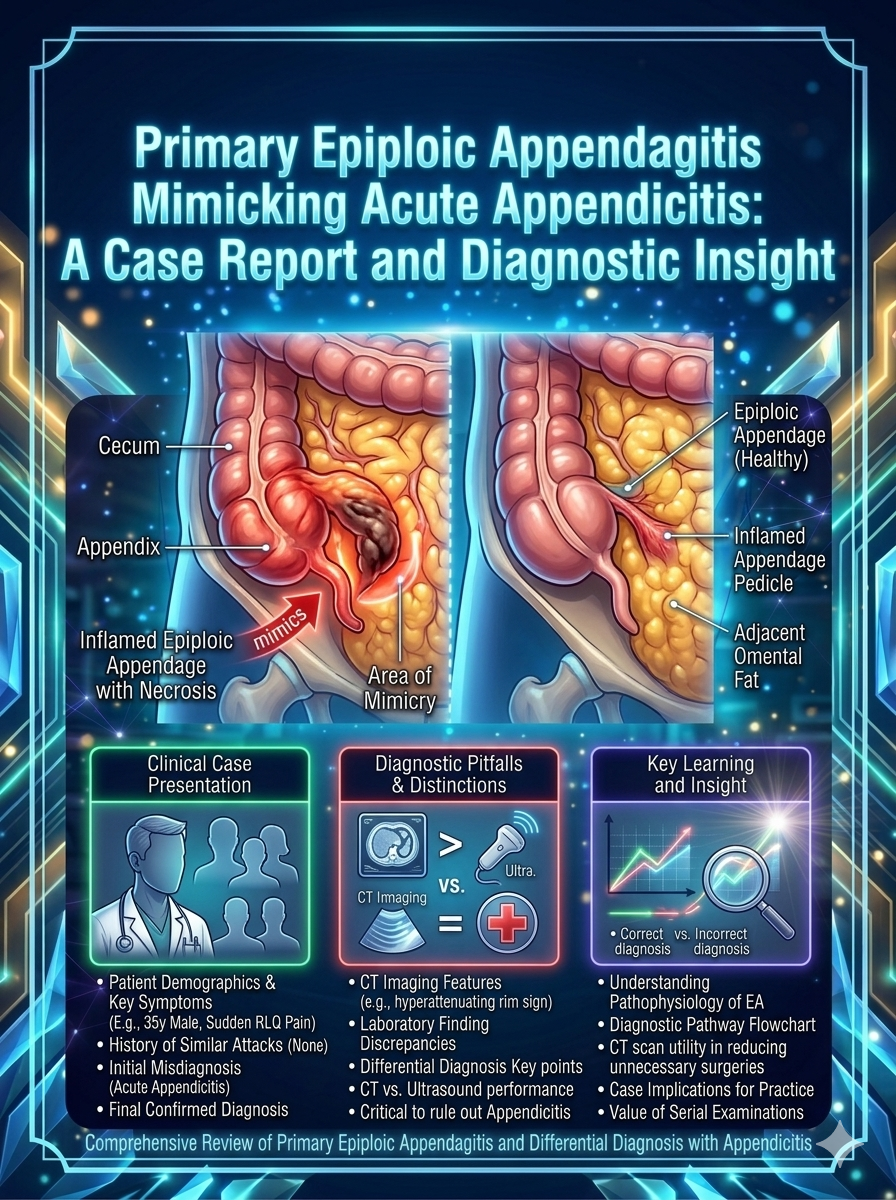
Primary Epiploic Appendagitis Mimicking Acute Appendicitis: A Case Report and Diagnostic Insight
DOI:
https://doi.org/10.64387/tjs.2026.279001Keywords:
Epiploic appendagitis, Appendicitis, Diagnostic laparoscopy, Primary epiploic appendagitis, Necrosis of epiploic appendageAbstract
Background and Objective: Epiploic appendagitis is an infrequent and often misdiagnosed cause of acute abdominal pain, commonly mistaken for conditions like appendicitis or diverticulitis due to its nonspecific and localized symptoms. Its underrecognition largely stems from limited clinical awareness and the lack of definitive diagnostic markers, with diagnosis typically made via computed tomography or incidentally during surgical exploration.
Case Description: This report presents a rare case of primary epiploic appendagitis in a 35-year-old male initially suspected to have acute appendicitis. Diagnostic laparoscopy revealed a normal appendix and a necrotic epiploic appendage originating from the mid-ascending colon. Laparoscopic excision of the appendage and prophylactic appendectomy were performed. The patient recovered well postoperatively and was discharged on day three, with follow-up confirming full recovery. Histopathology confirmed necrotic epiploic appendagitis.
Conclusion: Primary epiploic appendagitis should be considered in stable patients with focal abdominal pain and minimal systemic inflammatory features. In diagnostically uncertain patients, computed tomography can establish the diagnosis and help avoid unnecessary antibiotics, hospitalization, and surgery; reserve operative treatment for selected patients with persistent or worsening symptoms, recurrence, complications, or unresolved diagnostic uncertainty.
References
Issa IA, Berjaoui MT, Hamdan WS. Primary epiploic appendagitis: from A to Z. Int Med Case Rep J. 2010 Jul 22;3:67-9. doi: 10.2147/imcrj.s11710. PMID: 23754892;
Kefala MA, Tepelenis K, Stefanou CK, et al. Primary Epiploic Appendagitis Mimicking Acute Appendicitis: A Case Report and Narrative Review of the Literature. Korean J Gastroenterol. 2020 Aug 25;76(2):88-93. doi: 10.4166/kjg.2020.76.2.88.
Sand M, Gelos M, Bechara FG, et al. Epiploic appendagitis--clinical characteristics of an uncommon surgical diagnosis. BMC Surg. 2007 Jul 1;7:11. doi: 10.1186/1471-2482-7-11.
El-Sawaf Y, Alzayani S, Saeed NK, et al. Epiploic appendagitis: An overlooked cause of acute abdominal pain. World J Gastroenterol. 2025 Aug 28;31(32):109897. doi: 10.3748/wjg.v31.i32.109897.
Giambelluca D, Cannella R, Caruana G, et al. CT imaging findings of epiploic appendagitis: an unusual cause of abdominal pain. Insights Imaging. 2019 Feb 22;10(1):26. doi: 10.1186/s13244-019-0715-9.
Schnedl WJ, Krause R, Tafeit E, et al. Insights into epiploic appendagitis. Nat Rev Gastroenterol Hepatol. 2011 Jan;8(1):45-9. doi: 10.1038/nrgastro.2010.189.
Giannis D, Matenoglou E, Sidiropoulou MS, et al. Epiploic appendagitis: pathogenesis, clinical findings and imaging clues of a misdiagnosed mimicker. Ann Transl Med. 2019 Dec;7(24):814. doi: 10.21037/atm.2019.12.74.
Downloads
Published
How to Cite
Issue
Section
License
Copyright (c) 2026 The Royal College of Surgeons of Thailand

This work is licensed under a Creative Commons Attribution-NonCommercial-NoDerivatives 4.0 International License.
Articles must be contributed solely to The Thai Journal of Surgery and when published become the property of the Royal College of Surgeons of Thailand. The Royal College of Surgeons of Thailand reserves copyright on all published materials and such materials may not be reproduced in any form without the written permission.


