
Long term Outcomes of Surgical Treatment and Anatomical Characteristics of Acute and Chronic Cryptoglandular Anal Fistula Following Surgery
DOI:
https://doi.org/10.64387/tjs.2026.281231Keywords:
anal fistula, recurrence, healing, prognostic factors, anal fistula mappingAbstract
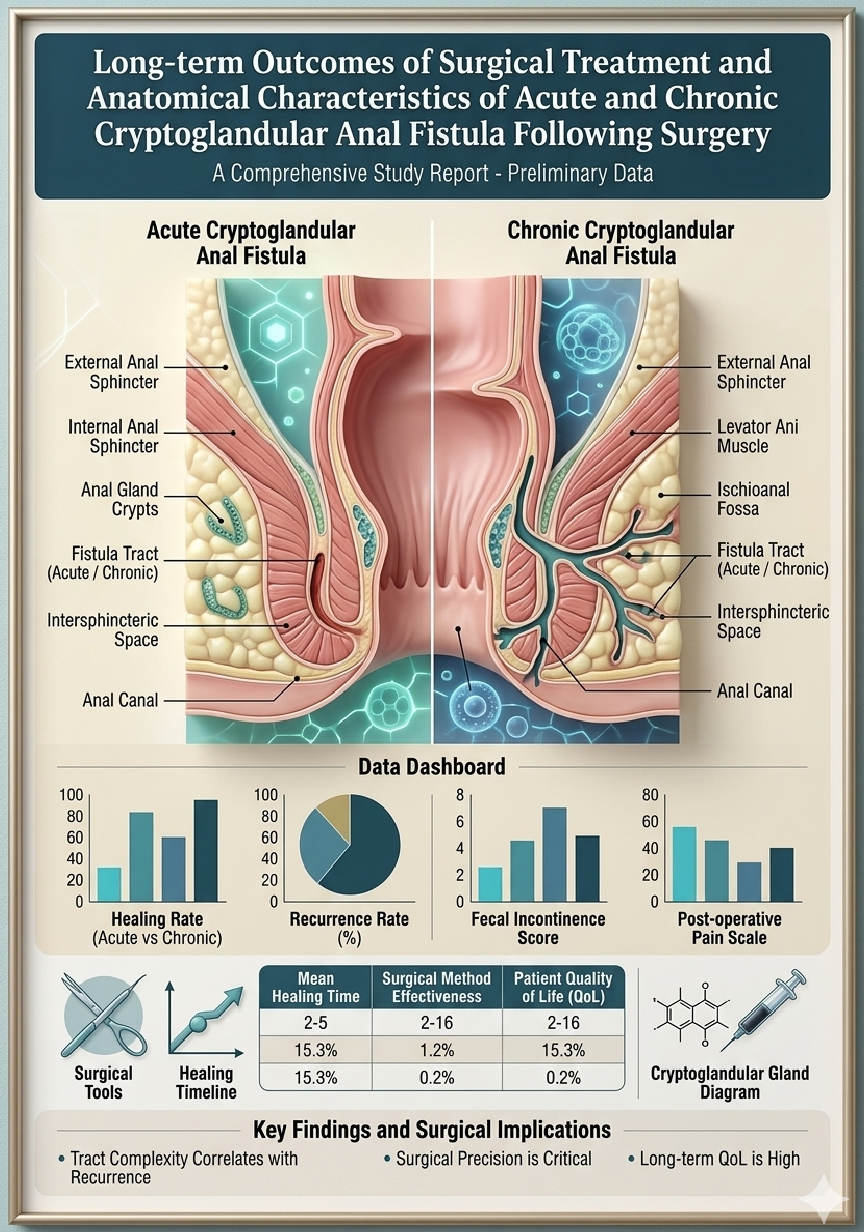
Background and Objective: Cryptoglandular anal fistula often recurs after surgery, especially with complex anatomy. This study evaluated healing, recurrence, anatomical patterns, and recurrence predictors in patients treated during acute abscess or chronic fistula stages.
Materials and Methods: This retrospective cohort study included 320 adults who underwent anatomy-tailored surgery for cryptoglandular anal fistula at Rayong Hospital (2012–2025). Patients were classified into acute abscess (n=142) or chronic fistula (n=178) groups. Anatomy was assessed via systematic mapping, supplemented by MRI in complex or recurrent cases. Results: Median follow-up was 42 months. The acute group showed a significantly higher healing rate (97.2% vs. 92.1%, p<0.017) and a lower recurrence rate (2.8% vs. 7.9%, p<0.041) than the chronic group. Multivariable Cox regression identified high transsphincteric fistula as the sole independent predictor of recurrence (adjusted HR 23.13, p<0.001). Conclusion: Anatomy-tailored surgery yielded high healing and low recurrence rates, with high transsphincteric anatomy strongly predicting recurrence.References
Wang D, Yang G, Qiu J, et al. Risk factors for anal fistula: a case-control study. Tech Coloproctol. 2014 Jul;18(7):635-9. doi: 10.1007/s10151-013-1111-y.
Andreou C, Zeindler J, Oertli D, et al. Longterm outcome of anal fistula - A retrospective study. Sci Rep. 2020 Apr 16;10(1):6483. doi: 10.1038/s41598-020-63541-3.
Włodarczyk M, Włodarczyk J, Sobolewska-Włodarczyk A, et al. Current concepts in the pathogenesis of cryptoglandular perianal fistula. J Int Med Res. 2021 Feb;49(2):300060520986669. doi: 10.1177/0300060520986669.
Sanchez-Haro E, Vela E, Cleries M, et al. Clinical characterization of patients with anal fistula during follow-up of anorectal abscess: a large population-based study. Tech Coloproctol. 2023 Oct;27(10):897-907. doi: 10.1007/s10151-023-02840-z.
Fang F, Wen L. Multifactorial Analysis of Postoperative Recurrence of Anal Fistula: A Retrospective Study. J Multidiscip Healthc. 2025 Sep 22;18:6015-24. doi: 10.2147/JMDH.S537028
Sirikurnpiboon S, Awapittaya B, Jivapaisarnpong P. Ligation of intersphincteric fistula tract and its modification: Results from treatment of complex fistula. World J Gastrointest Surg. 2013 Apr 27;5(4):123-8. doi: 10.4240/wjgs.v5.i4.123.
Chadbunchachai W, Lohsiriwat V, Paonariang K. Long-term outcomes after anal fistula surgery: results from two university hospitals in Thailand. Ann Coloproctol. 2022 Apr;38(2):133-40. doi: 10.3393/ac.2021.01.06.
Arun Rojanasakul, Tsang CB. Emerging Concepts in Classification of Anal Fistulae. Springer eBooks. 2020 Dec 10;995–1002.
Steele SR, Kumar R, Feingold DL, et al. Standards Practice Task Force of the American Society of Colon and Rectal Surgeons. Practice parameters for the management of perianal abscess and fistula-in-ano. Dis Colon Rectum. 2011 Dec;54(12):1465-74. doi: 10.1097/DCR.0b013e31823122b3.
Browning GG, Parks AG. Postanal repair for neuropathic faecal incontinence: correlation of clinical result and anal canal pressures. Br J Surg. 1983 Feb;70(2):101-4. doi: 10.1002/bjs.1800700216.
Malakorn S, Sammour T, Khomvilai S, et al. Ligation of Intersphincteric Fistula Tract for Fistula in Ano: Lessons Learned From a Decade of Experience. Dis Colon Rectum. 2017 Oct;60(10):1065-70. doi: 10.1097/DCR.0000000000000880.
Zbar AP. David Henry Goodsall: reassessment of the rule. Tech Coloproctol. 2009 Sep;13(3):185-8. doi: 10.1007/s10151-009-0511-5.
Kheira Gabsi. Risk factors for perianal abscess recurrence after incision and drainage: a review of the literature. International Surgery Journal. 2025 Jan 28;12(2):255–9.
Skovgaards DM, Perregaard H, Dibbern CB, et al. Fistula development after anal abscess drainage-a multicentre retrospective cohort study. Int J Colorectal Dis. 2023 Dec 13;39(1):4. doi: 10.1007/s00384-023-04576-6.
Narayanan S, Althans AR, Reitz KM, et al. Drainage of anorectal abscesses in the operating room is associated with a decreased risk of abscess recurrence and fistula formation. Am J Surg. 2023 Feb;225(2):347-51. doi: 10.1016/j.amjsurg.2022.09.005.
Huseynov A, Kuşlu Çiçek SN. Factors influencing fistula formation following perianal abscess treatment. Eur Res J. 2025;11(4):794-9. doi:10.18621/eurj.1678608
Lohsiriwat V, Yodying H, Lohsiriwat D. Incidence and factors influencing the development of fistula-in-ano after incision and drainage of perianal abscesses. J Med Assoc Thai. 2010 Jan;93(1):61-5.
Mei Z, Wang Q, Zhang Y, et al. Risk Factors for Recurrence after anal fistula surgery: A meta-analysis. Int J Surg. 2019 Sep;69:153-64. doi: 10.1016/j.ijsu.2019.08.003.
Khan S, Kotcher R, Herman P, et al. Predictors of recurrence and long-term patient reported outcomes following surgical repair of anal fistula, a retrospective analysis. Int J Colorectal Dis. 2024 Mar 11;39(1):37. doi: 10.1007/s00384-024-04602-1.
Malik AI, Nelson RL, Tou S. Incision and drainage of perianal abscess with or without treatment of anal fistula. Cochrane Database Syst Rev. 2010 Jul 7;2010(7):CD006827. doi: 10.1002/14651858.CD006827.
Xiao J, Santos E, Bonsu NY, Kim W, Eisenberg M, Cusick M, et al. Anal fistula: from diagnosis and classification to surgical management. IntechOpen; 2024. doi:10.5772/intechopen.1003888
Abe T, Tanaka Y, Kunimoto M, Hachiro Y, et al. Prevalence and Characteristics of Transsphincteric Anal Fistulas Unclassifiable by the Sumikoshi Classification: A Single-center Retrospective Study. J Anus Rectum Colon. 2025 Apr 25;9(2):244-51. doi: 10.23922/jarc.2024-086.
S DV, Thulasibai L, Paul D, Babu AV, Jayasankar, Kumari B. Goodsall’s rule– its predictive accuracy in tracing the tract of fistula in ano. International Surgery Journal. 2020 Nov 2;7(12):4116–6.
Liu WY, Aboulian A, Kaji AH, et al. Long-term results of ligation of intersphincteric fistula tract (LIFT) for fistula-in-ano. Dis Colon Rectum. 2013 Mar;56(3):343-7. doi: 10.1097/DCR.0b013e318278164c.
Alapach S, Khaimook A. Comparison between ligation of intersphincteric fistula tract (LIFT) technique and conventional fistulotomy in the treatment of fistula-in-ano at Hat Yai Regional Hospital. Thai J Surg. 2014; 35:20-23.
Emile SH, Elfeki H, Shalaby M, et al. A Systematic review and meta-analysis of the efficacy and safety of video-assisted anal fistula treatment (VAAFT). Surg Endosc. 2018 Apr;32(4):2084-93. doi: 10.1007/s00464-017-5905-2.
Elfeki H, Shalaby M, Emile SH, et al. A systematic review and meta-analysis of the safety and efficacy of fistula laser closure. Tech Coloproctol. 2020 Apr;24(4):265-74. doi: 10.1007/s10151-020-02165-1.
Jearanai S, Pattana-Arun J. A novel technique for treating complex anal fistulas with intersphincteric extension: intra-anal fistulotomy with fistula opening closure (IFOC). Tech Coloproctol. 2025 Mar 29;29(1):90. doi: 10.1007/s10151-025-03111-9.
Downloads
Published
How to Cite
Issue
Section
License
Copyright (c) 2026 The Royal College of Surgeons of Thailand

This work is licensed under a Creative Commons Attribution-NonCommercial-NoDerivatives 4.0 International License.
Articles must be contributed solely to The Thai Journal of Surgery and when published become the property of the Royal College of Surgeons of Thailand. The Royal College of Surgeons of Thailand reserves copyright on all published materials and such materials may not be reproduced in any form without the written permission.


